Home
Point of this research
- Research based on quantum field theory has shown that a different oscillation phenomenon occurs for one type of Majorana neutrino than conventional neutrino oscillations.
- This oscillation is characteristic of Majorana neutrinos and is accompanied by a change in lepton number (L) caused by the Majorana mass (m). Thus, the effect is enhanced in the non-relativistic case.
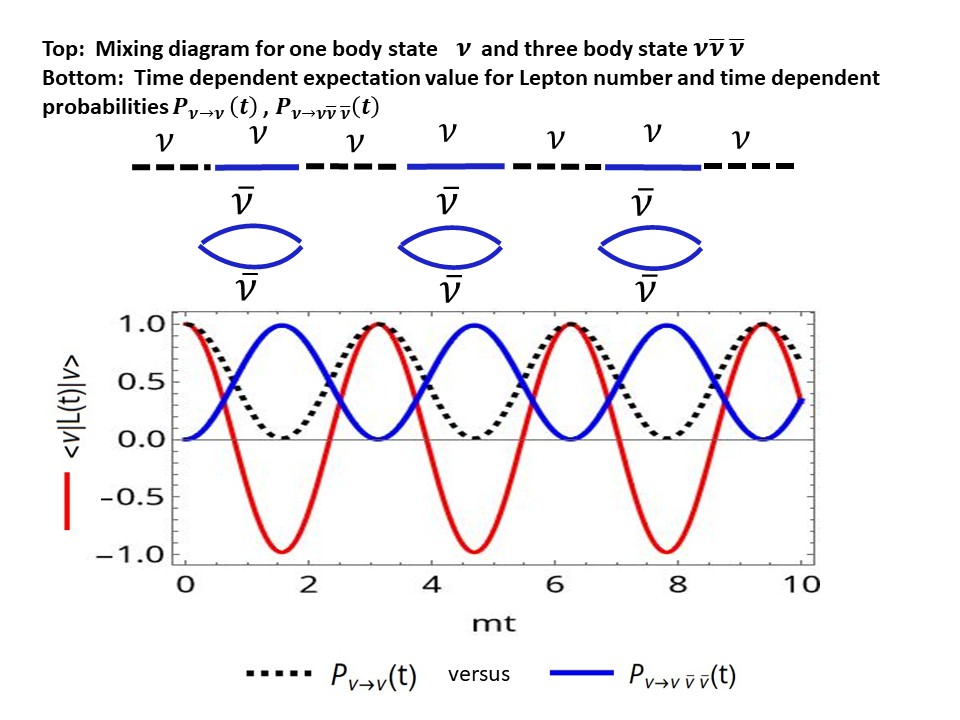
- We showed that oscillations occur between the state of a single neutrino (${\nu}$) with L = 1 and a state with L = -1 , consisting of a neutrino (${\nu}$) and a pair of antineutrinos ($\bar{\nu}$$\bar{\nu}$).
Abstract
It is known that there are three types of neutrinos: electron neutrinos, muon neutrinos, and tau neutrinos. It is also known that neutrinos change type during propagation, for example, from muon neutrinos to electron neutrinos. Neutrino oscillations occur between neutrinos of different types, but the neutrino remains a single entity before and after the oscillation. Such neutrino oscillations can be described using quantum mechanics.
Quantum field theory is a framework that extends quantum mechanics to be consistent with special relativity. Phenomena that can be described using quantum field theory include particle pair production and annihilation. These phenomena are characterized by a change in the number of particles before and after the reaction.
In this study, quantum field theory was applied to one type of Majorana neutrino. The results show that the Majorana mass (m) causes the generation of an antineutrino pair from the vacuum, leading to the following mixing between the one-body and three-body states:
A lepton number L = 1 can be assigned to the neutrino ${\nu}$, and L = -1 can be assigned to the antineutrino $\bar{\nu}$. From the perspective of lepton number, the above oscillation occurs between a single-particle state and a three-particle state possessing a L = 1 and L = 1 + (-1)× 2 = -1 , respectively. While it was known that the lepton number oscillates between L ± 1 over time, this study is the first to reveal that the L = -1 state is a three-body state consisting of a neutrino and an antineutrino pair ($\bar{\nu}$ $\bar{\nu}$).
Publication information
“The Probability for Chiral Oscillation of Majorana Neutrino in Quantum Field Theory”, Takuya Morozumi and Tomoharu Tahara, originally published in Progress of Theoretical and Experimental Physics, Volume 2025, Issue 6, 063B07, https://doi.org/10.1093/ptep/ptaf079, © Takuya Morozumi, Tomoharu Tahara, June 2025. Published by Oxford University Press on behalf of the Physical Society of Japan.