
 Home
Keiko Tanaka, Dr. (Ms.)
Contract-UEA/ Specially Appointed Assistant Professor
Headquarters for Education
Email: misima17 [at] hiroshima-u.ac.jp
On October 17, 2026, Hiroshima University FLAGs held the second session of its Ph.D. Career Seminar Series, titled “Researchers and Life Events.” It was an in-person event in Room K312 of the Education and Research Building, Higashi-Hiroshima campus, Hiroshima University.
[Guest Speaker] Dr. Michiharu Nakano (Doctor of Agriculture / Associate Professor, Research and Education Faculty Natural Sciences Cluster, Agriculture Unit, Kochi University
[Lecture Title] A Case Study of a Couple of Working-Researchers
[Participants] 9
Dr. Nakano is from Hyogo Prefecture, Japan. After completing his Master’s degree at Shimane University Graduate School and working at institutions such as the RIKEN Centre for Plant Science, he went on to pursue a PhD at Shizuoka University Graduate School. Whilst a doctoral student, he was awarded a JSPS DC2 fellowship and went on to obtain his PhD. Following the completion of his degree, he worked as a postdoc researcher at Shizuoka University, served as a Special Research Fellow at the National Agriculture and Food Research Organisation (NARO), and worked as a Technical Assistant and Researcher at the Kyoto University Farm. He was also sent on a short-term assignment to Senegal, Africa, under the JIRACAS International Joint Research Human Resource Development and Support Programme, where he participated in local breeding and cultivation trials. He also participated in activities to contribute the local farms with his agricultural expertise, serving as a director of the NPO ‘Iki-Iki Agriculture Support Team’ and as a farm support volunteer in Hiroshima City. After serving as a Specially Appointed Assistant Professor at the Plant Gene Bank and Experimental Facility attached to the Graduate School of Science (the Graduate School of Integrated Life Sciences) at Hiroshima University from 2013, he took up his current position as an Associate Professor, Research and Education Faculty Natural Sciences Cluster, Agriculture Unit at Kochi University in 2021. His area of specialisation is genetic breeding research on horticultural plants, and he conducts genetic and genomic analyses of floriculture crops and fruit trees.
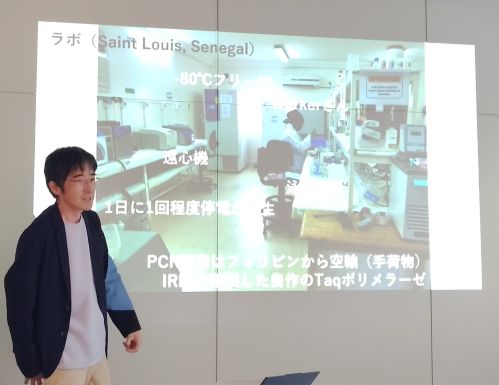
Dr. Nakano’s spouse also attended the event as a special guest. Under the theme of ‘Research Life as a PhD Couple’, the event took the form of a combination of a presentation by Dr. Nakano and a talk session between the couple, during which they reflected on their life events, research and social activities from 2009 to 2026.
Whilst working as a postdoctoral researcher at the nearest National Agriculture and Food Research Organisation (NARO) facility after obtaining her PhD, Dr. Nakano met his spouse, who was then one of the colleagues there. They married in 2010 and moved to Hiroshima Prefecture in 2013. His spouse became a fixed-term researcher at a national research institute and was later converted to permanent employment, enabling them to pursue their research and work on a stable basis. During this period, Dr. Nakano was affiliated with several different worksites and experienced in a variety of roles.
His doctoral research focused on floriculture, but after obtaining his degree, he published papers on subjects such as mites and lemons, out of the previous theme. At the Kyoto University Farm and the Hiroshima Prefectural Agricultural Technology Centre, he newly participated in research activities relating to fruit trees. He also took part in a short-term global program. He was sent to Senegal, where he undertook research into rice breeding and cultivation. Upon his return to Japan, whilst resuming his post at the Kyoto University Farm, he became involved in supporting domestic fruit growers. He remarked, ‘My postdoctoral period was when I had more spare and free time, so that I tried out various things then.’ It appears to have been a fulfilling period during which his expertise, the scope of his activities and his professional network all expanded.
When he first joined the Plant Gene Bank and Experimental Facility attached to the Graduate School of Science (the Graduate School of Integrated Life Sciences) at Hiroshima University in 2013, he was appointed as a research fellow responsible for projects on leaf senescence and photosynthesis; he was later appointed as a Specially Appointed Assistant Professor. Then he kept working there for eight years, dealing with the management and analysis of genes from wild chrysanthemums, rice and soya beans.
During this period at Hiroshima University, the couple were blessed with two children. Dr. Nakano’s spouse took maternity leave twice and a parental leave from the time of the first birth until the following year, and Dr. Nakano took it from the time of the second birth until the following year. Following their parental leave, they enrolled their children at a nursery established by Hiroshima University with the aim of promoting gender equality.
It is hard for young researchers in the prime of their careers to continue their work and research while juggling childcare and household chores. Although there were times when they struggled to manage the children’s health, the couple have supported one another by sharing responsibilities: the spouse took charge of breastfeeding, bathing the infants, and daily tasks such as laundry and cooking, whilst Dr. Nakano was responsible for looking after the children from infancy onwards, taking them to and from the nursery, and nursing them when they were ill.
The participants listened with great interest and asked many questions.
In response to a question asking, ‘What should one do if work circumstances mean the family has to live apart?’, Dr. Nakano and his spouse drew on their experience of living apart for about half a year in Hiroshima and Kōchi—to explain the situation and their thoughts at the time, which the audience found very helpful. Concerns were also raised regarding the influence that relocation might have on children. Although Dr. Nakano noted that their children ‘did not seem particularly bothered’ by the change in environment caused by changing schools, they advised that finding a nursery can sometimes be difficult depending on the area. They suggested it might be necessary to check the support available at the university or other institution to which one is being transferred, or to seek advice through local contacts.
After the talk, the couple kindly stayed to chat with the participants. Among the attendees was a PhD student due to undertake a long-term internship at one of the couple’s former workplaces this academic year; they appeared to listen with great interest. When asked about the workplace atmosphere at the time, the student received words of encouragement from the couple—‘You’ll be fine, I’m sure’—and seemed reassured. A PhD student due to graduate this year, who has already secured a postdoctoral position in academia, shared the following feedback: ‘I intend to pursue a research career, but I also want to respect my partner’s career. I had various concerns about how we would manage our lives together, but listening to today’s talk was extremely helpful.’
What’s the Hiroshima University FLAGs Career Seminar for Ph.D. Students?
This Seminar consists of 90-minute career lectures, each comprising an interactive presentation and a question-and-answer session, aimed at Ph.D. students.
Speakers are Ph.D. graduates of Hiroshima University or young professionals who previously worked at Hiroshima University. They will discuss the types of work Ph.D. graduates undertake in companies and other organizations, as well as how they utilize the skills acquired during their doctoral studies. They will discuss freely to cover a wide range of topics, from career choices and duties after joining a workplace to work-life balance at various stages of their careers.
Hopefully, this will give Ph.D. students an opportunity to gather vital information as they consider their future careers and life plans. Furthermore, if students express their interest in the organizations where the speakers are based, the organizers will support access to internships.
The upcoming Sessions 3 through 5 are scheduled as follows:
| [31st October 2026] Session 3/ Capacity: 10/ Language: Japanese <Theme> What an Alumni of Hiroshima University Who Keeps Growing up as a Researcher Wants to Share with His Juniors Now <Lecture Title> Coming to My Senses, I Found Myself with a Ph.D. — Seeking for a Degree in the Provinces — <Speaker> Dr. Masashi Enoki (Doctor of Engineering/ Assistant Professor, Kyoto Tachibana University, Japan) |
| [7th November 2026] Session 4/ Capacity: 10/ Language: Japanese <Theme> Ph.D. Graduates Thriving as Research Administrators (URAs) <Lecture Title> From a Researching Ph.D. to a URA Supporting Researchers — Career Prospects for Ph.D. Graduates — <Speaker> Dr. Gu Yunxing (Doctor of Literature/ URA, Hiroshima University, Japan) |
| [21st November 2026] Session 5/ Capacity: 10/ Language: English <Theme> What International Students Should Know When Seeking Employment in Japan (2) <Lecture Title> From Ph.D. to Commercial Plant Breeding: My Journey from Academia to the Seed Industry <Speaker> Dr. Ramin Rayee (Doctor of Agricultural Sciences/ Researcher, Vilmorin Mikado Co., Ltd. (Limagrain Group)) |
Click here for the report on the first session.
Contact Information
