
 Home
HomeE-mail: kyukyu * hiroshima-u.ac.jp (Please replace * with @)
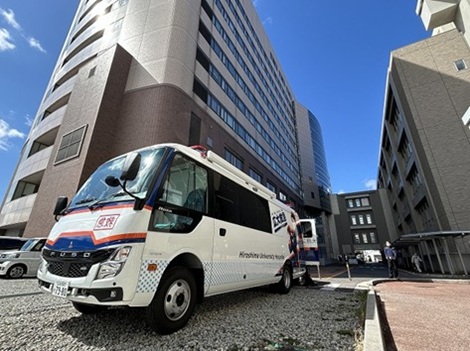
Hiroshima University Hospital has introduced a high-standard hospital ambulance designed specifically for transporting critically ill patients. Equipped to safely transport patients receiving cardiopulmonary support systems such as ECMO and/or mechanical ventilation, and featuring telecritical care capabilities, the ambulance functions as a "mobile intensive care unit (ICU)." This is the first mobile ICU initiative of its kind in Japan.
The vehicle was developed following the hospital’s selection for the Ministry of Education, Culture, Sports, Science and Technology’s FY2024 Program for Developing Advanced Medical Professionals, which supports the further enhancement of training environments for medical personnel at university hospitals.
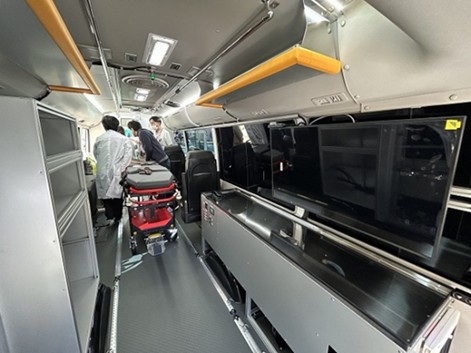
The large ambulance was converted from a minibus and can carry up to eight people, including the patient. It is equipped with one stretcher and can also transport up to three patients in wheelchairs together with medical staff. With its large-capacity oxygen supply and power system, the ambulance enables the stable operation of ECMO devices and ventilators, allowing intensive care to continue during transport.
Using a 5G communication network, the system enables real-time information sharing among the referring hospital, the ambulance, and Hiroshima University Hospital during transport. By monitoring patient data and video feeds from the ambulance, staff at Hiroshima University Hospital can assess the patient’s condition, prepare treatment strategies before arrival, and begin advanced medical treatment immediately upon arrival.
The ambulance is not dispatched through 119 emergency calls. Instead, it is sent out when a referring medical institution contacts Hiroshima University Hospital’s Advanced Emergency and Critical Care Center directly by phone. The service is expected to cover all of Hiroshima Prefecture and may also include parts of Shimane and Yamaguchi prefectures that are relatively close to the hospital. The vehicle is primarily operated by hospital-based paramedics from Hiroshima University Hospital.
The ambulance also represents a shift from the traditional model in which "patients wait to be transported to a hospital" to a new model in which "advanced medical care is actively provided near the patient’s location." It will be used to train staff at regional medical institutions and students undergoing clinical training. In times of disaster, it will also support both treatment and patient transport.
Transfer to advanced medical centers can improve survival outcomes for critically ill patients. However, conventional ambulances pose challenges, including the risk of a patient’s condition worsening en route, limitations on available medical equipment, and the risks associated with prolonged transport. During the COVID-19 pandemic in particular, growing demand for interhospital transport of patients receiving ECMO support underscored the need for a safe way to transfer the most critically ill patients.
By introducing this high-standard hospital ambulance, Hiroshima University Hospital aims to further help improve patient outcomes across Hiroshima Prefecture, support the training of regional healthcare personnel, and enhance the overall quality of regional medical care.
Program for Developing Advanced Medical Professionals
A total of 73 applications were submitted by universities across Japan for this program, and 27 initiatives were selected, including Hiroshima University’s “A Next-Generation Training Model for Regional Medical Personnel Using Remote Support and AI — The Hiroshima Model.”
Hiroshima University received a total grant of 190 million yen to support four initiatives. In addition to the high-standard hospital ambulance, these initiatives include:
- A system that connects Hiroshima University Hospital with ICUs at hospitals in Hiroshima Prefecture to provide clinical support
- A system that uses AI to detect lesions in gastric and colorectal endoscopic images and assist physicians in making diagnoses
- A system that generates and analyzes high-precision 3D images from CT and MRI scans, enabling stereoscopic viewing with the naked eye
[Inquiries]
Emergency and Critical Care Medicine, Graduate School of Biomedical and Health Sciences, Hiroshima University
Department of Emergency and Critical Care Medicine, Hiroshima University Hospital
