
 Home
HomeMajor Efforts Carried Out by Hiroshima University Hospital
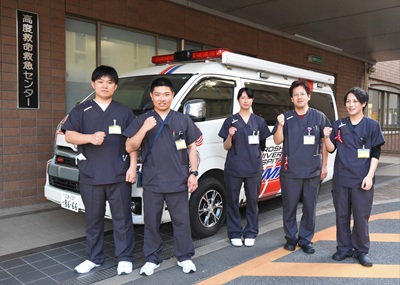
Hiroshima University Hospital (HUH) employs five paramedics and deploys a high-standard hospital ambulance
HUH employed five paramedics for the first time in fiscal 2025. As members of the emergency medical care team, the paramedics will be responsible for the initial response to emergency patients, as well as sharing information with the fire department, supporting doctors and nurses, and coordinating with other hospitals. For emergency patients, paramedics perform life-saving measures such as interventions using equipment and administering medication, under the direction of a doctor. When paramedics receive a report of an emergency patient from the fire department's ambulance crew or other emergency services, the paramedics gather information about the patient's condition and contact doctors and nurses so that treatment can begin as quickly as possible upon arrival at the hospital. In cases where there is a shortage of hospital beds, the paramedics also act as a liaison with nearby cooperating hospitals that can accept patients.
In 2026, a high-standard hospital ambulance specializing in transporting critically ill patients was deployed. This vehicle, the first initiative of its kind in Japan, can be described as a “mobile intensive care unit,” combining equipment for safely transporting critically ill patients on cardiopulmonary support devices (ECMO) or ventilators with telemedicine capabilities. This project was made possible following the selection of HUH for the Ministry of Education, Culture, Sports, Science and Technology's Program for Developing Advanced Medical Professionals. Using a 5G communication network, the system enables real-time information sharing among the referring hospital, the ambulance, and HUH during transport. The vehicle will primarily be operated by paramedics, and its service area is expected to cover the whole of Hiroshima Prefecture. The ambulance also represents a shift from the traditional model in which “patients wait to be transported to a hospital” to a new model in which “advanced medical care is actively provided near the patient’s location.” It will be used to train staff at regional medical institutions and students undergoing clinical training. In times of disaster, it will also provide both treatment and transportation services.
The autologous cultured cartilage transplantation treatment developed by Hiroshima University’s President is now covered by NHI for knee osteoarthritis, opening up the possibility of a complete cure
The autologous cultured cartilage transplantation therapy, developed and transferred by Hiroshima University (HU) President Mitsuo Ochi, received insurance coverage for knee osteoarthritis in January 2026. This treatment is expected to reduce medical expenses for the estimated 10 million patients with knee osteoarthritis in Japan, providing a new treatment method that opens up the possibility of a complete cure.
The product that received insurance coverage is “Jack,” an autologous cultured cartilage medical product manufactured and marketed by Japan Tissue Engineering Co., Ltd. (“J-TEC,” Headquarters: Gamagori, Aichi, Japan, President: Kazuto Yamada). We collect the patient's own normal knee cartilage cells, culture them, and then transplant the resulting gel-like cultured cartilage to the defective site to promote regeneration. With application of the high-cost medical expense reimbursement system, the amount you have to pay out of pocket can be kept to around 60,000 to 250,000 yen per month.
President Ochi developed the technology for autologous cultured cartilage in 1996. In 2012, the product received the first manufacturing and marketing approval in Japan for traumatic cartilage defects and osteochondritis dissecans, and in 2013, received NHI coverage. Approximately 2,000 patients have received treatment so far.
In a clinical trial initiated in 2019 by Professor Nobuo Adachi, then affiliated with the Graduate School of Biomedical and Health Sciences at Hiroshima University, significant improvements in knee function were confirmed, and the efficacy and safety of the treatment were recognized, with no adverse events observed, leading to expanded insurance coverage.
Hiroshima University Hospital completes “Cells at Work! VR,” the world’s first virtual reality (VR) software designed to support children with cancer during treatment
Hiroshima University Hospital (HUH) has announced that it has completed “Cells at Work! VR,” the world’s first virtual reality (VR) software designed to support children with cancer during treatment and help them find the strength to keep going. HUH spent more than three years developing the software, which was completed in March 2026.
In “Cells at Work! VR,” children playing the game enter their own bodies and become the protagonists of the story. As they learn how the body works together with familiar characters of the story, they fight bacteria and cancer cells alongside white blood cells in an immersive simulated experience. Though they struggle against powerful cancer cells, they ultimately defeat them with the help of anticancer drugs. The story includes both battle scenes against cancer cells and quizzes about how cells function. The passionate performances of the seven voice actors from the anime make the software even more lifelike. The software was designed to help children feel that the invisible “allies” inside their bodies—their cells—are working hard for them, fostering a more positive attitude toward treatment, a better understanding of their bodies, and the reassurance that they are not alone.
The software was produced by BeRISE Inc., a Hiroshima-based VR production company selected through a public call, with the cooperation of Kodansha, the Tokyo-based publisher of Cells at Work! The project received 132 donations totaling 15,109,000 yen, and development also moved forward with the support of additional grants and other funding. The software is expected to become available at hospitals across Japan that treat children with cancer.

© Akane Shimizu/Kodansha, Aniplex, David Production
Hiroshima University (HU) has signed an agreement with Hiroshima Prefecture regarding the development of an advanced medical care and human resource development center
In July 2025, HU signed an agreement with Hiroshima Prefecture to develop an advanced medical care and human resource development center (new hospital) that Hiroshima Prefecture plans to open in fiscal year 2030 on the north side of JR Hiroshima Station. The purpose is to maintain and develop the regional healthcare delivery system and to improve the standard of medical care. HU aims to build a system of world-class medical care and will fulfill its role as the only medical education institution in Hiroshima Prefecture.
HU and Hiroshima Prefecture have set forth four areas of collaborative effort: (1) providing the highest level of medical care that meets the needs of the region; (2) developing an environment for training high-quality medical personnel; (3) enhancing clinical research to provide high-level medical care; and (4) maintaining and securing a medical care delivery system that meets the needs of the region.
At HU Kasumi Campus, a “vaccine and pharmaceutical manufacturing base” will begin operations in fiscal year 2026, which will manufacture biopharmaceuticals during normal times and vaccines during emergencies such as pandemics. The Radiation Effects Research Foundation is also scheduled to relocate there in January 2027. Together with the new hospital, HU aims to contribute to the advancement of global medicine from Hiroshima.
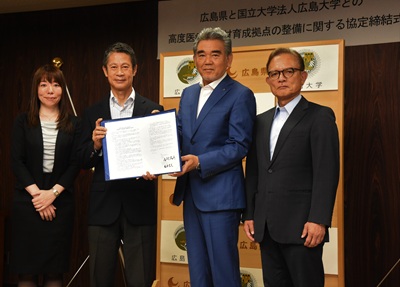
Right to left: Nobuo Adachi, Director of Hiroshima University Hospital; Mitsuo Ochi, President of Hiroshima University; Hidehiko Yuzaki, then Governor of Hiroshima; and Kanako Kitahara, Director General of the Hiroshima Prefectural Health and Welfare Affairs Bureau.
