
 Home
Home
Students identify a primary field as the foundation of their expertise and deepen their specialized knowledge while also studying across the other fields. In this way, they develop the ability to understand issues from multiple perspectives that leads them toward solutions beyond the boundaries of their own specialized fields.
Activities related to the ocean, including the international maritime order, maritime transportation, and the use of marine resources, extend beyond national borders.
This field examines how the use of the ocean can be managed and how it can contribute to society in a sustainable manner from the perspectives of international law, policy, economics, and other disciplines.
Students also develop the ability to understand the social systems surrounding the ocean as a whole, including international cooperation, security, logistics, and trade, and to apply this understanding to institutional design and policy proposals.
▶ Marine policy
▶ Ocean governance
▶ Maritime industry
▶ Maritime finance
▶ International logistics
▶ Maritime security
▶ International cooperation, peacebuilding, etc.
Technologies for utilizing the ocean, including ships, maritime mobility, ports, and marine energy, are advancing rapidly. The development and social implementation of new technologies, such as autonomous ships, decarbonization technologies, and digital transformation (DX) in logistics, are increasingly required.
Based on engineering, information technology, data science, and other disciplines, this field enables students to understand technologies in the maritime and marine fields and develop the ability to design and operate safer, more efficient, and more sustainable systems.
▶ Shipbuilding and marine engineering
▶ Marine science and technology
▶ Simulation technology
▶ Autonomous shipping
▶ Next-generation ships
▶ Maritime DX
▶ IoT applications
▶ Technological innovation
▶ Maritime mobility, etc.
Changes in the marine environment and the use of marine resources have become global challenges. Addressing issues such as climate change, ecosystem conservation, and the sustainable use of marine resources requires scientific understanding and technological responses.
In this field, students acquire the knowledge and learn the technologies needed to accurately understand the state of the ocean through ocean observation, environmental analysis, data analysis, and other approaches, with the aim of balancing environmental conservation and the utilization of marine resources.
▶ Ocean observation
▶ Marine environment
▶ Marine ecosystem
▶ Marine resources
▶ Marine spatial use
▶ Environmental conservation technology
▶ Blue carbon
▶ Smart fisheries, etc.
Learning Steps from Enrollment to Completion
This is a model showing how students progress through their studies and research from enrollment to completion. Use this as a guide to what your studies may look like after enrollment.
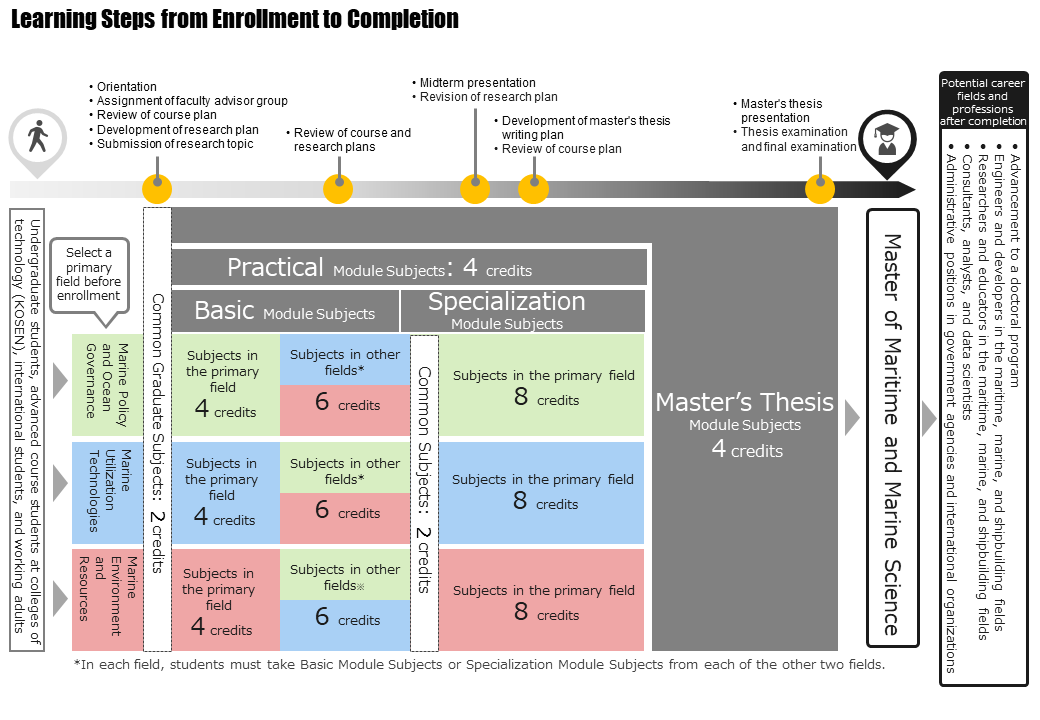
Curriculum
- The Graduate School has adopted a modular system. The modular system is a framework for students to develop a degree program by creating a course plan for each semester and combining modules.
- The curriculum consists of four modules—Basic, Specialization, Practical, and Master’s Thesis—along with Common Graduate Subjects. Students are required to earn at least two credits from each of the two fields other than their primary field, for a total of at least six credits, thereby developing foundational knowledge across all three fields.
- Education and research activities at the Graduate School are conducted in English, the international language of communication. By conducting the entire process—from acquiring foundational knowledge and deepening expertise in specialized fields to completing a master's thesis—in English, students develop in practice the English-language communication, implementation, and collaboration skills essential for addressing global challenges.
|
Subject Type |
No. of Credits Required for Completion |
Description |
|
| Common Graduate Subjects | Sustainable Development Subjects |
1credit |
These subjects cultivate a broad perspective and interest in and awareness of issues in society, while encouraging students to deepen their consideration of how their respective fields of specialization can contribute as science for sustainable development. They also enable students to gain an accurate understanding of recent developments in social systems and acquire the basic knowledge needed to play an active role in contemporary society. |
| Career Development and Data Literacy Subjects |
1credit |
||
| Basic Module Subjects | Subjects in the primary field |
4credits |
These subjects provide students with the foundational knowledge in the maritime and marine fields that serves a common basis for maritime and marine studies, as well as the foundational capabilities, thinking skills, and analytical skills in the maritime and marine fields needed to understand the essence of international and social issues and challenges in these fields and connect them to international engagement. |
| Specialization Module Subjects | These subjects cultivate perspectives and abilities that form a common foundation across the humanities, social sciences, and natural sciences, and allow students to develop flexible thinking skills to address interdisciplinary challenges. | ||
| Common Subjects |
2credits |
||
| Subjects in the primary field |
8credits |
These subjects enable students to acquire advanced specialized knowledge and skills in research fields related to the maritime and marine fields. | |
| Basic Module Subjects or Specialization Module Subjects in other fields* |
6credits |
||
| Practical Module Subjects |
4credits |
These subjects enable students to develop the necessary communication and practical skills through internships, fieldwork, and project management that are essential for conducting research in the maritime and marine fields. | |
| Master’s Thesis Module Subjects |
4credits |
These subjects enable students to develop research capabilities in the field of practical sciences that integrates multiple research fields, as well as the global and local practical skills, application skills, and other skills necessary to apply specialized expertise and complete an academic paper. | |
|
Total |
30credits |
||
* Students must take Basic Module Subjects or Specialization Module Subjects from each of the other two fields.
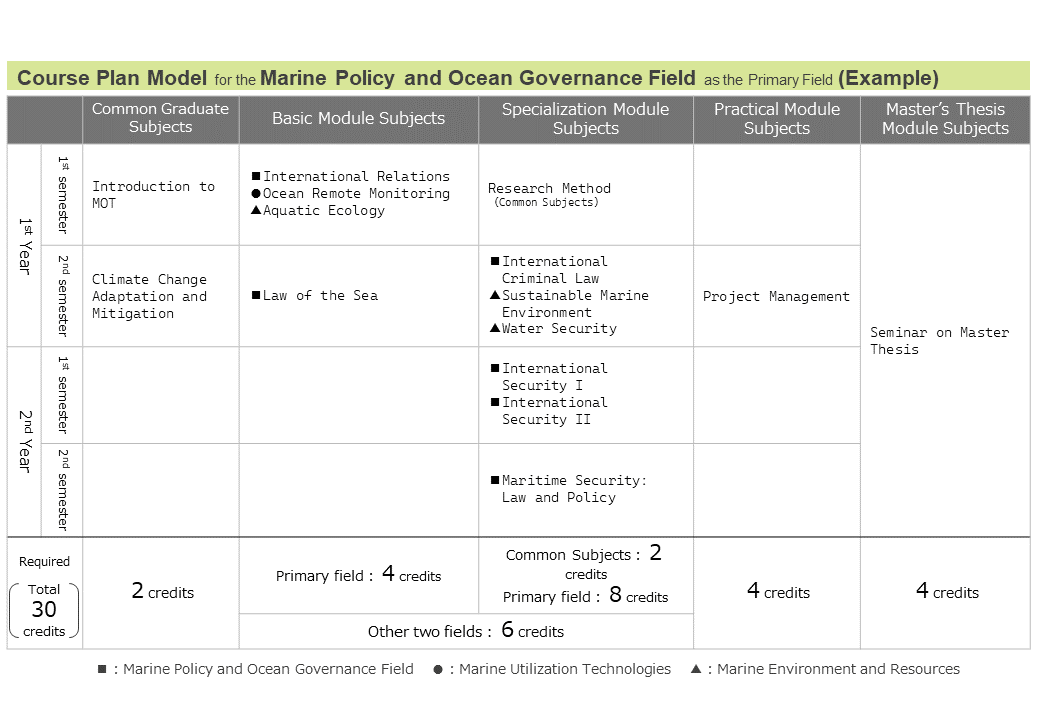
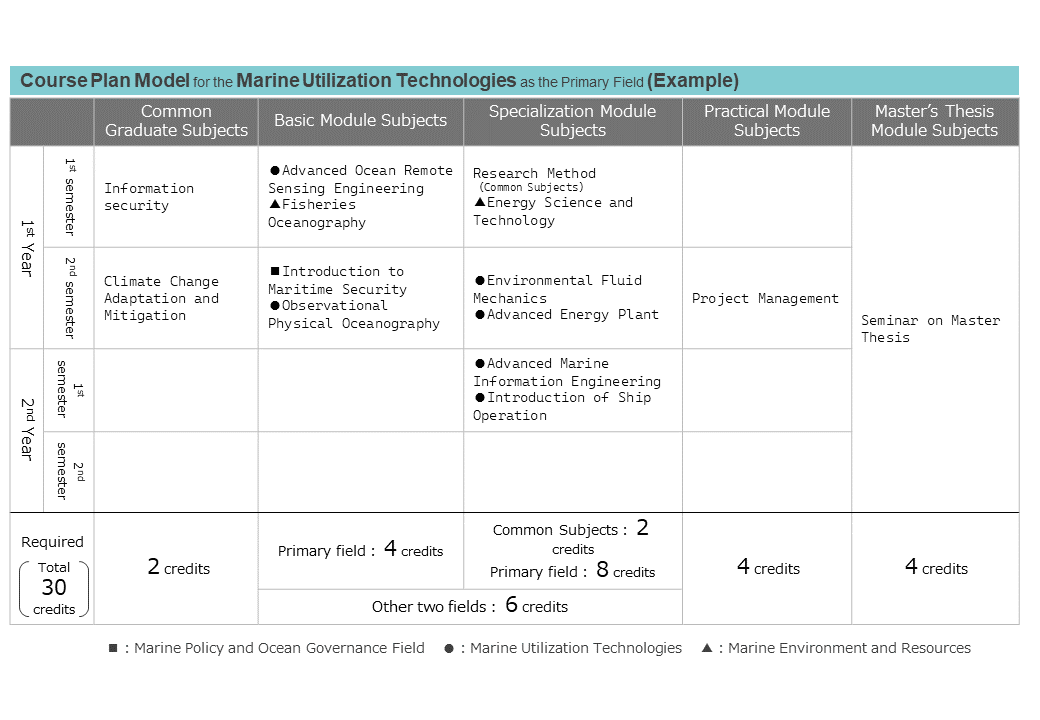
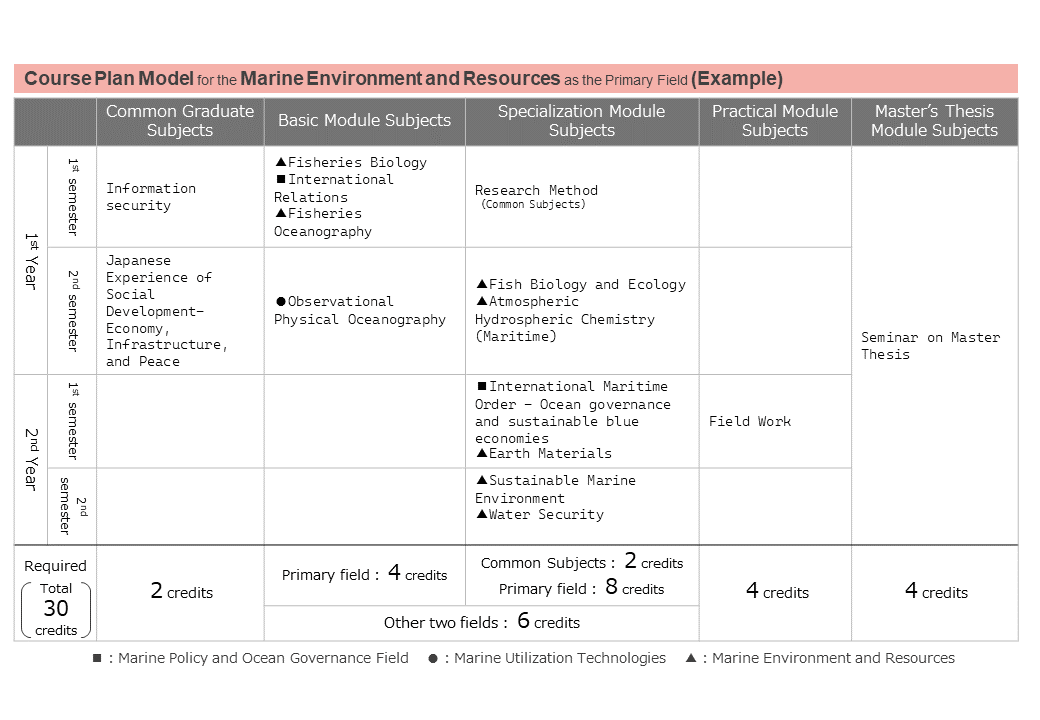
Course Plan Models
Course Plan models are provided as examples of possible study plans, and the actual courses taken will vary depending on students' research topics and areas of interest. Subjects offered and other details are subject to change.
Career Paths after Completion
Potential Career Fields
At the Graduate School, students study across three fields related to policy, technology, and the environment, while deepening their expertise in their primary field and developing the skills needed to play an active role in society.
After completion, students are expected to pursue careers in a wide range of fields, including industry, government agencies, international organizations, and research institutions, based on the expertise they have developed in their respective fields. The following are some examples.
International organizations whose mission is to address issues related to the maritime, marine, and shipbuilding fields, as well as government agencies and public institutions involved in the social sciences and policy planning & evaluation
▶ Administrative positions related to the social sciences and policy planning & evaluation in government agencies and international organizations
▶ Operations management and international affairs positions in the shipping, shipbuilding, and logistics industries
▶ Analyst positions in the finance, insurance, and consulting industries
▶ Planning positions in companies for environmental and disaster preparedness measures utilizing marine information
▶ Advancement to a doctoral program
Universities and research institutions in Japan and abroad; government agencies and public institutions; classification societies such as ClassNK, ABS, and DNV; and companies in shipbuilding, shipping, and logistics, marine equipment, electrical and electronics, machinery, plant and engineering, power and energy, materials and chemicals, information and communications, and related manufacturing industries
▶ Ship design and development engineers in the shipbuilding, ship design, and manufacturing fields
▶ Maritime transportation system developers and engineers in the shipping and maritime transportation fields
▶ Marine IoT engineers in the marine DX and IT fields
▶ Technical positions in government agencies and international organizations
▶ Advancement to a doctoral program
International organizations whose mission is to address issues related to the maritime and marine fields; government agencies and public institutions involved in environmental policy and fisheries resource management; and construction and environmental consultants, service providers, information and communications companies, construction companies, and other organizations involved in managing, conserving, and maintaining the global and local environment
▶ Administrative and technical positions related to environmental policy and fisheries resource management in government agencies, local governments, and research institutions
▶ Engineering and development positions at companies engaged in ocean observation and monitoring, environmental consulting, and technical support for blue carbon initiatives
▶ Engineering positions at energy and resource-related companies
▶ Marine data scientists and AI analysts, remote sensing engineers, and GIS and geospatial information specialists in the information and communications and marine technology fields
▶ Advancement to a doctoral program
