Home
HomeFuture-Leading and Advanced Graduate-schools (FLAGs)
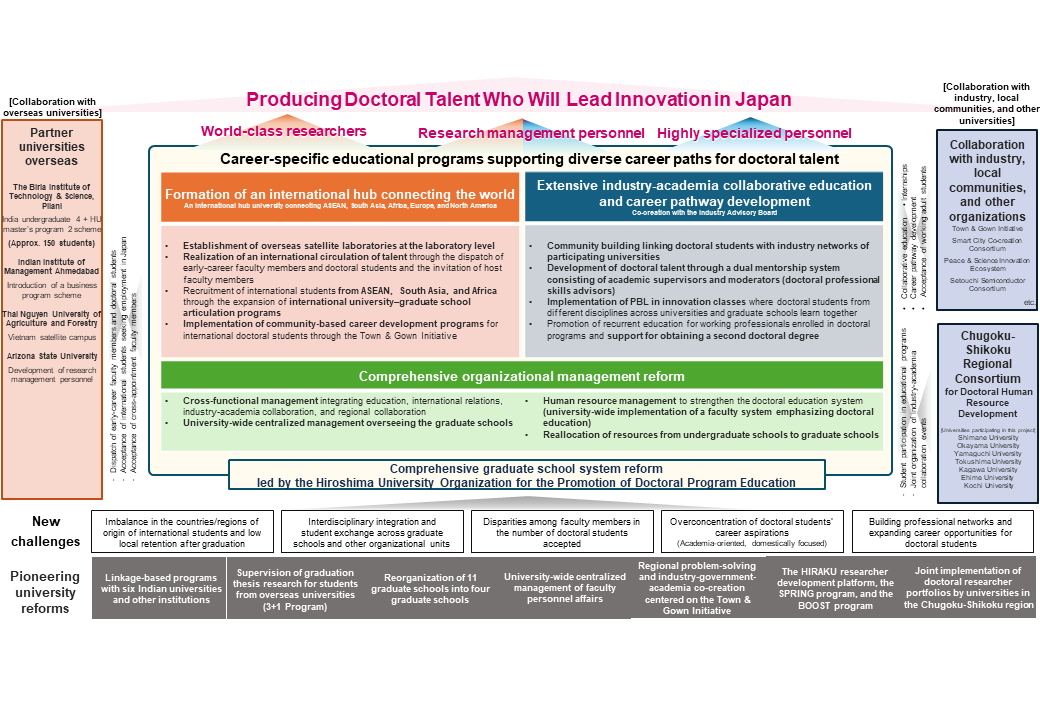
Formation of a World-Wide Graduate Education Hub that Practices “Science for Sustainable Development”
—Fostering doctoral talent who will lead innovation in Japan
【Purpose and Policy of the Project】
On September 16, 2025, Hiroshima University’s proposal, “Formation of a World-Wide Graduate Education Hub that Practices ‘Science for Sustainable Development’” (participating universities: Shimane University, Okayama University, Yamaguchi University, Tokushima University, Kagawa University, Ehime University, and Kochi University), was selected for the Ministry of Education, Culture, Sports, Science and Technology (MEXT)’s AY2025 Future-Leading and Advanced Graduate-schools (FLAGs) program.
The FLAGs program aims to support the formation of graduate education hubs that strengthen the capacity to cultivate doctoral talent equipped with broad academic expertise, international perspectives, and advanced practical competencies through the implementation of both thorough international hub formation (internationalization) and extensive industry-academia collaborative education. In addition, the project seeks to increase the number of highly qualified doctoral graduates through measures such as reviewing institutional resource allocation.
The program consists of two categories: the Comprehensive Type (365 million yen per year per project) and the Distinctive Type (165 million yen per year per project). Hiroshima University applied under the Comprehensive Type category. Among the 28 applications submitted overall (18 for the Comprehensive Type and 10 for the Distinctive Type), only six projects were selected (four Comprehensive Type projects and two Distinctive Type projects). Hiroshima University was the only university selected from western Japan. Selected universities will receive support for up to seven years beginning in this academic year.
Going forward, Hiroshima University will advance graduate school system reform through comprehensive organizational management reform, the formation of an international hub connecting the world, and industry-academia collaborative education and career pathway development. By enhancing the quality of doctoral education and expanding the scale of doctoral talent development, the University aims to establish a world-wide graduate education hub that practices “Science for Sustainable Development” through the cultivation of doctoral talent who will lead innovation in Japan and play active roles across diverse sectors and stages.