Home
HomeName:Masayuki SHIMADA
School of Applied Biological Science, Hiroshima University
E-mail:mashimad*hiroshima-u.ac.jp (Note: Please replace *with @)
Key points of this research
- Seminal vesicles supply a major fraction of semen components; this study shows how testosterone shapes seminal plasma composition through metabolic remodeling in seminal vesicle epithelial cells.
- Testosterone increases glucose uptake via GLUT4 and drives fatty-acid synthesis through ACLY, leading to elevated secretion of oleic acid.
- These testosterone-dependent changes in seminal plasma components have potential implications for understanding reduced semen quality with aging/low androgen status and may inspire new biomarkers or formulation strategies.
Content of research
Male factors account for a significant proportion of infertility cases, and semen quality depends not only on the sperm themselves, but also on the seminal plasma. However, the mechanisms by which the seminal vesicles and other accessory glands synthesize bioactive metabolites that influence sperm function are not fully understood.
Using mouse models, the authors first performed bioassays with “pseudo-seminal plasma” prepared from accessory gland secretions and quantified sperm kinematics. Seminal vesicle-derived components enhanced parameters associated with linear, straight-line swimming. This activity was reduced when androgen signaling was suppressed (e.g., with the androgen receptor antagonist flutamide) and in aged males with lower circulating testosterone.
Mechanistically, testosterone induced a metabolic shift in seminal vesicle epithelial cells. The data support a model in which testosterone promotes GLUT4-dependent glucose uptake, reallocating carbon toward fatty acid synthesis. A key node in this process is ATP citrate lyase (ACLY), which links citrate metabolism to the production of cytosolic acetyl-CoA for lipogenesis. shRNA-mediated knockdown of ACLY suppressed the secretion of fatty acids (especially oleic acid) induced by testosterone and attenuated the motility-enhancing effects of epithelial cell supernatants on sperm.
Importantly, similar testosterone-driven metabolic features were observed in commercially available human seminal vesicle epithelial cells, including glucose uptake dependent on GLUT4 and oleic acid secretion. Future studies should more directly test the causal relationship between specific fatty acid composition and in vivo fertility outcomes. Additionally, they should evaluate whether seminal plasma lipid profiles could serve as indicators of androgen status or semen quality.
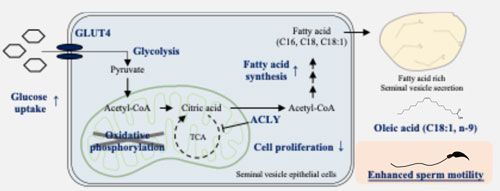
Summary of Research Findings
Information details of publication
- Journal: eLife (Version of Record published 18 December 2025)
- Title: Testosterone-induced metabolic changes in seminal vesicle epithelium modify seminal plasma components with potential to improve sperm motility
- Authors: Takahiro Yamanaka, Zimo Xiao, Natsumi Tsujita, Mahmoud Awad, Takashi Umehara, Masayuki Shimada
- DOI: 10.7554/eLife.95541.5
【Contact】