【Major Papers of the Laboratory】
・ Hatayama T, Takemoto K, Kobatake K, Miura K, Perera LP, Yamanaka R, Yukihiro K, Shikuma H, Iwane K, Tasaka R, Kohada Y, Naito M, Miyamoto S, Sekino Y, Kitano H, Goto K, Goriki A, Hieda K, Kaminuma O, Hinata N. Crucial Contribution of BACH1 to Bladder Cancer Progression via Upregulating Epithelial-Mesenchymal Transition Pathway. Cancer Science. 2026;117(2):364-376. doi:10.1111/cas.70284.
・Kohada Y, Kobatake K, Takemoto K, Sekino Y, Babasaki T, Miura K, Yamanaka R, Nakahara H, Tasaka R, Fukushima T, Kitano H, Goto K, Goriki A, Hieda K, Kaminuma O, Hinata N. KDM6A Deficiency Promotes Tumor Progression and Resistance to Cabozantinib Treatment in Clear Cell Renal Cell Carcinoma. Scientific Reports. 2025;15:38656.
・Kobatake K, Ikeda K, Teishima J, Sekino Y, Babasaki T, Kohada Y, Tasaka R, Takemoto K, Fukushima T, Miyamoto S, Kitano H, Goto K, Hieda K, Hayashi T, Hinata N. Complexity in Radiological Morphology Predicts Worse Prognosis and Is Associated with an Increase in Proteasome Component Levels in Clear Cell Renal Cell Carcinoma. Frontiers in Oncology. 2022;12:1039383. doi:10.3389/fonc.2022.1039383.
・Kobatake K, Goto K, Sakamoto Y, et al., Hinata N. Influence of Best Objective Response to First-Line Treatment on Survival Outcomes in Advanced Urothelial Carcinoma in the Era of Sequential Therapy with Enfortumab Vedotin. International Journal of Urology. 2025;32(5):524-530.
・Fukushima T, Goto K, Hayashi T, Ikeda K, Hatayama T, Yamanaka R, Iwane K, Tasaka R, Kohada Y, Takemoto K, Kobatake K, Goriki A, Toshida A, Nakahara H, Motonaga M, Tokumo K, Fujii Y, Hayes CN, Okamoto W, Kubo T, Matsumoto T, Shiota M, Yamamoto N, Urabe Y, Hiyama E, Arihiro K, Hinoi T, Hinata N. Comprehensive Genomic Profiling Testing in Japanese Castration-Resistant Prostate Cancer Patients: Results of a Single-Center Retrospective Cohort Study. Japanese Journal of Clinical Oncology. 2024;54(2):175-181. Nomura N, Hayashi T, Sekino Y, et al., Hinata N. TUBB3 Is Associated With a Poor Prognosis and Basal Subtypes in Upper and Lower Tract Urothelial Carcinoma. International Journal of Urology. 2025. doi:10.1111/iju.70220. Sekino Y, Pham QT, Kobatake K, Kitano H, Ikeda K, Goto K, Hayashi T, Nakahara H, Sentani K, Oue N, Yasui W, Teishima J, Hinata N. KIFC1 Is Associated with Basal Type, Cisplatin Resistance, PD-L1 Expression and Poor Prognosis in Bladder Cancer. Journal of Clinical Medicine. 2021;10(21):4837. doi:10.3390/jcm10214837.
【Education】
The Department of Urology at Hiroshima University is committed not only to providing advanced specialized care for urologic diseases, but also to educating the next generation of urologists and clinician-scientists. Through undergraduate medical education, postgraduate clinical training, specialist training, and graduate school education, we provide a structured educational environment in which students and trainees can acquire the knowledge, skills, and research mindset required for modern urologic practice.
In undergraduate medical education, we place emphasis on comprehensive learning across the full spectrum of urologic diseases. These include urologic malignancies such as prostate cancer, bladder cancer, renal cell carcinoma, and upper tract urothelial carcinoma, as well as lower urinary tract symptoms, urinary tract infections, urolithiasis, benign prostatic hyperplasia, male infertility, female urology, and pediatric urology. Our goal is not merely to provide factual knowledge, but to help students integrate symptoms, imaging findings, pathophysiology, treatment selection, and perioperative management into patient-centered clinical reasoning.
During clinical clerkships, students participate in outpatient care, inpatient management, surgery, clinical conferences, and case discussions. We emphasize active clinical participation, allowing students to learn as members of the clinical team. Through this process, they develop clinical reasoning skills, communication skills, and an understanding of the importance of multidisciplinary team-based care.
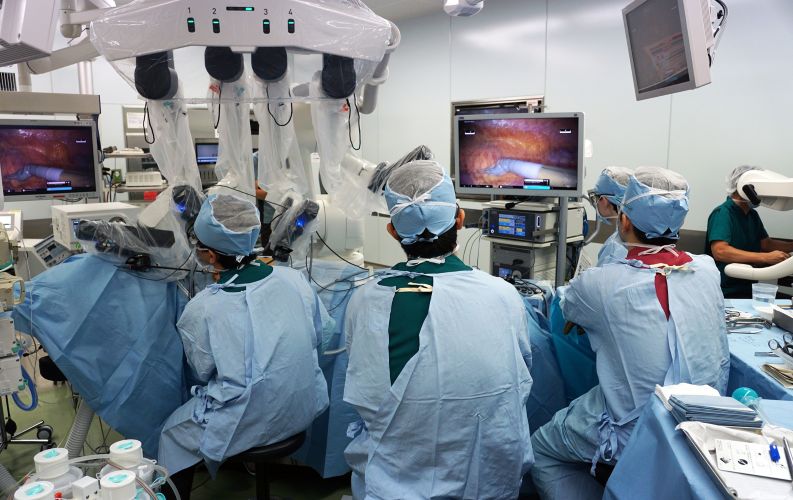
We also place strong emphasis on education in robotic surgery. Students and trainees have opportunities to observe procedures using the da Vinci Surgical System and the hinotori Surgical Robot System, participate in surgical video conferences, learn through preoperative simulation, and deepen their understanding of surgical anatomy. Based on the principle that good surgery begins with a good surgical view, our teaching emphasizes surgical exposure, anatomical recognition, understanding of dissection planes, and safe use of energy devices. We aim to provide education that prioritizes safety, standardization, and reproducibility rather than individual technical virtuosity. In addition, by using intraoperative images, 3D reconstruction, and artificial intelligence-based analysis, we seek to visualize and share the tacit knowledge of expert surgeons, thereby improving the standardization and efficiency of surgical education.
For residents and urology trainees, we provide a stepwise training program designed to support the acquisition of core competencies required for board certification in urology. Trainees learn endoscopic surgery, laparoscopic surgery, robotic surgery, pharmacotherapy, perioperative management, and emergency care in a structured manner. Our educational approach emphasizes not only technical skills, but also patient safety, prevention and management of complications, perioperative team medicine, informed consent, and ethical decision-making.
In graduate school education and research supervision, we foster the ability to design research projects, conduct clinical and translational studies, write scientific papers, and communicate research findings internationally. Students and trainees are encouraged to participate in advanced research themes, including cancer genomic medicine, biomarker discovery, organoid research, artificial intelligence-based image analysis, intraoperative image navigation, and medical-engineering collaboration. We actively support presentations at domestic and international conferences as well as the preparation of English-language scientific manuscripts.
We are also actively involved in multicenter studies, academic society activities, and international collaboration. Through these opportunities, we aim to cultivate urologists and clinician-scientists with broad perspectives, scientific thinking, and a strong commitment to patient-centered care.
【Research】
The Department of Urology at Hiroshima University focuses on multidisciplinary treatment for urologic malignancies, minimally invasive and function-preserving surgery centered on robotic surgery, cancer genomic medicine, biomarker discovery, image-guided surgery, artificial intelligence-based analysis, and medical-engineering collaboration. By identifying clinical questions that arise in daily practice and developing them into basic research, clinical studies, translational research, and medical device development, we aim to provide safer and higher-quality urologic care for patients.
1. Multidisciplinary Treatment and Personalized Medicine for Urologic Malignancies
We conduct research on multidisciplinary treatment for urologic malignancies, including prostate cancer, renal cell carcinoma, bladder cancer, upper tract urothelial carcinoma, testicular cancer, and retroperitoneal tumors. Our research integrates surgery, pharmacotherapy, radiotherapy, and cancer genomic medicine. In particular, for advanced prostate cancer, castration-resistant prostate cancer, metastatic renal cell carcinoma, and advanced urothelial carcinoma, we investigate the clinical significance of novel treatment strategies, including immune checkpoint inhibitors, molecular targeted therapy, antibody-drug conjugates, and radioligand therapy.
We are also working to establish personalized medicine by integrating clinicopathological factors, imaging findings, genetic alterations, tumor immune microenvironment, and treatment responses. Through these efforts, we aim to improve treatment outcomes while reducing unnecessary treatment burden for individual patients.
2. Robotic Surgery and Minimally Invasive, Function-Preserving Surgery
We study the safety, efficacy, oncological outcomes, functional preservation, and postoperative quality of life of a wide range of robot-assisted procedures in urology. These include robot-assisted radical prostatectomy, robot-assisted partial nephrectomy, robot-assisted radical cystectomy, robot-assisted nephroureterectomy, robot-assisted adrenalectomy, and robot-assisted simple prostatectomy.
In prostate cancer surgery, we focus on urinary continence, preservation of sexual function, surgical margins, and postoperative quality of life. In partial nephrectomy for renal cell carcinoma, we emphasize renal function preservation, reduction of warm ischemia time, negative surgical margins, and perioperative safety, particularly in patients with complex renal tumors. In bladder cancer and upper tract urothelial carcinoma, we are working to standardize and improve the safety of robot-assisted radical cystectomy, intracorporeal urinary diversion, and robot-assisted nephroureterectomy.
Furthermore, we utilize both the da Vinci Surgical System and the hinotori Surgical Robot System, a Japanese-made robotic surgical platform, to develop surgical techniques, educational methods, and surgical support systems that can be applied across multiple robotic platforms.
3. Intraoperative Imaging, Fluorescence-Guided Surgery, and Artificial Intelligence-Based Analysis
We promote research on intraoperative imaging technologies to achieve safer and more precise surgery. In partial nephrectomy, we use three-dimensional reconstruction, intraoperative 3D image navigation, and augmented reality to accurately understand the spatial relationships among tumors, blood vessels, the collecting system, and normal renal parenchyma. Through these approaches, we aim to achieve both renal function preservation and oncological control.
We are also working on the clinical application of technologies that visualize tumors and critical structures, including indocyanine green fluorescence imaging, photodynamic diagnosis using 5-aminolevulinic acid, and prostate-specific membrane antigen-targeted intraoperative fluorescence imaging. Through these technologies, we aim to accurately identify tumors, optimize resection margins, and reduce the risk of complications.
In addition, we are advancing AI-based image analysis using surgical videos, intraoperative images, and 3D imaging data. By visualizing the tacit knowledge of expert surgeons, such as operative field exposure, recognition of dissection layers, and avoidance of critical structures, we aim to improve surgical safety, standardization, and reproducibility, and to apply these methods to next-generation surgical education systems.
4. Molecular Pathology, Biomarkers, and Translational Research
To understand the development, progression, metastasis, and drug resistance of urologic malignancies, we conduct molecular pathological research and biomarker discovery. In bladder cancer, urothelial carcinoma, renal cell carcinoma, and prostate cancer, we analyze tumor-related molecules, gene expression, the tumor immune microenvironment, and drug-resistance-related factors, aiming to identify novel biomarkers useful for prognostic prediction and treatment selection.
In urothelial carcinoma, we investigate molecules related to therapeutic response to antibody–drug conjugates and immune checkpoint inhibitors. In renal cell carcinoma, we study factors involved in resistance to molecular targeted agents and immunotherapy, and search for new therapeutic targets. In prostate cancer, our research themes include cancer genomic medicine, PSMA-targeted diagnosis and treatment, and personalized therapy for castration-resistant prostate cancer.
5. Development of Patient-Derived Organoids and Disease Models
We are also engaged in research using patient-derived organoids. Organoids are experimental models that can reflect the disease characteristics of individual patients and are expected to serve as a foundation for disease mechanism studies, drug sensitivity testing, biomarker discovery, and personalized medicine.
At the Department of Urology, Hiroshima University, we are expanding our targets beyond urologic malignancies such as prostate cancer and renal cancer to include benign diseases such as chronic prostatitis and chronic pelvic pain syndrome, and are working to establish disease models and analyze pathophysiology. Through research using clinical specimens, we aim to build a cyclical form of translational research in which clinical problems are brought back to basic research and then applied again to clinical practice.
6. Research on Benign Prostatic Hyperplasia, Lower Urinary Tract Dysfunction, and Benign Urologic Diseases
Research on benign urologic diseases, including benign prostatic hyperplasia, lower urinary tract dysfunction, overactive bladder, chronic prostatitis, and chronic pelvic pain syndrome, is also an important pillar of our work. For benign prostatic hyperplasia, we have introduced new minimally invasive treatments such as Aquablation therapy and robot-assisted simple prostatectomy, and evaluate their safety, efficacy, reproducibility, and postoperative quality of life.
For lower urinary tract dysfunction and chronic pelvic pain syndrome, we aim to establish more precise diagnosis and personalized treatment through symptom assessment, pathophysiological analysis, molecular marker discovery, and the development of patient-derived models. Although these are benign diseases, they can have a major impact on patients’ quality of life; therefore, we promote research that emphasizes functional improvement and enhancement of quality of life.
7. Medical–Engineering Collaboration, Multicenter Collaborative Research, and Development of Next-Generation Medical Technologies
Through medical–engineering collaboration, we are also engaged in the development of next-generation diagnostic and therapeutic support technologies. We promote collaboration with medicine, engineering, information science, pharmacy, and industry in areas such as robot-assisted surgery, intraoperative image navigation, AI analysis, fluorescence imaging, endoscopic devices, and surgical education support systems.
We also actively participate in domestic and international multicenter collaborative research, clinical trials, and academic society-led studies, aiming to generate generalizable evidence that goes beyond single-institution experience. Through these research activities, we aim to contribute to the standardization of safe, high-quality urologic care, the social implementation of new medical technologies, and the training of young physicians and researchers.

 Home
Home