【Major Papers of the Laboratory】
・Muguruma K, Takahashi T, Tagane Y, Nazere K, Hara N, Nakamori M, Yamazaki Y, Morino H, Maruyama H. Intracellular anionic substances cause tau liquid-liquid phase separation. Biochem Biophys Res Commun. 2025 Apr 9;757:151605. doi: 10.1016/j.bbrc.2025.151605.
・Naito H, Nakamori M, Nishi H, Toko M, Muguruma T, Yamada H, Sugimoto T, Yamazaki Y, Ochi K, Kawaguchi H, Maruyama H. The periodontal pathogen Fusobacterium nucleatum is associated with disease severity in multiple sclerosis. Sci Rep. 2025 Nov 3;15(1):38316. doi: 10.1038/s41598-025-22266-x.
・Ishikawa R, Yamazaki Y, Nakazawa N, Li X, Tazuma T, Takebayashi Y, Nakamori M, Sotomaru Y, Maruyama H. A novel conditional knock-in mouse model for APOE4-to-APOE3 switching. Neurobiol Dis. 2026 Jan;218:107244. doi: 10.1016/j.nbd.2025.107244.
・Takenaka M, Sugimoto T, Hironaka A, Naito H, Nakamori M, Yamazaki Y, Ochi K, Maruyama H. Ultrasonographic reference values of the brachial plexus cross-sectional area in healthy Japanese adults. Muscle Nerve. 2026 Feb;73:277-282. doi: 10.1002/mus.70093.
【Education】
With the rapid aging of society and declining birth rate, the number of patients with disorders managed by neurology—including cerebrovascular diseases, dementia, epilepsy, Parkinson’s disease, neuroimmunological disorders, and peripheral neuropathies—continues to increase. At the same time, advances in neuroimaging, neuromuscular ultrasonography, genetic diagnostics, molecular targeted therapies, nucleic acid therapeutics, endovascular treatment, digital health, and AI-based analysis are dramatically transforming neurological practice.
Our department places great emphasis not only on developing comprehensive clinical expertise across a wide range of neurological disorders, but also on fostering the ability to translate clinical questions into research. We provide training that equips physicians with the essential competencies required of neurologists, including history taking, neurological examination, interpretation of imaging and neurophysiological studies, emergency care, chronic disease management, multidisciplinary collaboration, rehabilitation, and nutritional and dysphagia management.
In our graduate education program, we offer opportunities to engage in clinical research, basic science research, and translational research, with the goal of cultivating the next generation of leaders in neurological practice and neuroscience research.
【Research】
1. Stroke
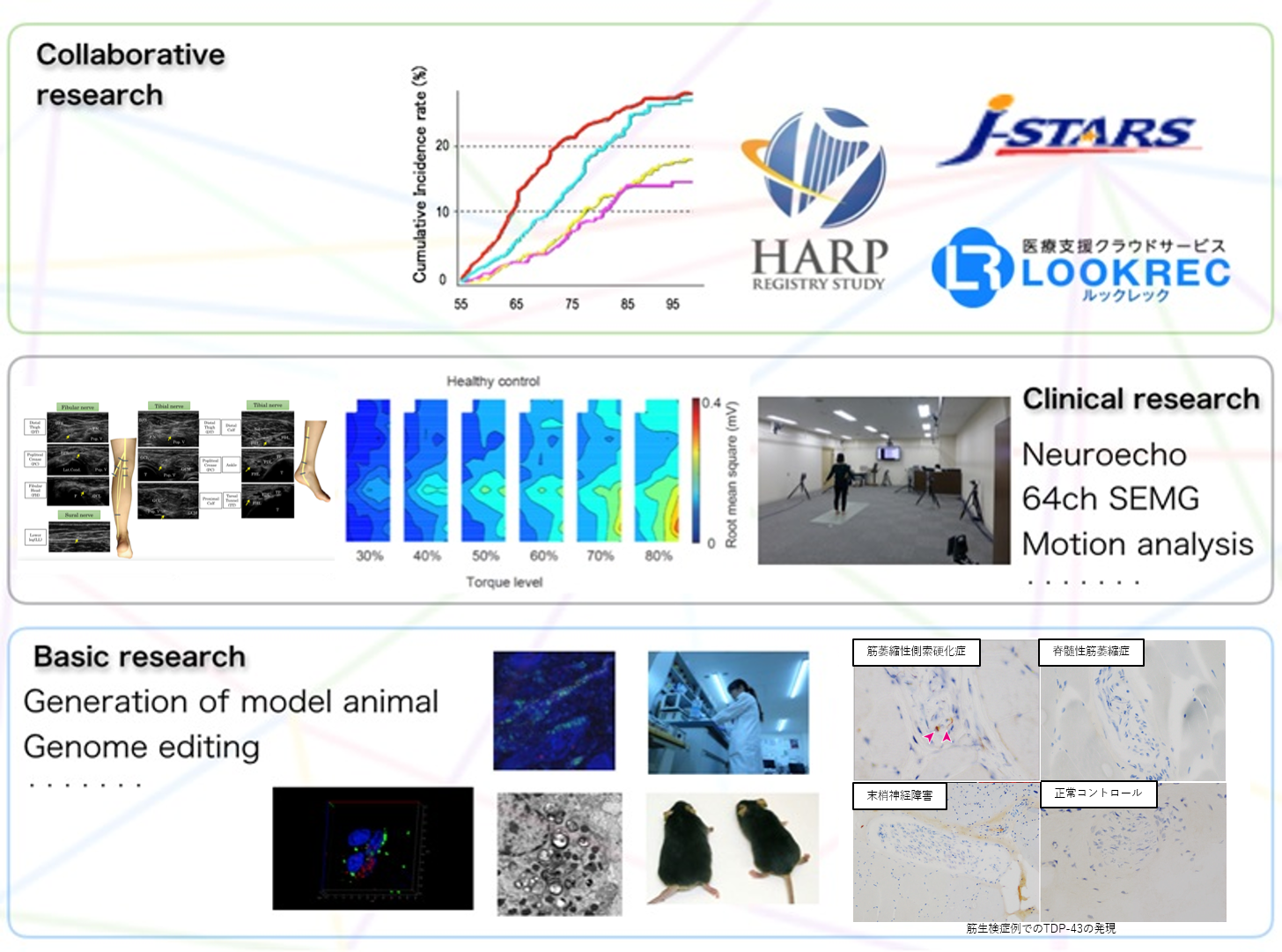
In the field of stroke research, we investigate the pathophysiology, prognostic prediction, and recurrence prevention of stroke using neuroimaging, blood biomarkers, oral environmental factors, nutritional status, and autonomic nervous system function. We actively participate in stroke registry studies and multicenter collaborative research. Recently, we have focused on outcome prediction using synthetic MRI-based myelin quantification and brain function assessment using electroencephalographic analysis in acute neurological disorders.
2. Neurodegenerative Diseases
We position neurodegenerative diseases—including Alzheimer’s disease, Parkinson’s disease, amyotrophic lateral sclerosis (ALS), and spinocerebellar degeneration—as major research areas, and conduct a broad spectrum of studies ranging from clinical research to molecular pathophysiological analysis and therapeutic development.
In Alzheimer’s disease research, we particularly focus on APOE, one of the strongest genetic risk factors. We have developed a knock-in mouse model that enables APOE4-to-APOE3 isoform switching and are investigating its impact on Alzheimer’s disease pathology. We are also studying intracellular transport mechanisms of amyloid-β and tau proteins, neuroinflammation, and lipid metabolism abnormalities. More recently, we have been working on novel therapeutic strategies utilizing APOE-switch models and blood–brain barrier-penetrating vectors.
In Parkinson’s disease research, we focus not only on motor symptoms but also on dysphagia. We are conducting studies on non-invasive neuromodulation using cervical electrical stimulation to investigate its potential for improving swallowing and cough function. At the same time, we are pursuing basic research on α-synuclein aggregation mechanisms and inhibition of protein aggregation.
In ALS research, we focus on causative genes such as OPTN (optineurin) and TDP-43 pathology, conducting pathophysiological analyses using cellular models, animal models, and patient-derived cells. Furthermore, through the multicenter collaborative observational CARP Study, mainly involving institutions in the Chugoku region of Japan, we are performing longitudinal analyses of disease progression.
In spinocerebellar degeneration research, we investigate novel disease-causing genes and their functional analysis, with particular emphasis on calcium channel abnormalities and synaptic transport dysfunction. We are also conducting pathophysiological and drug discovery research using CRISPR-Cas systems and related technologies.
3. Epilepsy
In epilepsy research, we perform brain function mapping and epileptic focus analysis using broadband electrocorticography in drug-resistant epilepsy. We also study critical care EEG and density spectral array analysis in acute neurological disorders for early diagnosis of toxic-metabolic encephalopathy and nonconvulsive status epilepticus.
4. Neuroimmunological and Peripheral Nerve Disorders
We investigate the pathophysiology and treatment responsiveness of neuroimmunological disorders, including CIDP, Guillain–Barré syndrome, myasthenia gravis, multiple sclerosis, and NMOSD.
We also conduct studies using neuromuscular ultrasonography to evaluate peripheral nerves, nerve roots, and the brachial plexus, including morphological analyses in hereditary transthyretin amyloidosis and other neuropathies, aiming to establish non-invasive diagnostic approaches complementary to electrophysiological studies.
5. Dysphagia and Nutrition
We conduct cross-disciplinary research on dysphagia, malnutrition, and aspiration pneumonia risk associated with neurological diseases. Multidimensional assessments include tongue pressure measurement, cough testing, videofluoroscopic swallowing studies, high-density multichannel surface electromyography, and swallowing sound analysis using electronic stethoscopes.

 Home
Home