
 Home
Homee-mail: capr@hiroshima-u.ac.jp (Replace @ with a half-width charactor)
The Centre for Academic Practice and Resources oversees the management of Teaching Assistants (TAs) at Hiroshima University. Students who have worked as TAs are required to submit reports about their duties. This article presents the results of an analysis of their descriptions to grasp an overview of the TAs’ roles as Qualified Teaching Assistants (QTAs). The analysis focuses on approximately QTA students’ 5,000 reports, specifically the sections where they describe their own duties. Given the large volume of data, basic text mining techniques were used to identify overall trends.
A co-occurrence network analysis was conducted to visualise relationships between words that frequently appear together in the text. The figure below shows the results of this analysis. Only the top 50 relationships (edges—lines) with the highest Jaccard coefficients are displayed. This coefficient indicates the strength of association between two terms and represents the proportion of sentences in which both terms appear, relative to those in which at least one of them appears.
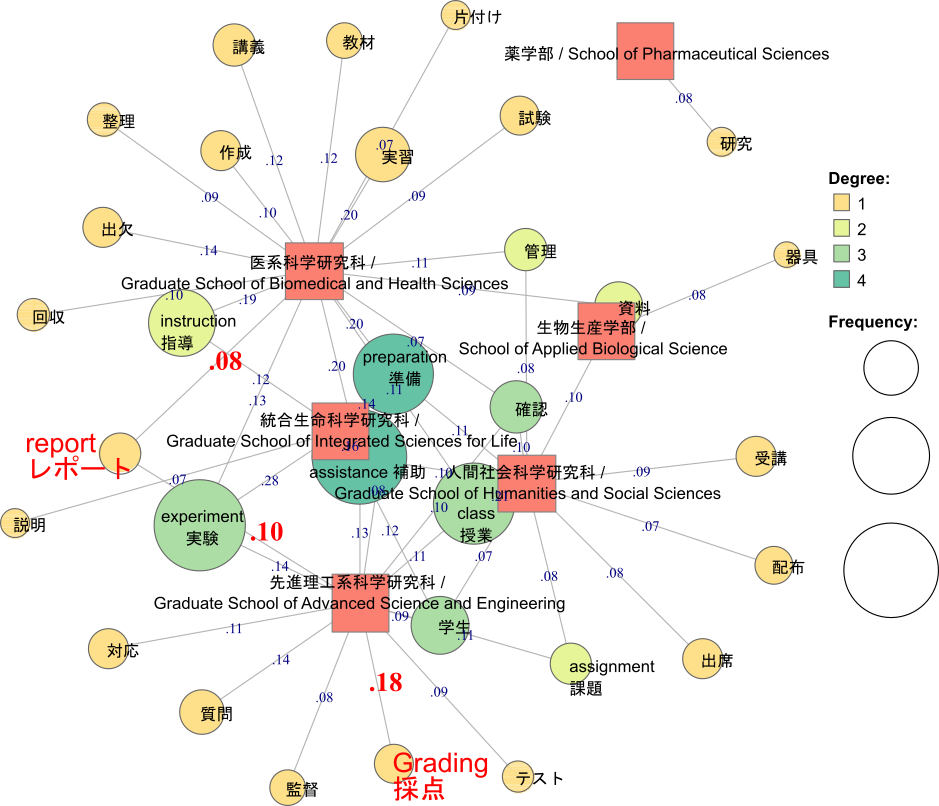
Figure 1: Relationships of Students' Affiliations and Used Words in the TA reports
When the relationships between words and students’ graduate schools were mapped as a network, larger nodes were observed for words such as “preparation,” “experiment,” “instruction,” “assignment,” “assistance,” and “class.” These words appear frequently in student reports and relate to class management and support for practical sessions. This pattern suggests that QTAs primarily undertake roles that support teaching staff, such as preparing classes, assisting with students’ practical studies, and responding to enrolled students.
Further analysis focused on the terms “report” and “grading.” These terms were relatively often associated with specific graduate schools, particularly the Graduate School of Biomedical and Health Sciences and the Graduate School of Advanced Science and Engineering. The term “report” appeared in 8% and 10% of cases respectively, while “grading” appeared in 18% of cases within the latter. A closer examination of the relevant reports suggests that some of these references involve assignments that require written responses or discussion assignments, rather than fixed-answer formats. Several cases indicate that QTAs may have been involved in grading such work.
In principle, QTAs may grade responses with clearly defined correct/wrong answers and may assist in preparing preliminary marking results for students’ assignments/tasks. However, the presence of cases where QTAs appeared to be involved in evaluating open-ended assignments is an important operational concern for the university. These findings suggest that when Tas are asked to grade written reports or discussion-based tasks, they should be appointed as Teaching Fellows (TFs) rather than QTAs. Appointing TFs allows the university to maintain a more appropriate and structured system while ensuring that students receive suitable remuneration. It will be important to further clarify the distinction between QTA and TF roles through faculty development initiatives and to communicate these distinctions clearly in TA training programmes.
Contact Us
Center for Academic Practice and Resources
