Home
HomeKey points of this research results
- Application of atmospheric-pressure thermal plasma jet to etching by adding reactive gases
- Realization of a new process that integrates millisecond-scale heating with etching reactions
- Achievement of ultrahigh-speed etching of photoresist at 84 µm per second
Outline
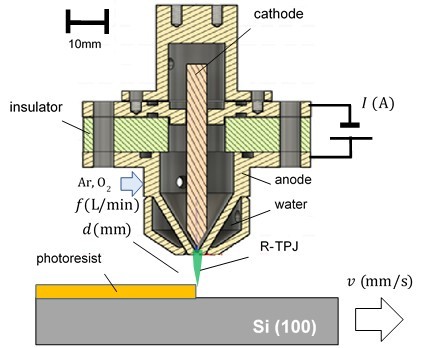
In advanced semiconductor manufacturing, the removal of insulator, metal, and photoresists that accumulate on the wafer edge bevel has become a major challenge. These byproducts formed on the bevel can peel off during subsequent processes and reattach to the device area on the wafer, resulting in reduced yield. Although dry etching techniques for photoresists have been studied for many years, they have not been able to exceed the high etching rate of wet etching -about 30 micrometers per second- making practical application difficult. Therefore, we focused on the application of a Reactive Atmospheric Pressure Thermal Plasma Jet (R-TPJ), in which reactivity is imparted to thermal plasma. When oxygen was added to the thermal plasma jet generated by a DC arc discharge of argon, emission spectrum analysis confirmed the generation of atomic oxygen radicals, indicating that reactive species capable of decomposing organic materials were produced. When the photoresist was irradiated with the R-TPJ, a reduction in the thickness was observed, and the etching rate increased exponentially with increasing discharge current. Measurements of the photoresist surface temperature during R-TPJ irradiation showed that the surface was heated to over 200°C in approximately 5 milliseconds, and that the temperature increased with the discharge current. These results indicate that simultaneous surface heating along with the supply of reactive species greatly contributes to the improvement of the etching rate. As a result, an ultrahigh etching rate of 84 micrometers per second was achieved.