Home
HomeKey points of this research results
- We performed a theoretical analysis of an inverse problem involving the detection of foreign objects (cavities, inclusions) within a homogeneous medium using wave reflections, employing a mathematical method known as the enclosure method.
- Previous studies have only addressed cases where, even if there were multiple cavities or inclusions, they were limited to a single type. In this study, we examined the inverse problem in a ‘mixed-type medium’ in which multiple types of cavities and inclusions coexist. [Fig. 1]
- Based on the sign of the indicator function, foreign objects in a medium are classified into two types. We considered cases where cavities with different signs in the indicator function coexist, and clarified the relationship between the position, shape, and type of the cavities and the leading terms of the indicator function.
Outline
The problem of estimating foreign objects using observation data consisting of pairs of incidents and reflected waves is known as “reconstruction” within the field of inverse problems. Inverse problems are frequently encountered in the real world in the context of non-destructive testing, and both practical considerations and theoretical analysis from a mathematical perspective are important. We examined this problem using the ‘enclosure method’ (developed in 1999 by Masaru Ikehata, currently Professor Emeritus, Hiroshima University), which utilizes a formulation based on weak derivatives in the theory of differential equations.
In inverse problems, a real-valued function known as an “indicator function”—which can be calculated from observation data—is naturally introduced. Using the indicator function, we can extract the shortest length of the line segments connecting each observation point to each foreign object. This is a fundamental property of the indicator function in the enclosure method. Furthermore, the indicator function has a positive or negative value depending on the type of cavity or inclusion. These properties allow us to determine the shortest distance from the observation point to the foreign object and to classify the foreign object based on its sign. On the other hand, if multiple types of cavities or inclusions are present, the signs may cancel each other out, making it impossible to obtain information. For this reason, previous studies assumed as prior information that even if there were multiple cavities or inclusions, they would all be of the same type. In this study, we investigated cases where the above-mentioned prior information is absent and obtained the following results.
(1) An object that makes the indicator function positive (negative) is called a positive (negative) object. First, we examined the case where it is known in advance that the shortest distances from the observation site to each foreign object do not match. We demonstrated that information on position and sign can be obtained using the same analytical method as that employed in previous studies when only one type of target was considered. (Reference [1])
(2) In the "equal distance case", where both positive and negative objects are located at the same shortest distance from the observation site, the method described in [1] cannot be applied. For cavities only case, by constructing an approximate solution for this problem using asymptotic solutions, we determined the form of the leading term in the asymptotic behavior of the indicator function (see [2] for details). It has been well known that a cavity with Dirichlet boundary conditions is a negative object, while a cavity with Neumann boundary conditions is a positive object. As an example, when these correspond to the equal distance case, it is found that the cavities with smaller curvature at the point on the cavity boundary that gives the shortest distance determines the behavior of the indicator function. [Fig. 2]
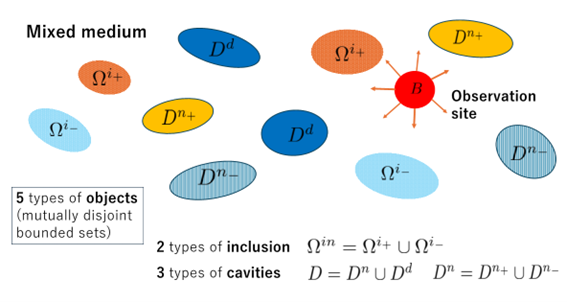
[Fig.1]
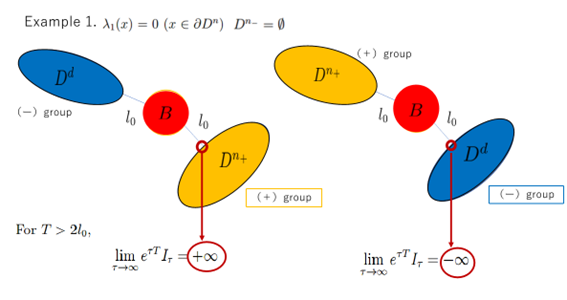
[Fig.2]
Paper Info
[1] Kawashita, M. and Kawashita, W., Inverse problems of the wave equation for media with mixed but separated heterogeneous parts, Math. Meth. Appl. Sci. (2025) 48 No. 4, 4144-4172 (https://doi.org/10.1002/mma.10537).
[2] Kawashita, M. and Kawashita, W., Asymptotic behavior of the indicator function in the inverse problem of the wave equation for media with multiple types of cavities, Phys. Scr., (2024) 99 No.11, https://doi.org/10.1088/1402-4896/ad6fe2