
 Home
Homee-mail: capr@hiroshima-u.ac.jp (Replace @ with a half-width charactor)
In Japanese higher education policy, student course experience data may serve as useful evidence to guarantee internal quality assurance and facilitate the transition towards student-centred education. Recent policy directives demand visualising student learning and multifaceted course feedback to drive systematic educational improvements. Consequently, course experience metrics play a vital role in supporting university-wide curriculum reviews and governance.
As part of pedagogical quality enhancement, Hiroshima university has continuously conducted student experience surveys for all undergraduates, publicly releasing summary results since academic year 2009. The administration frequency expanded from biannual to four times per year following the introduction of the term system in 2016. Additionally, the assessment scale transitioned from a 4-point scale to a 5-point scale in 2014. To enable long-term comparisons across these institutional changes, this report tracks multi-year trends using converted values that rescale historical 4-point data onto a 5-point equivalent (Figure presented below).
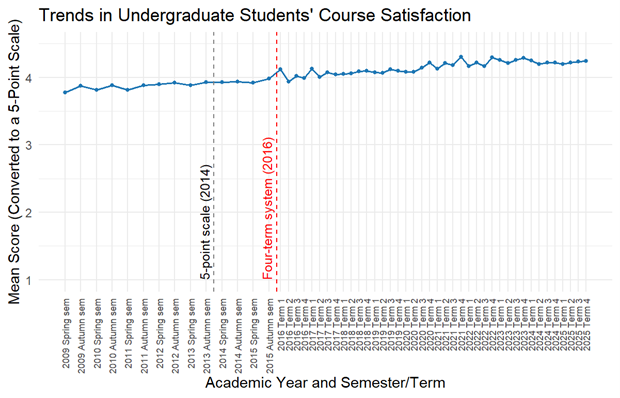
Overall satisfaction at our university has shown a steady upward trajectory from approximately 3.7 in 2009, remaining stable at a high level around 4.2 between 2021 and 2025, peaking at 4.306 in Term 4 of 2021.
This sustained high satisfaction rating across all undergraduate faculties indicates that institutionalised faculty development activities and educational quality initiatives have succeeded. Concurrently, changing student dispositions, including students’ increased proactive engagement, may also contribute to this trend. However, current data alone cannot isolate these underlying causes, and validating this hypothesis requires comparative analysis with longitudinal data from other institutions.
With satisfaction now stabilised between 4.2 and 4.3, the university must qualitatively re-examine what this metric represents. For example, high satisfaction derived merely from friendship or ease of completion risks conflicting with the core purpose of higher education, which requires a cognitive workload to cultivate critical thinking and inquiry. Therefore, high satisfaction scores do not necessarily represent optimal educational outcomes. Future initiatives must carefully examine course quality beyond mere satisfaction towards a genuine sense of intellectual growth achieved by overcoming academic challenges.
From a strategic management perspective, because educational improvement processes are now mature, the university could streamline resources in this area and reallocate efforts towards other core priorities as a university, such as research and societal contribution. Ultimately, applying empirical evaluation data to university-wide governance offers a crucial framework for ensuring our institution maintains global distinction well into the future.
Contact Us
Center for Academic Practice and Resources
