Home
Key points of this research results
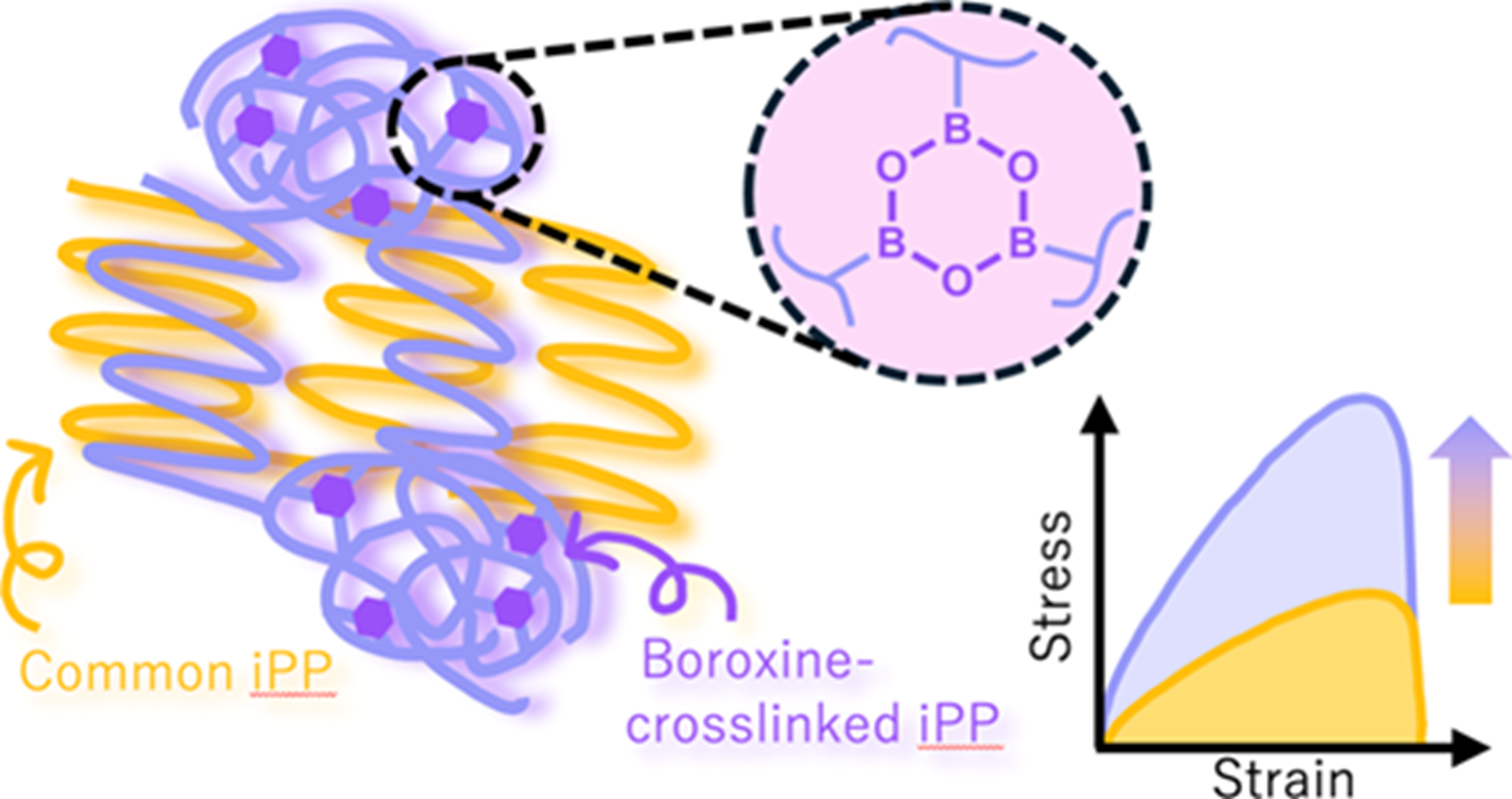
- A crosslinked polypropylene-based additive enhancing the tensile strength up to 1.5 times was developed. This finding has a significant potential for application in the recycling of a broad range of plastics.
Outline
Isotactic polypropylene (iPP) is one of the most widely used thermoplastic materials, accounting for approximately 20% of the production. The upcycling strategies of the postconsumer polyolefin waste are strongly required in terms of environmental protection and economic security. One of the challenges in recycling iPP is the deterioration of its mechanical properties caused by the main chain scission through repeated mechanical and thermal processing.
A research group of Prof. Ryo Tanaka, in applied chemistry program, has developed an additive that enhances the tensile strength of iPP by 1.5-fold with only 5 wt% of addition. The additive consists of a highly stereospecific iPP segment that can be incorporated into the crystal structure of original iPP and co-crystallize with it, and boronic acid moieties that form crosslinked structures in the amorphous phase. Various experimental results suggest that the additive enhances the mechanical strength by forming chemical bonds between multiple crystalline domains within the iPP matrix. The synthesis of this additive was enabled by a boronic acid-containing vinyl monomer previously developed by the same research group, which allows the preparation of high-molecular-weight polymers with a uniform distribution of boronic acid moieties. This research is expected to contribute not only to the recovery of mechanical properties lost during the recycling of iPP, but also to a wide range of applications, including enhanced heat resistance and control of the crystalline structure of iPP.
Literature information
Enhancing Mechanical Properties and Crystallization Kinetics of Isotactic Polypropylene by Boronic Acid-Cross-Linked Additives. Kazuki Shimizu, Shin-ichi Kihara, Mikihiro Hayshi, Hiroyuki Koga, Yuushou Nakayama, Takeshi Shiono, Ryo Tanaka* Macromolecules, 2025, 58, 8143.
Doi: 10.1021/acs.macromol.5c00783