Home
Key points of this research results
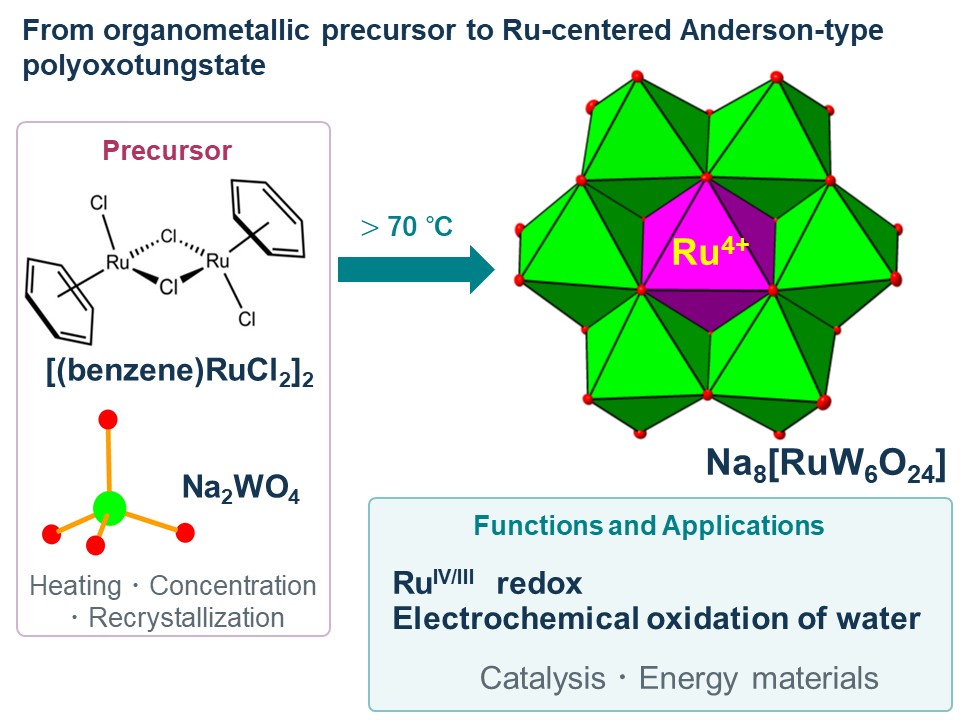
- The first Anderson-type polyoxotungstate incorporating a Ru(IV) ion at its molecular center, Na₈[RuW₆O₂₄], was synthesized and isolated.
- Single-crystal X-ray structure analysis and X-ray absorption spectroscopy revealed a planar structure in which six WO₆ octahedra surround a single RuO₆ octahedron, and characterized the local structure around Ru(IV).
- The target structure was obtained only from [(benzene)RuCl₂]₂ and not from commonly used Ru salts, demonstrating that an organometallic precursor can direct the formation of a metal oxide cluster.
- The central Ru ion exhibited quasi-reversible Ru(IV/III) redox behavior, and the resulting compound showed higher catalytic activity for water oxidation than related benzene–Ru tungstates.
Outline
Polyoxometalates (POMs) are molecular metal oxides composed of oxygen and metals such as tungsten and molybdenum. Their elemental composition and molecular structure can be designed at the atomic level, making them promising candidates for redox catalysts, photochemical and electrochemical materials, and sensors. Although Ru-containing POMs exhibit useful redox properties, compounds incorporating Ru at the center of an Anderson-type structure had not previously been isolated.
In this study, sodium tungstate and [(benzene)RuCl₂]₂ were heated in a water/ethanol mixture. After solvent evaporation and recrystallization, Na₈[RuW₆O₂₄] was obtained as dark green crystals. Single-crystal X-ray structure analysis established an Anderson-type structure in which six WO₆ octahedra surround a central RuO₆ octahedron. Elemental analysis, powder X-ray diffraction, infrared spectroscopy, thermal analysis, and Ru K-edge X-ray absorption fine structure (XAFS) spectroscopy also supported the composition and local structure.
A comparison of synthetic conditions showed that the target compound could not be obtained from RuCl₃, Ru(acac)₃, Ru(DMSO)₄Cl₂, or K₂RuCl₅(H₂O), and formed only when [(benzene)RuCl₂]₂ was used. Cleavage of the Ru–benzene bond at elevated temperature is thought to be involved in the formation of the W–O framework around Ru. These results suggest that organometallic complexes can serve as precursors that control the nucleation of inorganic clusters, rather than simply as metal sources.
Na₈[RuW₆O₂₄] exhibited a quasi-reversible redox response assigned to the Ru(IV/III) couple in aqueous solution at pH 4. When immobilized on a carbon paste electrode and evaluated at pH 8, the compound catalyzed water oxidation. The current was sustained during controlled-potential electrolysis, and no major changes were observed in the infrared spectrum of the recovered material.
Sherif E. Ebied, Sugiarto, Takuo Minato, Soichi Kikkawa, Seiji Yamazoe, and Masahiro Sadakane, “Anderson-Type Polyoxotungstate with Central Ruthenium, [RuᴵⱽW₆O₂₄]⁸⁻: Synthesis, Structure, Redox Studies, and Electrochemical Water Oxidation Activity,” Inorganic Chemistry, 2026, 65, 18676–18685.
DOI: https://doi.org/10.1021/acs.inorgchem.6c02109
| Polyoxometalate | A structurally well-defined, nanoscale polynuclear metal oxide ion composed primarily of oxygen and metals such as W, Mo, and V. Abbreviated as POM. |
| Anderson Type | A planar POM framework in which six metal–oxygen octahedra form a ring around a central metal–oxygen octahedron. |
| XAFS | X-ray absorption fine structure spectroscopy, a technique used to investigate the oxidation state and coordination number of a specific element, as well as distances to neighboring atoms. |
| Overpotential | The additional voltage beyond the theoretical potential required to drive an electrochemical reaction at a practical rate. Under otherwise identical conditions, a lower overpotential generally indicates that the reaction can be driven more readily. |