Home
HomeKey points of this research results
- We found that a planar molecule forms structurally well-defined intermolecular cavity in the crystalline state, which selectively accommodates only guest molecules that fit the shape and dimensions of the cavity.
- It is demonstrated that the planar molecule selectively encapsulated cis-decalin within the intermolecular cavity from the cis-/trans-decalin mixture.
- We established a mechanism of “selective encapsulation using latent intermolecular cavities in planar molecules,” highlighting their potential as building blocks for efficient separation materials.
Outline
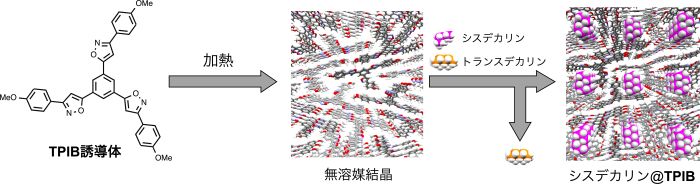
A tris(phenylisoxazolyl)benzene derivative (TPIB) derivative was found to form intermolecular cavities capable of accommodating small molecules, even though its crystals appear to contain no mappable cavities. Unlike the structurally well-defined cavities framed by macrocyclic molecules, these cavities originate from the molecular arrangements in the crystalline packing structure. TPIB preferentially adopts columnar stacking structures in the crystalline state, which uniquely defined cavities between the stacked TPIB.
To explore how to use the intermolecular cavities for molecular separation, we examined the selective uptake of geometrical isomers (structurally similar molecules). When powdered TPIB was exposed to a vaporous mixture of cis- and trans-decalin, the TPIB selectively encapsulated only cis-decalin, leaving trans-decalin unabsorbed.
To date, such selective encapsulation has been studied using cyclic host molecules possessing inherent intramolecular cavities. These macrocyclic molecules provide well-defined cavities, which capture guest molecules whose shape and dimensions match precisely. In contrast, this study demonstrates that a nonmacrocyclic planar molecule can generate structurally well-defined intermolecular cavities in the crystalline state, enabling selective molecular adsorption.
These findings offer a new strategy for the design of separation materials. Beyond the established framework of porous organic crystals, the work opens possibilities for developing lightweight, metal-free separation systems based on planar molecules.
【Paper Info】
Y. Ono, T. Hirao, N. Kawata, T. Haino, “Latent porosity of planar tris(phenylisoxazolyl)benzene” Nature Commun., 2024, Article No. 8314. DOI: 10.1038/s41467-024-52526-9