Home
HomeKey points of this research results
- This research seeks to establish a novel system design framework for Human-in-the-loop (HITL) systems, in which humans are actively involved in the operation of systems such as automobiles, construction machinery, and aircraft.
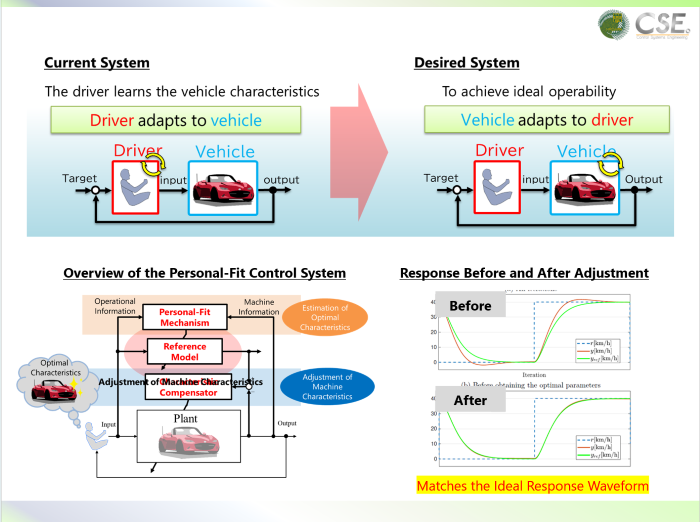
- On the basis of control theory, the optimal machine characteristics for each individual are estimated, and the system compensates the machine so that its characteristics match the identified optimum. This approach is expected to improve operability through active human operation and to enhance experiential values such as enjoyment and a sense of achievement.
- This research focuses on automobiles as a representative example of an HITL system. Experimental validation demonstrated that the system can identify the optimal vehicle characteristics for each driver and automatically adjust the vehicle accordingly.
Outline
In recent years, the importance of realizing well-being while respecting human diversity and values has been increasing in Japan, as represented by the concept of Society 5.0. Similarly, in industry, product development has been shifting from a conventional function-oriented approach to one that places greater emphasis on experiential value. Since Human-in-the-loop (HITL) systems are based on cooperation between humans and machines, it is especially important to take human diversity and individual conditions into account.
This research aims to establish a new type of HITL system that adapts to humans, referred to as a personal-fit control system. Specifically, assuming active human operation, this study develops a control system that optimizes machine characteristics for each individual in order to realize the operability desired by the user. This is expected to contribute to enhancing experiential value, such as the enjoyment and sense of fulfillment gained through operation.
At present, this research focuses on verifying the effectiveness of the personal-fit control system using automobiles, which are a representative example of HITL systems. In the demonstration experiments, a driving simulator is used to reproduce real driving environments, and students from Hiroshima University and elderly participants take part as subjects. The experimental results confirmed that each driver has an optimal set of vehicle characteristics that makes driving easier, and that the vehicle characteristics can be automatically adjusted to match this optimum. These findings suggest that the proposed system has strong potential for practical application as a driver-assistance system that enables people to drive comfortably for a long time.