Home
Key points of this research results
- Cultivation of a thraustochytrid using seasoning liquid waste generated from the production of pickles, such as Hiroshima, yielded functional polyunsaturated fatty acids, docosahexaenoic acid (DHA) and eicosapentaenoic acid (EPA).
- Without sterilization, the pickle seasoning liquid can be repeatedly used for culturing the thraustochytrid.
- The resultant biomass may be useful for producing eggs enriched with DHA and EPA.
Outline
DHA and EPA are polyunsaturated fatty acids (PUFAs) that play important roles in maintaining human health and are widely used in functional foods and dietary supplements. Moreover, these fatty acids are essential for the growth and development of marine fish and are therefore incorporated into aquaculture feed. Fish oil is currently the primary commercial source of DHA and EPA; however, its production depends on wild-caught fish stocks. Such reliance raises sustainability concerns in light of the projected increase in global demand for DHA and EPA. Therefore, this study focused on DHA- and EPA-producing microorganisms known as thraustochytrids and investigated a carbon-circulation scenario (Fig. 1), where seasoning liquid waste from pickle production—rich in organic matter but difficult to reuse because of its high salinity—is utilized as a growth substrate.
After adjusting the seasoning liquid wastes to pH 7, Aurantiochytrium sp. strain L3W was inoculated and cultivated. Although productivity was lower than that obtained with artificial medium, biomass containing DHA and EPA was successfully produced (Table 1). In particular, the biomass produced on the Hiroshima and Umeboshi seasoning liquid wastes contained sufficient amounts of DHA for enriching eggs. By contrast, DHA and EPA contents were lower in the biomass produced on the Sakura radish seasoning liquid waste because of the negative impact of coexisting microorganisms. When the post-cultivation supernatant of Hiroshimana was repeatedly used for culturing the strain L3W, growth of strain L3W and production of DHA and EPA were confirmed; however, both decreased with increasing reuse cycles. Further investigation revealed the accumulation of lactic acid and its inhibitory effects on strain L3W. This study demonstrates the potential of pickle seasoning liquid waste as a substrate for DHA and EPA production and provides the first evidence that lactic acid inhibits the growth of thraustochytrid.
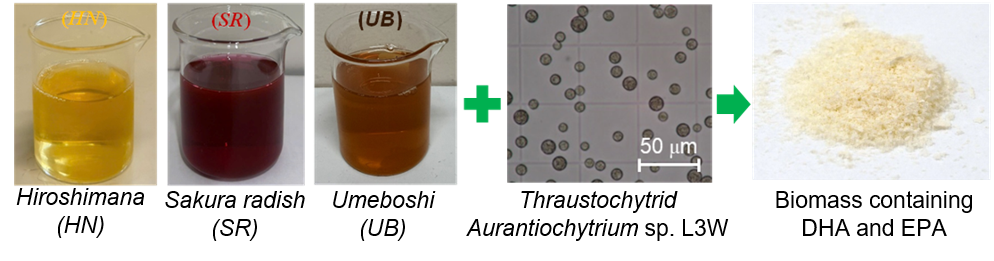
Figure 1
DHA and EPA production from pickle seasoning liquid waste through carbon recycling
Table 1
Biomass production of the strain L3W on various pickle seasoning liquid wastes and DHA and EPA contents
|
|
Hiroshimana |
Sakura radish |
Umeboshi (5-times diluted) |
Artificial medium (Control) |
|
Biomass [g/L] |
3.2 |
2.3 |
2.8 |
1.69 |
|
DHA [mg/g] |
60.6 |
8.9 |
49.6 |
150 |
|
EPA [mg/g] |
2.5 |
0.28 |
0.45 |
4.59 |