Home
Home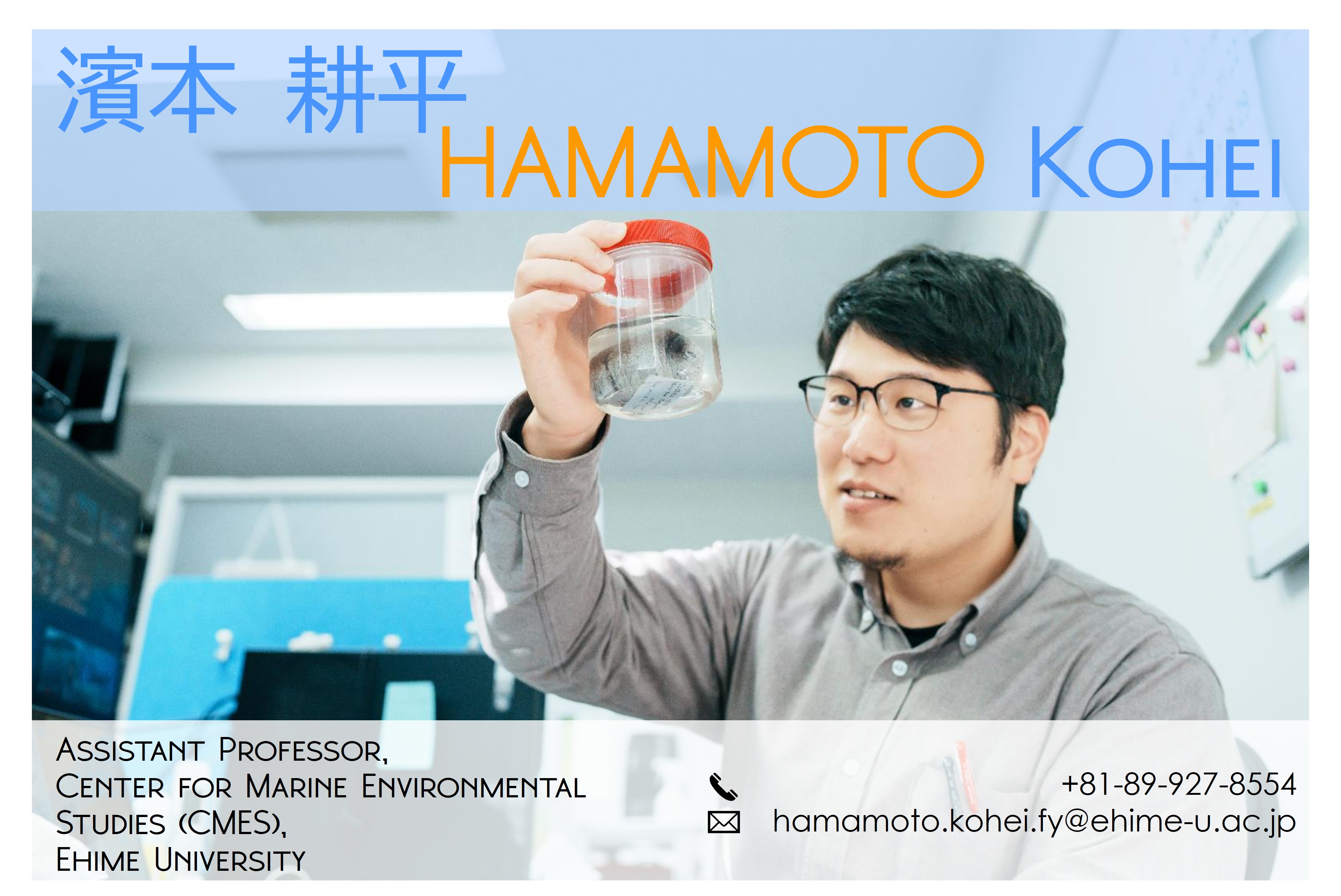

- Kohei Hamamoto, Masaru Mizuyama, Miyuki Nishijima, Ayumi Maeda, Kodai Gibu, Angelo, Poliseno, Akira Iguchi, James Davis Reimer. (2024a). Diversity, composition and potential roles of sedimentary microbial communities in different coastal substrates around subtropical Okinawa Island, Japan. Environmental Microbiome 19(1), 54. DOI
- Kohei Hamamoto, Akira Iguchi, Kodai Gibu, Hiroyuki Ozawa, Mari Kojima, Saki Mizuno, Yuki Yoshioka, Naoki Saito, Yoshihisa Fujita. (2024b). Asymmetric genetic population structures at the range edges of a mangrove whelk. Science of The Total Environment, 173248. DOI
- Kohei Hamamoto, Taha Soliman, Angelo Poliseno, Iria Fernandez-Silva, James Davis Reimer. (2021). Higher genetic diversity of the common sea sucumber Holothuria (Halodeima) atra in marine protected areas of the Central and Southern Ryukyu Islands. Frontiers in Conservation Science 2:736633. DOI
To view a more comprehensive list of publications, please click on the "researchmap" link below.


Dr. Kohei Hamamoto initially graduated with a bachelor’s degree from the Faculty of Science, University of the Ryukyus (Japan) in 2018, where he also completed the Chemistry, Biology, and Marine Science master’s program at the Graduate School of Engineering and Science in 2020, finally obtaining a Ph.D. in Marine and Environmental Sciences in 2023. In April 2023, Dr. Hamamoto became a postdoctoral researcher at the Research Institute of Geology and Geoinformation, National
Institute of Advanced Industrial Science and Technology (AIST) in Tsukuba, Japan, continuing his research on Okinawan waters with a focus on coral reef ecosystems and sea cucumbers. Dr. Hamamoto has held his current position of assistant professor at Ehime University (Japan) since 2024.

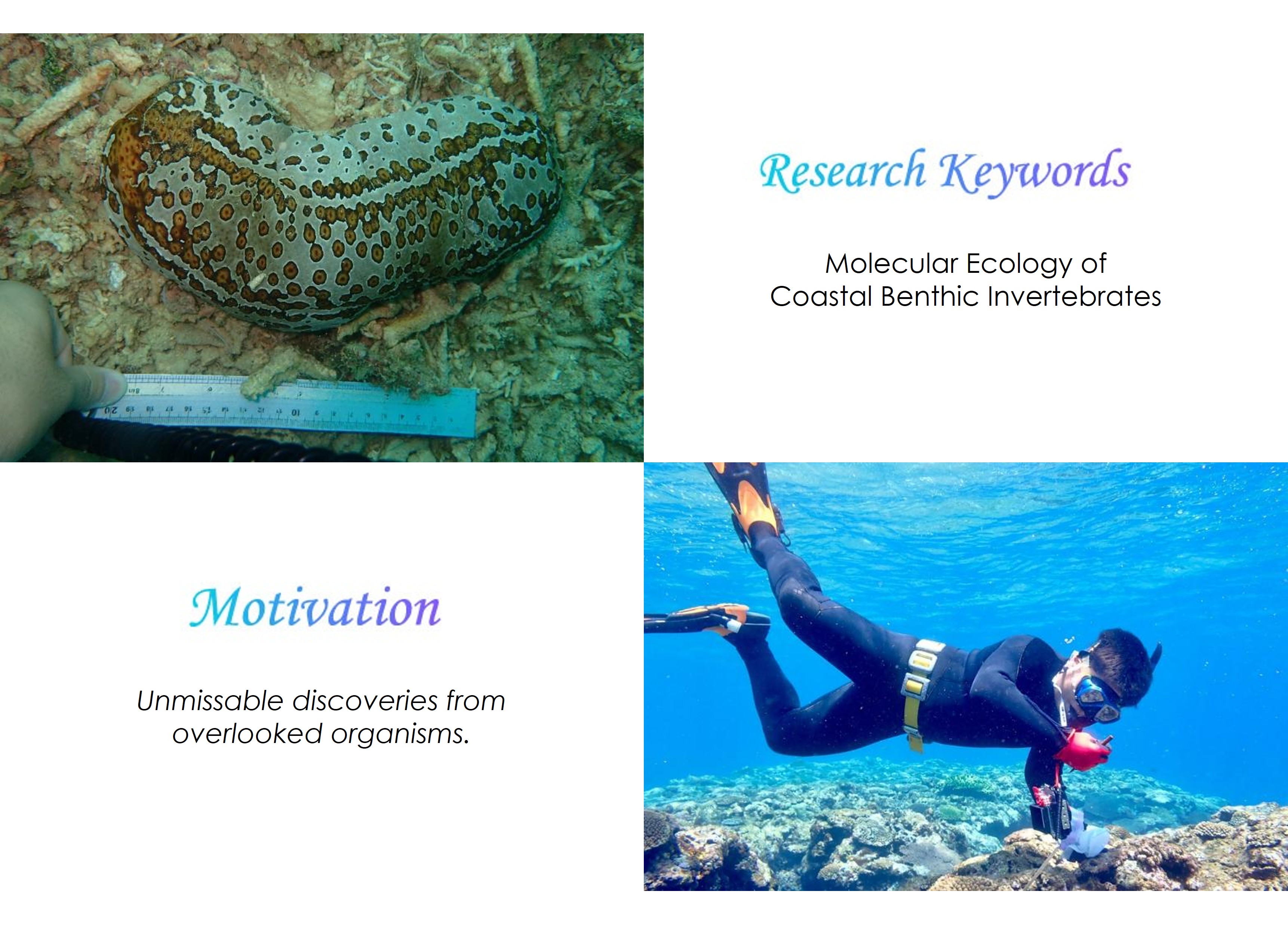
Dr. Hamamoto began diving in high school. Captivated by the underwater scenery, he was thus inspired to pursue the study of marine organisms and ecosystems, initially focusing on sea cucumbers. Sea cucumbers feed on accumulated organic matter as they crawl on the sea floor, churning the sand, which aerates the sea floor sediment; through these activities, sea cucumbers play a vital role in improving the marine environment. Dr. Hamamoto currently seeks to uncover the ecology of sea cucumbers using environmental DNA (eDNA) as a key marker. Dr. Hamamoto has also been expanding his research to investigate how the powerful flow of the Kuroshio Current affects seafloor organisms and ecosystems at large, collaborating with researchers from the Philippines, Taiwan, and Indonesia (among others), locations with similar marine environments as Japan.