Home
HomeKey points of this research results
- Electronic structure decomposition approach, ESDA, was developed and applied to predict the activity of Al2O3-supported metal nanoparticles.
- Adsorption of carbon monoxide and C-O bond dissociation by ruthenium nanoparticles were found to be dependent on specific regions of their density of states (DOS).
- It was demonstrated that CO adsorption and activation energies on Ru nanoparticles affected by alumina, can be predicted without DFT calculations.
- Reduction of computational cost by ESDA will contribute to speeding up catalyst development.
Outline
To realize carbon recycling, which involves capturing carbon dioxide (CO2) emitted from industrial facilities and vehicles and repurposing it as a resource for chemicals and liquid fuels, there is a growing demand to enhance the efficiency of the Fischer-Tropsch (FT) reaction, a process that synthesizes liquid fuels from carbon monoxide (CO) and hydrogen (H2). The FT synthesis employs heterogeneous catalysts composed of active metals and supports, necessitating the design of catalysts capable of efficiently activating CO molecules.
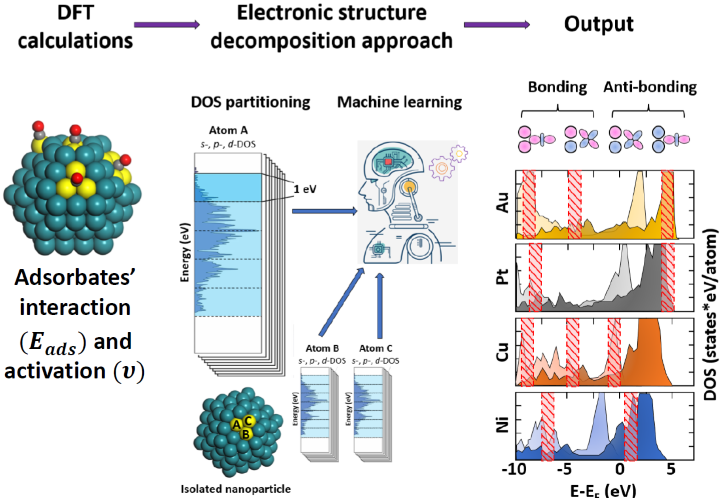
In this study, we developed the Electronic Structure Decomposition Approach (ESDA), which integrates quantum chemical calculations (DFT calculations) with machine learning as a computational strategy for catalyst design. We applied ESDA to predict the catalytic activity of heterogeneous catalysts utilizing ruthenium (Ru) as the active metal. Our analysis revealed that specific areas of the density of states (DOS) of Ru atoms exhibit a significant correlation with CO adsorption and C–O bond dissociation. By leveraging a prediction model trained on these correlations, we demonstrated that catalytic activity can be accurately predicted without the computationally expensive calculations required for Al2O3-supported systems.
These findings suggest that the rational design of catalysts with desired performance can be achieved by modulating the DOS areas correlated with catalytic activity. ESDA will therefore facilitate data-driven catalyst design, reducing the reliance on trial-and-error experimentation to accelerate the development of novel catalysts.
Paper Info
Rivera Rocabado D. S., Aizawa M. &, Ishimoto T. (2024). Universal Predictive Power: Introducing the Electronic Structure Decomposition Approach for CO Adsorption and Activation on Al2O3-Supported Ru Nanoparticles. ACS Applied Materials & Interfaces 16(33), 44305-44318.
https://doi.org/10.1021/acsami.4c09308