Home
HomeKey points of this research results
- We focused on rare garnet occurring in rhyolites of the Hime-shima Volcanic Group, Oita Prefecture, and investigated its origin through petrographic observations and EPMA-based mineral chemical analyses.
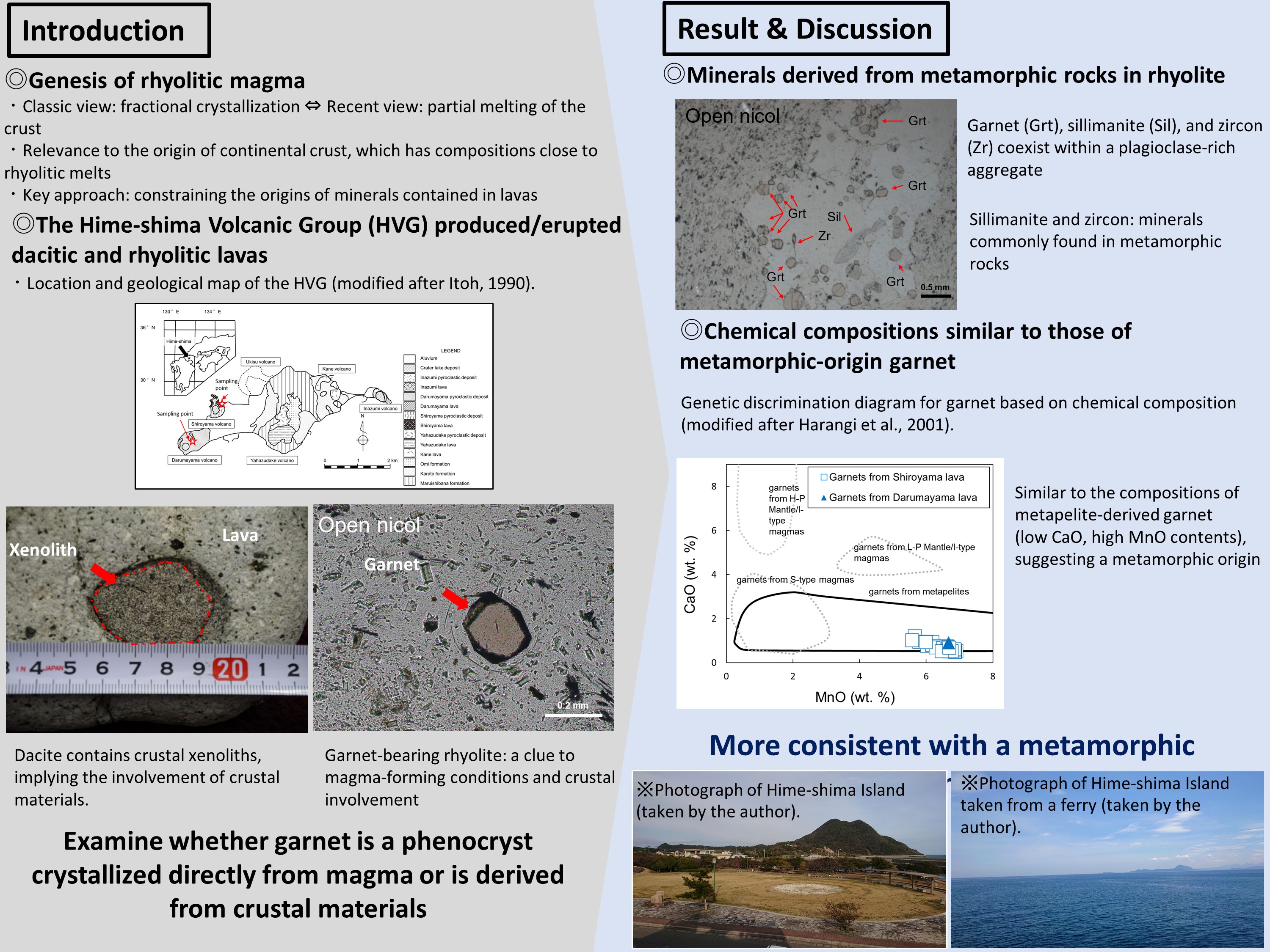
- The coexistence of garnet with sillimanite and zircon (minerals commonly found in metamorphic rocks) in a plagioclase-rich mineral aggregate, together with the garnet’s high-MnO and low-CaO compositions, showed that the garnet is a metamorphic-derived xenocryst rather than a magmatic phenocryst.
- These results provide mineralogical and geochemical evidence for possible crustal involvement in rhyolitic magma formation in the Hime-shima Volcanic Group, and offer clues for understanding continental crust formation and evolution through crustal remelting.
Outline
Rhyolitic magmas have generally been considered to form through fractional crystallization of basaltic to andesitic magmas. However, some volcanic rocks found in nature are difficult to explain by this process alone, and determining how to identify crustal involvement remains an important issue.
In this study, we focused on rare garnet in rhyolites of the Hime-shima Volcanic Group (HVG), located offshore of the Kunisaki Peninsula in Oita Prefecture, and examined whether the garnet is a phenocryst that crystallized directly from magma or a crust-derived xenocryst, based on mineralogical observations and EPMA analyses. Garnet is relatively rare in volcanic rocks, and its origin provides an important clue to understanding magma formation processes and crustal contributions. Garnets from the Darumayama and Shiroyama rhyolites have similar chemical compositions, suggesting a high likelihood of a common origin. In addition, the Shiroyama rhyolite contains a plagioclase-rich aggregate including garnet, sillimanite, and zircon.
Furthermore, the garnet’s high-MnO and low-CaO compositions support an origin from metapelitic metamorphic rocks rather than a magmatic origin. These results showed that garnets in the HVG rhyolites are xenocrysts derived from metapelitic metamorphic rocks and indicated possible crustal involvement in rhyolitic (silicic) magma formation.
In this way, detailed investigation of the origins of minerals in volcanic rocks enables us to infer deep subsurface magma-forming processes that cannot be directly observed at the surface. From the perspective of crustal remelting, this study contributes not only to understanding the origin of rhyolitic magmas but also to understanding continental crust formation and evolution.
Paper Info
Hirayama, T., Yoshikawa, M., & Shibata, T. (2026). The origin of garnet in Quaternary rhyolites of the Hime-shima Volcanic Group, east Kyushu, southwest Japan Arc. Journal of Mineralogical and Petrological Sciences, 241129L, https://doi.org/10.2465/jmps.241129L.