Home
Key points of this research results
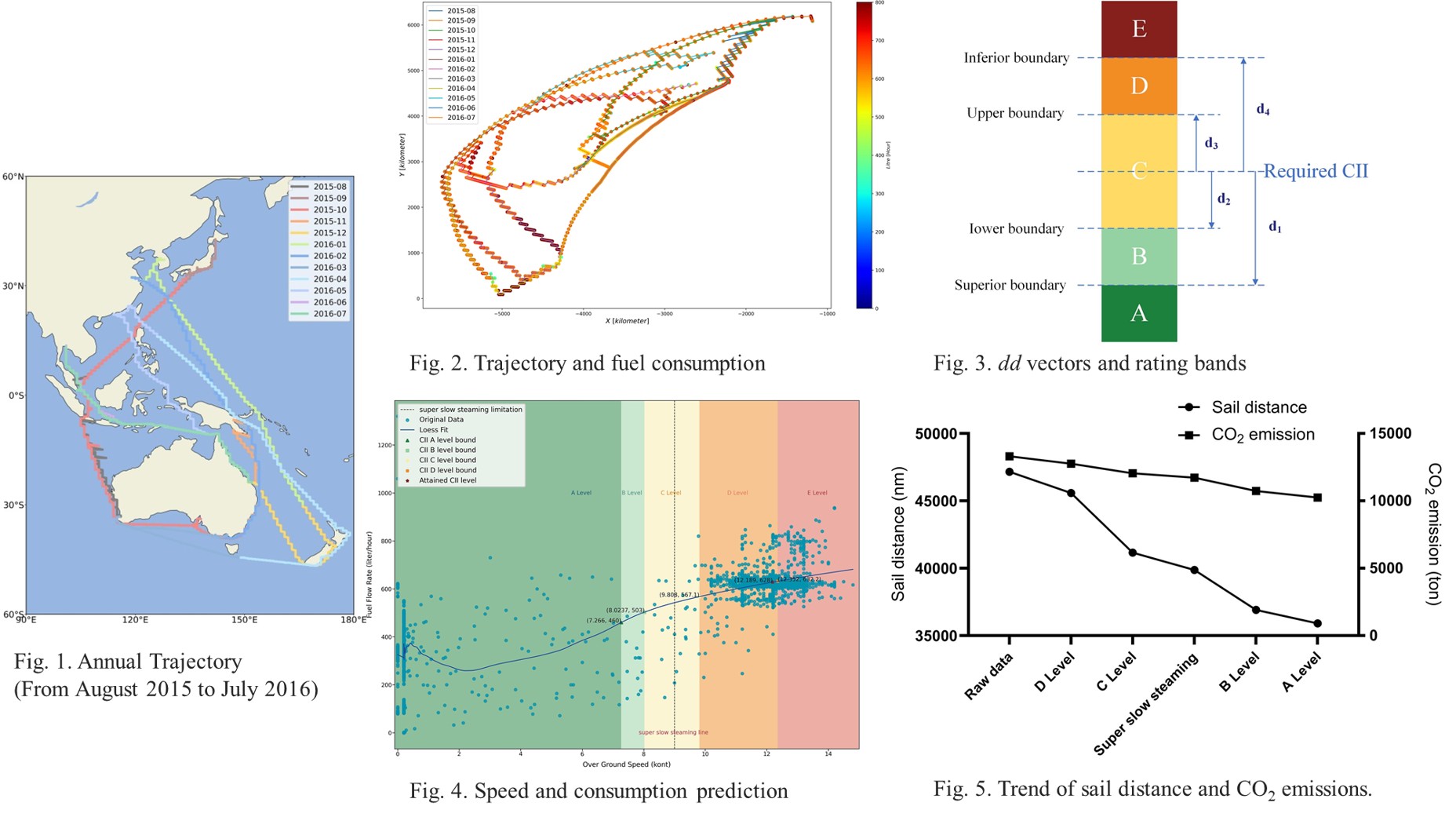
- Based on onboard measurement data, the relationships among ship speed, main engine operation, fuel consumption, and CO₂ emissions were analyzed, and a speed optimization method was proposed to support compliance with the Carbon Intensity Indicator (CII) introduced by the IMO.
- For CII ratings from A to E, speed reduction scenarios at different operational levels were compared, and their effects on environmental performance, transport efficiency, and economic feasibility were quantitatively evaluated.
- A practical decision-support basis was developed for simultaneously considering safety, energy-saving operation, and CII compliance while avoiding excessive deterioration of transport service quality.
Outline
The International Maritime Organization (IMO) has introduced the Carbon Intensity Indicator (CII) to reduce greenhouse gas emissions from international shipping. CII evaluates CO₂ emissions per unit transport work and classifies operational efficiency into ratings from A to E. For shipping companies, improving CII is not only an environmental requirement but also an operational issue closely related to voyage planning, fuel costs, service quality, and fleet management. For existing ships, where immediate large-scale modification of engines or hulls is difficult, speed management based on actual operational data is a realistic measure.
In this study, navigation records and engine operation data obtained from actual ships were used to analyze the relationships among ship speed, fuel consumption, and CO₂ emissions. Multiple speed optimization scenarios were then developed, including normal operation, stepwise speed reduction, and CII-rating maintenance, to evaluate the feasibility of CII compliance at different operational levels. The results showed that appropriate slow steaming is effective for reducing CO₂ emissions and improving CII performance, whereas excessive speed reduction may cause arrival delays and lower transport efficiency. The study also demonstrated the importance of adjusting ship speed according to voyage segments and operational objectives rather than applying uniform slow steaming.
This research is characterized by its quantitative evaluation of the balance between environmental and operational performance using onboard measurement data. By integrating the proposed approach with metocean forecasting and route optimization, it is expected to contribute to future ship operation support systems that simultaneously consider safety, economic performance, and environmental efficiency.
This research achievement was recognized for its academic and practical value and was published in Marine Pollution Bulletin, an international scientific journal ranked as a Q1 journal in the fields of environmental science and marine pollution.
Paper Info
Yan, D., Chen, C., Gan, W., Sasa, K., He, G., Yu, H. (2025). Carbon intensity indicator (CII) compliance: Applications of ship speed optimization on each level using measurement data. Marine Pollution Bulletin, 212, 117593,
10.1016/j.marpolbul.2025.117593