Home
Key points of this research results
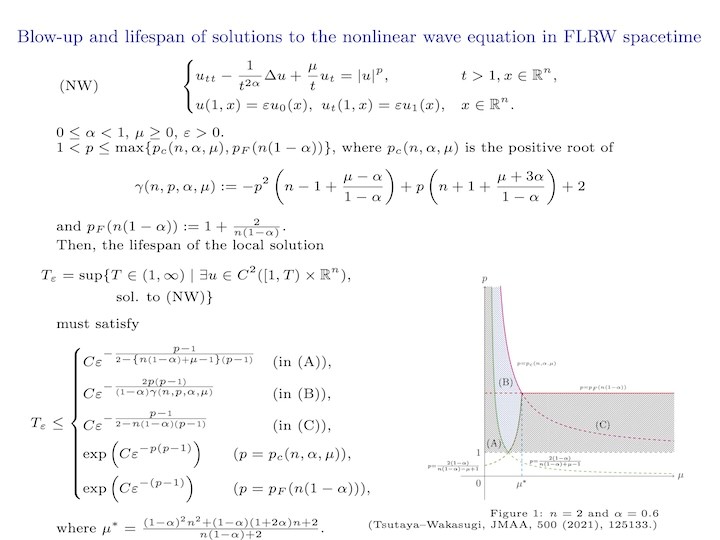
- For the Cauchy problem of nonlinear wave equations in Friedmann–Lemaître–Robertson–Walker (FLRW) spacetime, we derived the critical exponent separating the global existence and nonexistence of solutions for small initial data, and established finite-time blow-up and lifespan estimates in the critical and subcritical regimes.
- Corresponding results were also obtained for equations with derivative nonlinearities and for the case of de Sitter spacetime.
- In recent work, we have also established the global existence of solutions for equations with derivative nonlinearities by means of the energy method.
Outline
Nonlinear wave equations are partial differential equations that describe the propagation of waves through space, such as water waves, sound waves, and electromagnetic waves. In particular, they have been studied as mathematical models of phenomena in which waves concentrate and singularities develop. In this research, we consider the global existence and nonexistence of solutions to the Cauchy problem for nonlinear wave equations in curved spacetimes. Although this problem has been extensively studied since the 2000s, a systematic theory has not yet been established for Friedmann–Lemaître–Robertson–Walker (FLRW) spacetimes, which describe expanding or contracting universes, except in some special cases.
In this research, by combining a differential inequality argument called Kato’s lemma for nonlinear wave equations with analytical methods developed for dissipative wave equations with time-dependent coefficients, we derived the critical exponent and established finite time blow-up and lifespan estimates for solutions in the critical and subcritical regimes. These results clarify how the spacetime metric affects the critical exponent and lifespan estimates in both decelerating and accelerating expanding universes. We also showed that, compared with the case of Minkowski spacetime, solutions in FLRW spacetimes can blow up in a shorter time.
We further established corresponding blow-up and lifespan estimates for equations with derivative nonlinearities. In addition, in more recent work, we have obtained global existence results by means of the energy method.