
 Home
HomeDay 1
Day 1 of the Innovation Practice 2018 was successfully completed on Wednesday, October 10, 2018 at VBL office, Industry-Academia Collaboration Center, Hiroshima University. Participants varied from graduate students/postdocs to representatives from proposing companies, which covered quite a wide range of generations.
It started with an overview of the end to end workshop, followed by the self-introduction by all participants, including his/her profiles, strengths and hobbies.
Tetsuo Yamada, CEO of Lucks, Co., Ltd, Masanori Tagi, the Area Manager of Planning Supply Co., Ltd and Tunenori Suzuki, former CEO of Koizumi Honpo, and his wife, Junko represented each proposing company to present profiles, histories, business strategies, background of proposing challenges, etc. Colors of presentations were quite different per each, but they were all filled with passion and enthusiasm.
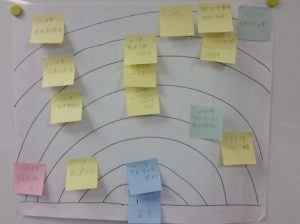
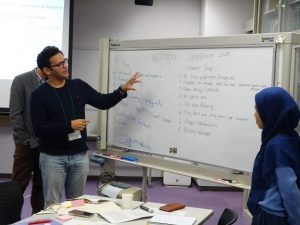
Then the participants were divided into three groups per challenges to start group work. They first tried the “Innovation Map” to analyze histories of each company, identify key products/services, turning points and innovators and map them out on the paper to find the key strategies or direction running throughout. One of the students said, “Good tool. We can leverage this map to analyze our research as well.”
After that, participants have learned the ground rules for ideation through “Let’s plan your party” exercise. Also learned a basic concept of “bracketing” to think out of the box.
It was a learning experience “to say yes” to keep positive and add on others’ opinions to pile up ideas and “to bracket the knowledge, stereotypes, experience, pre-informed concepts, etc.,” to set them aside to come up with brand new ideas.
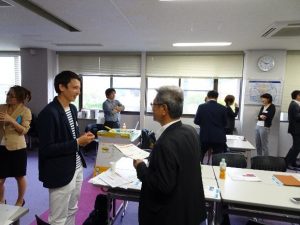
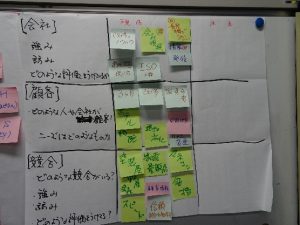
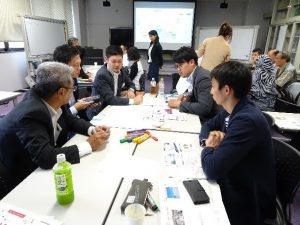
Based on the findings from the Innovation Map exercise, each group analyzed the values of the companies, applying the Aaker’s Product Value Proposition. Assignment was given to all, to think about the expected current and changes in 10 years from PESTLE perspectives, and to identify the viewpoints to observe and questions to ask at the fieldwork scheduled a week after.
Day 2
The Fieldwork tour was kicked off as a part of the Innovation Practice 2018, on Wednesday, October 17, 2018. The party of 17 participants in total left VBL Office, Hiroshima University, for Fukuyama City.
We visited the rooftop of Lucks, Co., Ltd., to get some clues on the first challenge, “how to utilize the rooftop in a certain area.” Lucks’ rooftop was filled with new ideas, from jet bath, astronomic observation, rooftop greening to beekeeping, which arose the participants’ interest and motivation.
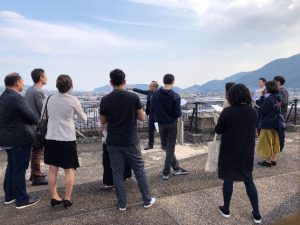
Next we visited the rooftop of the Brain Attack Center Ota Memorial Hospital, one of the clients for Lucks, Co., Ltd.. Mr, Shimazu, Public Relations Manager, provided us plenty information about their rooftop in full depth and width, from its layout and current usage to the history of the region, city development plan and their business model. The hospital is located at the edge of the commercial district, right next to the residential one (without any tall buildings under regulation), which gave us a 360 view of Fukyama City. Enjoyed panoramic beauty, we’ve got different insights to think about the usage of rooftops.
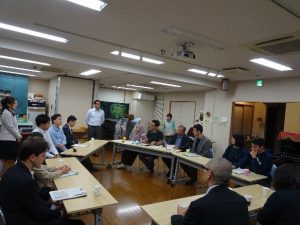
We came back to Saijo and visited the Salon of Koizumi Shinbunho, to get some insights for the Challenge #3, “How to become a ‘Window’ of the Saijo Sakagura-Street.” We were all welcomed by the owners’ family, served with the mother water of sake. They were already acting as a ‘Window’ of the street! Mr. Keita Suzuki, the president of the company, then talked about the long history of the family business carried over for 4 generations, his thoughts/opinions against it, the facing crisis of paper media industry, background of the proposing challenge, etc. Lot of questions were raised by the participants, such as targeting audience as of today and in the future, possibility of IT implementation, the definition of ‘Window’, etc.
The party moved to the dormitory in front of Hiroshima University, which is run by Planning Supply, Co., Ltd., to understand the background of their proposing Challenge #2 “How to create an ‘AREA’ in Shitami, everyone wants to live in.” It was filled with amazing luxury, including Mr. Masanori Tagi, the Area Manager, answered questions raised from the participants one after another, against the luxurious dormitory. We were all surprised to know that the rooms have been fully occupied since it opened this year, despite the rent much higher than the normal properties, but we’ve got convinced in the end, knowing the full advantage of the property – homemade meals served every day, high-standard security systems, completely furnished, equipped with electric appliances, fun events organized periodically, etc.
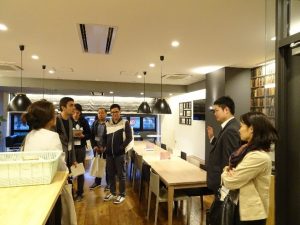
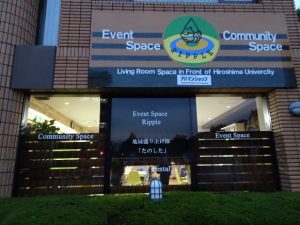
The last spot was “Ripple”, the open event space run by Planning Supply Co., Ltd. We learned the project “Tanoshita” up and running to energize the Shitami region. The room was equipped with a projector, a copy machine and a kitchen – easy for event organizers to utilize it for any types of events. It is open to any residents in the region for free, surprisingly. The reason behind was shared with the participants, who have got some insights to tackle the challenge.
All the above five facilities looked completely different at the beginning, but they share some core values against the “region”. We also found some benefits of experiencing the end-to-end fieldwork altogether (i.e. three groups together) – it brought some new idea, such as “leveraging a Ripple rooftop for publicity!” Killing two birds in one stone – maybe.
Day 3
The 3rd workshop of the “Innovation Practice 2018” was held on Wednesday, October 31, 2018 at VBL Office, Hiroshima University.
It started with a download session from the fieldwork on October 17. Each group presented and shared the insights from the fieldwork and exchanged opinions/feedback from each other.
The group #1 got some clues from various trial usage of the rooftop at Lucks, Co., Ltd, and came up with some seeds of ideas through the history and the current environment of the region learned from the Ota Memorial Hospital. The group #2 focused on the insights obtained from the observation at the event space “Ripple” owned by Planning Supply Co., Ltd, and felt some potential opportunities to leverage the location and facilities prepared there. The group #3 integrated their findings from the PESTLE/SWOT Analysis and shared their opinions to tackle anticipated future crisis the newspaper industry faces, based on the current situation, history and the future vision, shared by the CEO and the former CEO of Koizumi Shinbunho.
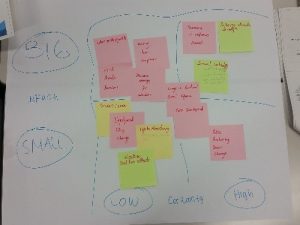
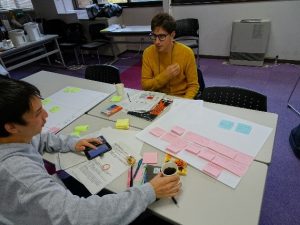
Based on all of the above insights and findings, each group set up the theme to create future scenarios in 2028 and mapped out the information collected against the theme by certainty and impact. They have learned a new theory as to which part of the information map they should try to focus on to be innovative. We tend to focus on the information with higher certainty and higher impact, while innovative ideas can be generated more from the information categorized under the lower certainty and higher impact. Some of the participants seemed to be struggling to shift their focus.
At the last part of the session, they started to think about the detailed future scenarios based on the above information. They’ve learned another new tips here. They first came up with common sense or highly potential scenarios from the theme set up upfront, then got asked to think about the completely opposite situation to be innovative. Struggling to think about the opposite from the common sense at first place, but they have gradually got a point and started to enjoy creating interesting scenarios from various angles.
Day 4
The 4th workshop of the “Innovation Practice 2018” was held on Wednesday, November 14, 2018 at VBL Office, Hiroshima University.
To begin with, everyone shared the respective future scenarios designed as an assignment from the previous workshop. They have integrated the key points of each member’s scenario and refined one. Based on the refined scenario, they reconsidered the real needs underlying there and identified the details of “whose” “what” they want to resolve as well as the value they want to carry over, which helped them clarify the framework of their proposals.
The group #1 created an interesting scenario with quite unique characters, based on the future analysis done so far. They have further stretched the scenario to come up with variety of needs behind, which seemed to have given them some clues to think about future roles of rooftops in 10 years.
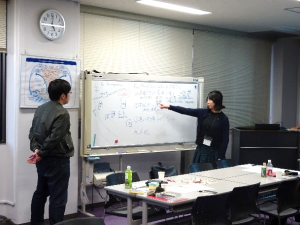
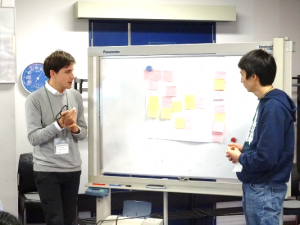
The group #2 focused on the changes in population demographics in Shitami area in 2028. They made two opposite scenarios, one of which anticipates drastic growth in international students or population while the other of which anticipates downsize of the international population. For the former scenario, they are proposing to use an open event space “Ripple” to resolve troubles/issues international students face at first place. For the latter scenario, they are proposing to organize events to engage kids in the region.
The group #3 developed a new business model to correspond to two layers of customers, the elderly and the younger generation. To face the former, they are proposing to keep on delivering hard copies of newspapers and at the same time to deliver substitute products using the existing channel. On the other hand, to face the latter, they are proposing to introduce smart-technology as well as to create an open platform to accept online posting from readers, which will eventually realize the two-way communication the proposing company is wishing to achieve.
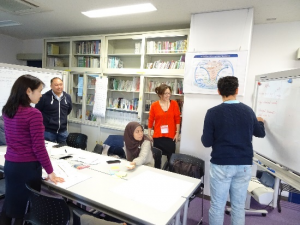
At the next 5th workshop, they will further refine these draft proposals, based on the stakeholder analysis.
Day 5
The 5th workshop of the “Innovation Practice 2018” was held on Wednesday, November 28, 2018 at VBL Office, Hiroshima University.
To begin with, each group shared the progress of their proposal planning and the results of their analysis on similar services/products in public.
The group 1 had further deepened their consideration on use of rooftops, based on the two opposite future scenarios. One of them is where the air gets cleaner thanks to the advanced technology, and the other is to have sensible increase in air pollution due to expanded factory bases along with the industry development. They had considered how their imaginary unique characters would wish to spend their lives in each scenario and what kind of roles rooftops can play there, and investigated various topics from diseases, recreation activities, exercises for health for the elderly, to child-care service and the governmental policy over the environment, etc.
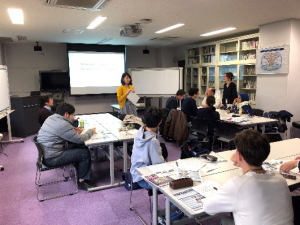
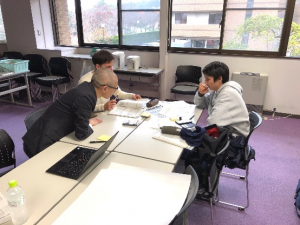
The group 2 investigated the existing services and the municipal materials related to the international students and children in the region. Compared against the existing services both in public and private, they were trying to identify where to mimic and what is currently missing. They also shared the interesting finding that the population of children has been leveling off in Higashi-Hiroshima City as a whole, while we know that it is growing in Saijo area. It gave some clue to the group 3 as well.
The group 3 further developed their business model to face two different layers of customers, one is mainly the elderly to wish the continued service to deliver paper-based news and the other is mainly the younger generation, wishing to receive news via smart technology. They have investigated diversified services and products in the market to think about how to leverage the established delivery channel of Koizumi Shinbunho, as well as to analyze feasibility of respective smart technology. They have started to create some image pictures of their proposals.
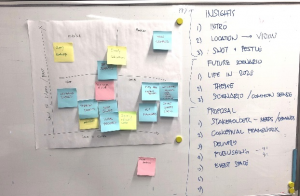
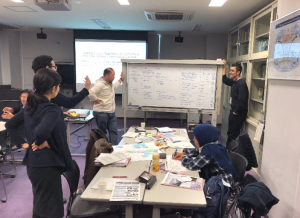
Following after, all tried the stakeholder analysis to be well prepared for the final presentation on December 12. They mapped out the stakeholders depending on the level of their impact and interest and ensured all potential stakeholders are properly covered.
Then they reconfirmed their ultimate objectives in 10 years, analyzed the gap between the objectives and the current state and came up with details action plans to fill the gap.
Each group has agreed on the roles and responsibilities at the final presentation coming in 2 weeks. We are all looking forward to seeing their idea buds unfold there!