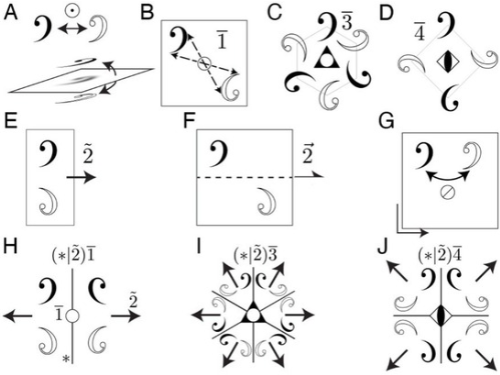
New symbols introduced to extend Conway’s orbifold notation to layer groups
©Sonia Mahmoudi et al.
Symmetry is all around us, from the repeating patterns of crystals to the stitches in a knitted sweater. In materials science, these patterns are more than just visually appealing: They can influence how a material conducts heat, transports electricity and interacts with light.
Now, an international research team led by Tohoku University’s Advanced Institute for Materials Research (WPI-AIMR) has developed a mathematical framework for describing symmetry in complex, layered structures, opening new possibilities for understanding and designing functional materials. Their findings were published in the journal Interface Focus on August 14, 2026.
“By extending orbifold notation to layered structures, we are developing a more flexible mathematical language for describing complex materials. This framework could help us better understand how symmetry and entanglement influence material properties, and ultimately support the design of materials for specific applications,” said Sonia Mahmoudi, assistant professor at WPI-AIMR in Japan.
Mahmoudi and co-author Elizabeth J. Dresselhaus are also affiliated with Hiroshima University’s International Institute for Sustainability with Knotted Chiral Meta Matter (WPI-SKCM2). Mahmoudi is an affiliate member of the institute, while Dresselhaus is a specially appointed assistant professor. WPI-SKCM2 brings together researchers across disciplines, including mathematics, physics, and chemistry, to study knot topology and chirality and how they can be used to understand and design new forms of matter.
“We are excited for the possibilities this notation offers for interdisciplinary research: uniting entangled materials across chemistry, physics, and materials science with a common mathematical language,” Dresselhaus said.
The study extends a mathematical system known as orbifold notation to describe structures that repeat in two directions but extend into three dimensions. These doubly periodic layered structures are found in knitted textiles and certain advanced materials. Until now, orbifold notation had been developed for describing symmetry in periodic two-dimensional patterns and three-dimensional structures that repeat in all three directions, leaving a gap in the mathematical description of periodic layered structures.
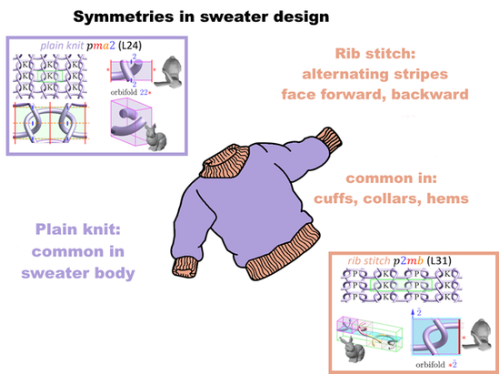
Symmetries in sweater design
©Sonia Mahmoudi et al.
“Crystalline materials arrange molecules a bit like the tiles on your kitchen floor: They have designs that repeat and fit together neatly. What we are interested in are structures whose tiles have a thickness somewhere between two and three dimensions,” said Dr. Michael Dimitriyev, assistant professor in the Department of Materials Science and Engineering at Texas A&M University and a co-author of the study.
Originally developed by mathematician John Conway and his collaborators, orbifold notation provides a compact way to describe symmetry using a set of symbols that follow consistent mathematical rules. These symbols can be combined like letters to form words, each representing a particular arrangement of symmetries. The notation can describe features such as rotation, reflection and glide reflection, offering an alternative to more cumbersome descriptions of complex patterns.
“The language of traditional crystallography is too rigid for tangled materials like textiles, which deform and curve throughout space,” Dimitriyev said. “We develop an extension of orbifold theory that defines symmetry without imposing a coordinate system. This gives us a new tool for designing textiles and other tangled materials.”
To illustrate how the new mathematical framework applies to real-world structures, the researchers turned to knitted fabrics. Although familiar, knitted structures present a challenging mathematical problem: Their interlocking strands form intricate three-dimensional arrangements, with curves that bend and pass around one another. Unlike conventional crystals, these structures do not necessarily have an underlying atomic lattice. This makes them a useful test case for developing a more flexible way to describe structural symmetry.
The new framework provides a foundation for applying orbifold notation to layered structures, including entangled materials. In knitted textiles, for example, the arrangement of strands affects how a garment stretches and fits. Similar principles could help researchers understand how the geometry and topology of engineered materials influence their physical properties.
Such insights could eventually support the design of materials for a wide range of applications. A clearer mathematical description of material structures could help researchers identify promising designs and predict their performance more efficiently.
The framework is an early step toward this goal. Future work will explore how mathematical quantities known as knot invariants can be defined within the orbifold framework. These quantities capture important features of how strands are entangled and could make certain calculations more efficient. By describing symmetry without relying on specific coordinates, the approach may also help simplify algorithms used in materials simulations.
Ultimately, a compact mathematical language for layered materials could help bridge the gap between how a material is structured and what it can do, giving researchers a new tool for designing materials with tailored properties.
This study was conducted in partnership with the Department of Materials Science and Engineering at Texas A&M University, the International Institute for Sustainability with Knotted Chiral Meta Matter (WPI-SKCM2) at Hiroshima University, and the University of California, Berkeley.

 Home