Home
Inquiries on the study
Futao Huang
Professor, Research Institute for Higher Education, Hiroshima University
Email: futao * hiroshima-u.ac.jp
(Note: Please replace * with @)
Inquiries on the story
Hiroshima University Public Relations Office
E-mail: koho * office.hiroshima-u.ac.jp
(Note: Please replace * with @)
Rather than converging toward Western managerial models, China’s leading universities appear to combine professional and political forms of authority as they navigate global academic competition and national strategic priorities, according to a study published in the journal Studies in Higher Education.
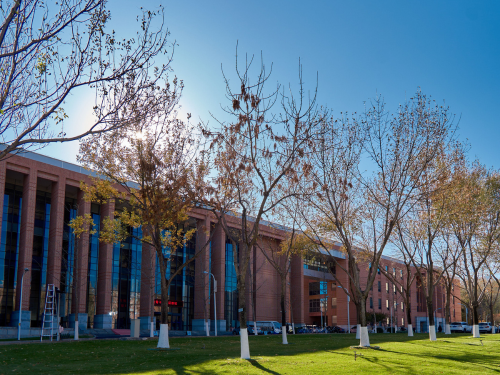
(Cobb Gk / Pexels)
China’s leading universities face two overlapping pressures: competing globally while remaining aligned with national strategic priorities. A study of 132 university president-Party secretary pairs, conducted by a Hiroshima University researcher, found that 53% had different but potentially complementary backgrounds and experience, the most common of three leadership configurations. The study describes China’s university governance system as a dual leadership system that formally assigns administrative authority to university presidents and political authority to Party secretaries. The findings suggest that professional and political forms of authority can be combined, rather than professionalization necessarily pushing universities towards a Western-style managerial model.
The study was published in the journal Studies in Higher Education on July 16, 2026.
“The central message of the study is that leadership in China’s leading universities has become increasingly professional, internationally experienced, and managerially specialized, but these changes have occurred within—rather than instead of—continued centralized Party control,” says Futao Huang, professor at Hiroshima University’s Research Institute for Higher Education and author of the study. “A striking finding is that doctorate-holding leaders rose from 73.2% to 88.5% among Party secretaries and from 82.1% to 93.7% among presidents, while Communist Party membership remained nearly universal.”
Previous research has documented increasing professionalization alongside continued political authority but has largely examined leaders individually. Huang instead analyzed university presidents and Party secretaries as leadership pairs to examine how these forms of authority are configured together within institutions.
“The study addresses how the socio-demographic, academic, and career profiles of leaders in China’s leading universities changed between 2013 and 2023, and what these changes reveal about the relationship between leadership professionalization, global competitiveness, and continuing Party-state control,” says Huang. “It also examines whether leadership patterns differ between former 985 Project universities and other leading institutions. This question is important because university leadership has become central to the implementation of China’s Double First-Class (DFC) reforms and to institutional performance ... The study helps explain how Chinese universities combine rising academic qualifications, international experience, and managerial specialization with persistent political supervision.”
Huang introduced the concept of leadership coupling to study the relational configurations of leadership within Chinese universities. He defined leadership coupling “as the patterns of interaction, alignment, and coordination between Party secretaries and university presidents within a given institution;” identified three key dimensions of leadership coupling (“professional alignment,” “international orientation,” and “institutional mobility”); and developed a typology that captures the degree of variation in leadership coupling (“aligned,” “complementary,” and “fragmented”). He then examined how leadership relations are structured in China’s leading universities and what this reveals about their governance, with particular attention to the differences between former 985 Project universities and non-985 Project universities now part of the DFC Initiative.
Biographical data of senior leaders in China’s leading universities was collected from a variety of primary and verified secondary sources. After processing, the full dataset contained 147 DFC universities, and the final dataset contained 132 leadership pairs, or 264 individuals. Of the final 132 DFC universities, 34 were former 985 Project universities, while the remaining 98 were non-985 Project universities.
Leadership coupling types vary, with just 19 leadership pairs of the aligned type, which exhibits high similarity across the three key dimensions and facilitates strong coordination, reduces internal friction, and supports coherent strategic direction. Seventy pairs were of the complementary type, where leadership actors possess differentiated but mutually reinforcing key attributes, enabling institutions to balance competing demands, particularly those arising from global academic norms and national strategic priorities. The remaining 43 pairs were of the fragmented type, marked by low alignment and weak complementarity which may lead to coordination difficulties, ambiguity in decision-making, and reduced strategic coherence.
This study suggests that governance in Chinese universities is best understood as a relational and hybrid process in which professional and political logics are combined through structured patterns of leadership interaction, an example of ‘professionalization without depoliticization.’ Huang concludes, “The next step is to extend the analysis to other state-steered systems, such as Japan, South Korea, and Singapore, and to add interviews and career-network analysis. The ultimate goal is to explain how university leadership can become more professional, international, and diverse while operating within different political and governance systems.”
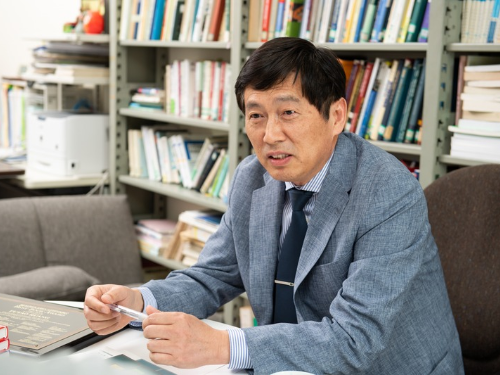
Professor Futao Huang, Research Institute for Higher Education, Hiroshima University, and author of the study. (Futao Huang / Hiroshima University)
This work was supported by Japan Society for the Promotion of Science (JSPS; 24KK0049).
About the study
- Journal: Studies in Higher Education
- Title: Leadership coupling under global-national tensions: governance configurations in China’s leading universities
- Authors: Futao Huang
- DOI: 10.1080/03075079.2026.2704774
- Date: July 16, 2026
Media Contact