Home
HomeHOSTY Association (Graduate School of Advanced Science and Engineering)
Email: bprc*hiroshima-u.ac.jp (Please replace*with @)
Date & Time: October 2, 2026
Program
Commentary: Yukihiko MATSUMURA
Professor, Graduate School of Advanced Science and Engineering, Hiroshima University
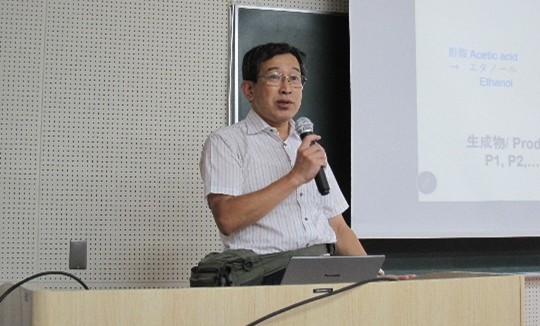
Lecture: Jiajian MENG
M1, Graduate School of Innovation and Practice for Smart Society, Hiroshima University
“Reaction of Erythrose in Hot Compressed Water”
Erythrose is a four-carbon aldose sugar and an important intermediate in the thermal decomposition of carbohydrates. In this study, the decomposition behavior of erythrose in supercritical water was investigated using a laboratory-scale continuous-flow reactor. The effects of activated carbon as a catalyst were also examined. Hydrogen was the dominant gaseous product under all experimental conditions, accounting for approximately 59–91 % of the total gas composition. Under catalytic conditions, the hydrogen fraction reached 83.9 % at a residence time of 20 s. Activated carbon showed little influence on the initial decomposition of erythrose, indicating that it did not significantly promote the conversion of erythrose to its primary decomposition intermediates. However, activated carbon promoted the gasification of downstream intermediates, resulting in an increase in carbon gasification efficiency, particularly at short residence times. These results provide insights into the decomposition pathway of erythrose in supercritical water and the role of activated carbon in promoting the gasification of its downstream products.
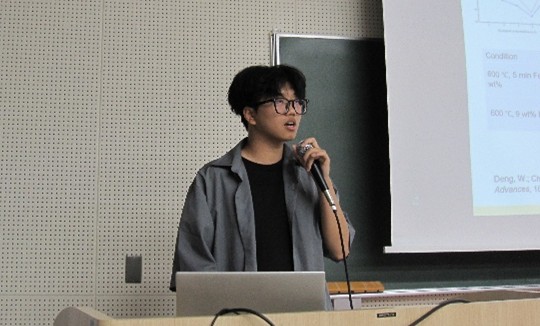
Lecture: Raito ARAKAWA
M2, Graduate School of Advanced Science and Engineering, Hiroshima University
“Effect of Ruthenium Catalyst on the Reaction Kinetics of Xylose Gasification in Supercritical Water”
Biomass has attracted considerable attention as a renewable and carbon-neutral energy resource. In particular, supercritical water gasification (SCWG) is an effective technology for converting wet biomass into gaseous fuels because it does not require an energy-intensive drying process. In this study, xylose, a major monosaccharide component of hemicellulose, was used as a model compound, and SCWG experiments were conducted at 450 °C and 25 MPa using a Ru/CNT catalyst. The results demonstrated that the Ru/CNT catalyst effectively promoted the gasification of xylose. Furthermore, the catalyst was found to enhance the rapid gasification of acetic acid, an important intermediate product.
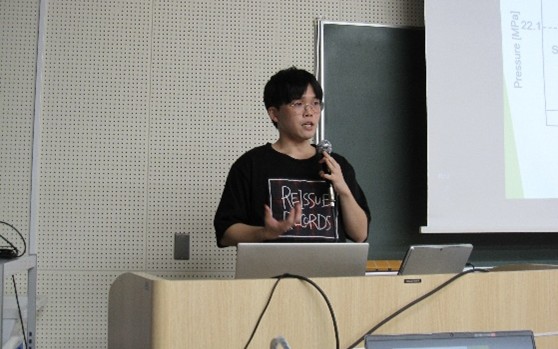
Lecture: Yutaka NAKASHIMADA
Professor, Graduate School of Integrated Sciences for Life, Hiroshima University
“Latest Developments in Thermophilic Syngas Fermentation”
Syngas is attracting increasing attention as a promising feedstock for future chemical production because it can be produced from various organic materials as well as from H₂ and CO₂ via the reverse water–gas shift reaction. Against this backdrop, the development of biomanufacturing technologies using syngas (H₂/CO) as a feedstock is advancing worldwide.
This presentation will highlight recent advances in our laboratory’s strain engineering and process development for the fermentative production of fuels and chemical feedstocks using thermophilic acetogenic microorganisms as host strains.
Chair: Yukihiko MATSUMURA
Professor, Graduate School of Advanced Science and Engineering, Hiroshima University
Inquiries: