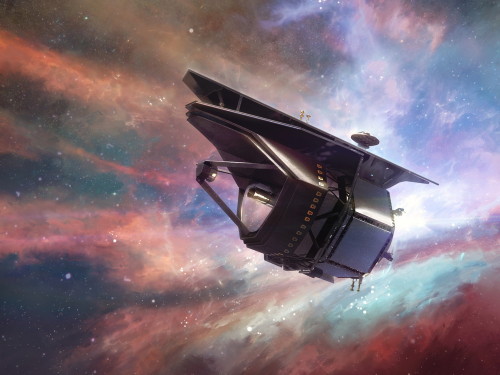
Courtesy NASA/JPL-Caltech
This release is jointly issued by Hiroshima University, Ehime University, The University of Tokyo, Waseda University, Tokyo City University, University of Tsukuba, Nagoya University, Tsukuba University of Technology, the National Astronomical Observatory of Japan, and RIKEN.
NASA has selected the PRobe far-Infrared Mission for Astrophysics (PRIMA) to move into Phase B, advancing it into preliminary design and technology development and marking a new stage in a three-year effort in Japan to explore the country’s potential role in the mission.
Organized PRIMA-related activities by researchers in Japan began in June 2023. In December 2024, the effort became a working group at the Institute of Space and Astronautical Science (ISAS), part of the Japan Aerospace Exploration Agency (JAXA), focused on possible Japanese participation. The working group is chaired by Hiroshima University (HU) astronomer and PRIMA co-investigator Hanae Inami, who studies dust-obscured star formation and galaxy evolution using infrared observations.
Science hidden in the far-infrared
PRIMA would survey the universe in far-infrared light, wavelengths largely blocked by Earth’s atmosphere and not broadly covered by current observatories. The mission would address three major questions:
- How do planets and their atmospheres form?
- How do galaxies and their central supermassive black holes grow and evolve together?
- How have dust and heavy elements built up across cosmic history?
Far-infrared observations could also help scientists investigate the role of water in planet formation.
Other HU researchers involved in Japan’s PRIMA-related efforts are exploring how the mission could advance their fields. HU cosmochemist Hikaru Yabuta studies the origins and chemical evolution of organic matter in the Solar System.
“I hope that PRIMA will enable us to trace the chemical connections between complex organic matter in protoplanetary disks and that found in comets and asteroids using common chemical indicators,” Yabuta said. “Such a breakthrough would bridge astronomy and Solar System materials science, bringing us a major step closer to understanding where and how the building blocks of planets were formed.”
Dust can obscure star-forming regions by absorbing visible light from young stars and reradiating that energy in the far-infrared. PRIMA would detect and study this far-infrared light with two complementary instruments: an imager that would map dust emission and measure its polarization, and a spectrometer that would trace gas and heavy elements.
“Infrared astronomy has been at the heart of my research career, and I’m thrilled to see PRIMA move forward toward realization,” Inami said. “PRIMA will open a new window onto this unseen Universe—and I’m especially excited about the possibility of discovering what we don’t even know we’re missing: the unknown unknowns.”
PRIMA would observe beyond the infrared range covered by the James Webb Space Telescope and into wavelengths shorter than those studied by facilities such as the Atacama Large Millimeter/submillimeter Array (ALMA). By helping fill this observational gap, the mission could reveal processes that are difficult to see at visible wavelengths and give astronomers a new view of how planets, stars, and galaxies form and evolve.
HU astronomer Koji Kawabata, another researcher involved in Japan’s PRIMA-related efforts, sees opportunities to combine PRIMA with observations from the university’s Kanata Telescope.
“By combining PRIMA’s capabilities with optical and near-infrared observations from the Kanata Telescope and other facilities, we hope to open new avenues for exploring the dynamic and transient universe,” he said.
PRIMA’s path to space
Current designs call for a 1.8-meter telescope cooled to about –268 degrees Celsius (4.5 kelvins), reducing infrared emission from the telescope itself so it can detect faint signals from cold material across the universe.
The mission must still pass a confirmation review before moving into implementation in Phase C.
NASA is targeting a 2033 launch for the planned five-year mission. If launched on that schedule, the observatory would reach space about two decades after the European Space Agency’s Herschel Space Observatory ended far-infrared science observations in 2013.
PRIMA is the first mission in NASA’s new Probe Explorers class. NASA’s Jet Propulsion Laboratory in Southern California will manage the mission, with contributions from other agency centers and international partners.

 Home