Home
Inquiries on the study
Toshinori Ando
Professor
Graduate School of Biomedical and Health Sciences, Hiroshima University
E-mail: toando19 * hiroshima-u.ac.jp
(Note: Please replace * with @)
Inquiries on the story
Hiroshima University Public Relations Office
E-mail: koho * office.hiroshima-u.ac.jp
(Note: Please replace * with @)
In a study published in Communications Biology, researchers found that hyperactive YAP and TAZ, cancer-promoting proteins regulated by the Hippo pathway, were associated with genomic instability that may make cancer cells more recognizable to the immune system and also increased PD-L2, which helps the cells evade T-cell attack. That combination may help explain why certain Hippo pathway alterations were linked to better outcomes among cancer patients treated with immune checkpoint inhibitors, which can block inhibitory signals that restrain T-cell activity.
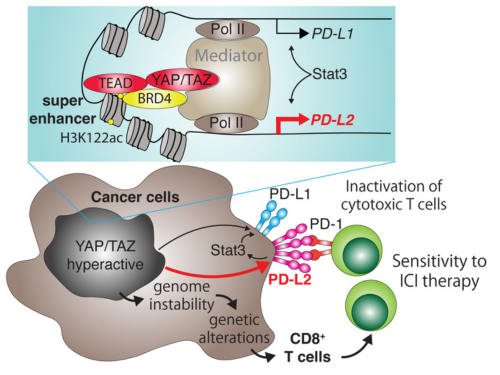
Schematic of YAP/TAZ-mediated immune evasion. YAP/TAZ hyperactivation is associated with genomic instability that may make cancer cells more recognizable to CD8+ T cells, immune cells that can recognize and kill abnormal cells, including cancer cells. At the same time, YAP/TAZ hyperactivation can increase PD-L2, which binds to PD-1 receptors on CD8+ T cells and suppresses their attack. Together, these effects may help explain why certain Hippo pathway alterations were linked to better outcomes following immune checkpoint inhibitor therapy. (Toshinori Ando/Hiroshima University)
The immune system may recognize a cancer cell and still fail to destroy it. Researchers at Hiroshima University (HU) and their international collaborators found that hyperactive YAP and TAZ (YAP/TAZ), two cancer-promoting proteins, were associated with genomic instability that may make cancer cells more recognizable to the immune system, while also increasing PD-L2, which helps the cells suppress T-cell attack.
That combination could matter for immune checkpoint inhibitor (ICI) therapy, which can block inhibitory signals that restrain T-cell activity. If genomic instability makes a tumor more likely to be recognized by the immune system while PD-L2 helps suppress the T cells that recognize it, blocking such inhibitory signaling could leave the tumor more vulnerable to immune attack. The researchers propose that this may help explain why tumors with certain Hippo pathway alterations were associated with better outcomes in a separate analysis of 1,662 patients treated with ICIs.
How YAP/TAZ helps cancer cells evade immune attack
The Hippo signaling pathway helps control cell growth by keeping YAP/TAZ activity in check, in part through the regulators LATS1 and LATS2 (LATS1/2). When LATS1/2 are lost, that restraint can weaken, allowing YAP/TAZ activity to increase.
Overactive YAP/TAZ are known to promote cancer growth, but their role in helping tumors evade immune attack has been less clear.
The researchers found that increased YAP/TAZ activity drove up PD-L2 expression. To test whether PD-L2 helped cancer cells resist immune attack, they exposed head and neck squamous cell carcinoma (HNSCC) cells to engineered T cells designed to recognize EGFR, a protein on the cancer cells.
Cells lacking LATS1/2 resisted the T-cell attack, but removing PD-L2 made them more vulnerable. The result indicated that PD-L2 contributed to their ability to evade attack by the engineered T cells.
The researchers also examined the other side of the apparent paradox. In laboratory models, loss of LATS1/2 was accompanied by increased YAP/TAZ activity, greater genomic instability, and more mutations in tumor cells. Genome instability and elevated DNA damage may make cancer cells more likely to be recognized by CD8+ T cells.
Hippo pathway alterations linked to better immunotherapy outcomes
The study, published in Communications Biology, combined clinical and genomic data with experiments in cancer cells and mouse tumor models. The patient dataset included several types of advanced cancer, while the laboratory experiments examined the mechanism across multiple cancer-cell types, with much of the detailed work focused on HNSCC.
In the patient analysis, tumors with alterations in selected Hippo pathway genes, including FAT1, NF2, LATS1, LATS2 and YAP1, were associated with better overall survival following ICI therapy than tumors without those alterations. The altered tumors also carried significantly more mutations and had higher tumor mutational burden.
The researchers did not demonstrate that the laboratory-observed links among YAP/TAZ activation, genomic instability and PD-L2-mediated immune evasion caused the improved outcomes in those patients. The clinical dataset contained genomic, tumor mutational burden, and survival information but did not directly measure YAP/TAZ activation, PD-L2 expression and immune-cell infiltration in the same tumors.
“Cancer patients harboring mutations regulating the Hippo pathway and YAP/TAZ hyperactivation may be sensitized to immune checkpoint inhibitor therapy owing to genome instability and PD-L2 expression,” said corresponding author Toshinori Ando, professor at HU’s Graduate School of Biomedical and Health Sciences.
The authors said Hippo pathway alterations and associated YAP/TAZ hyperactivation may have potential as prognostic factors for stratifying patients undergoing ICI therapy. However, further studies using independent patient cohorts with matched molecular and tumor microenvironment data are needed to translate the findings into clinical applications.
What the findings could mean for head and neck cancer
The findings may be particularly relevant to HNSCC, where response rates to ICI monotherapy remain below 20%. Anti-PD-1 antibodies, a type of ICI already used to treat HNSCC, block PD-1, a receptor that acts as a brake on T cells when PD-L2 binds to it, helping restore T-cell activity. Anti-PD-1 treatment itself was not tested in this study’s laboratory experiments.
The team also investigated how YAP/TAZ increase PD-L2 expression. Their experiments implicated TEAD and BRD4, along with a super-enhancer involved in regulating PD-L2. Disrupting these components reduced YAP/TAZ-driven PD-L2 expression in laboratory models, pointing to possible therapeutic strategies that would require further testing.
The research team included Toshinori Ando, Nanako Kataoka, Yukina Kobayashi, Hisako Furusho and Mutsumi Miyauchi of Hiroshima University’s Department of Oral and Maxillofacial Pathobiology; Kento Okamoto, Yume Ueda, Kai Omachi, Yuga Maeda and Souichi Yanamoto of its Department of Oral Oncology; and Tetsuya Yoshimoto, Tomoaki Shintani and Mikihito Kajiya of the Center of Oral Clinical Examination at Hiroshima University Hospital in Japan. Kataoka and Kobayashi are also affiliated with the Center of Oral Clinical Examination at Hiroshima University Hospital.
Other collaborators included Kuniaki Sato and J. Silvio Gutkind of the University of California, San Diego, in the United States; Yusuke Goto of Chiba University, Japan; Hiroki Izumi of the National Cancer Center Hospital East, Japan; and Ramiro Iglesias-Bartolome of the National Cancer Institute at the U.S. National Institutes of Health. Gutkind is also affiliated with UC San Diego’s Department of Pharmacology.
About the study
- Journal: Communications Biology
- Title: Dysregulation of the Hippo pathway enhances PD-L2 transcription to promote immune evasion in head and neck squamous cell carcinoma
- Authors: Toshinori Ando, Kento Okamoto, Kuniaki Sato, Yusuke Goto, Hiroki Izumi, Nanako Kataoka, Yume Ueda, Yukina Kobayashi, Kai Omachi, Yuga Maeda, Hisako Furusho, Ramiro Iglesias-Bartolome, Tetsuya Yoshimoto, Tomoaki Shintani, Souichi Yanamoto, Mutsumi Miyauchi, J. Silvio Gutkind & Mikihito Kajiya
- DOI: 10.1038/s42003-026-11092-0
Media Contact