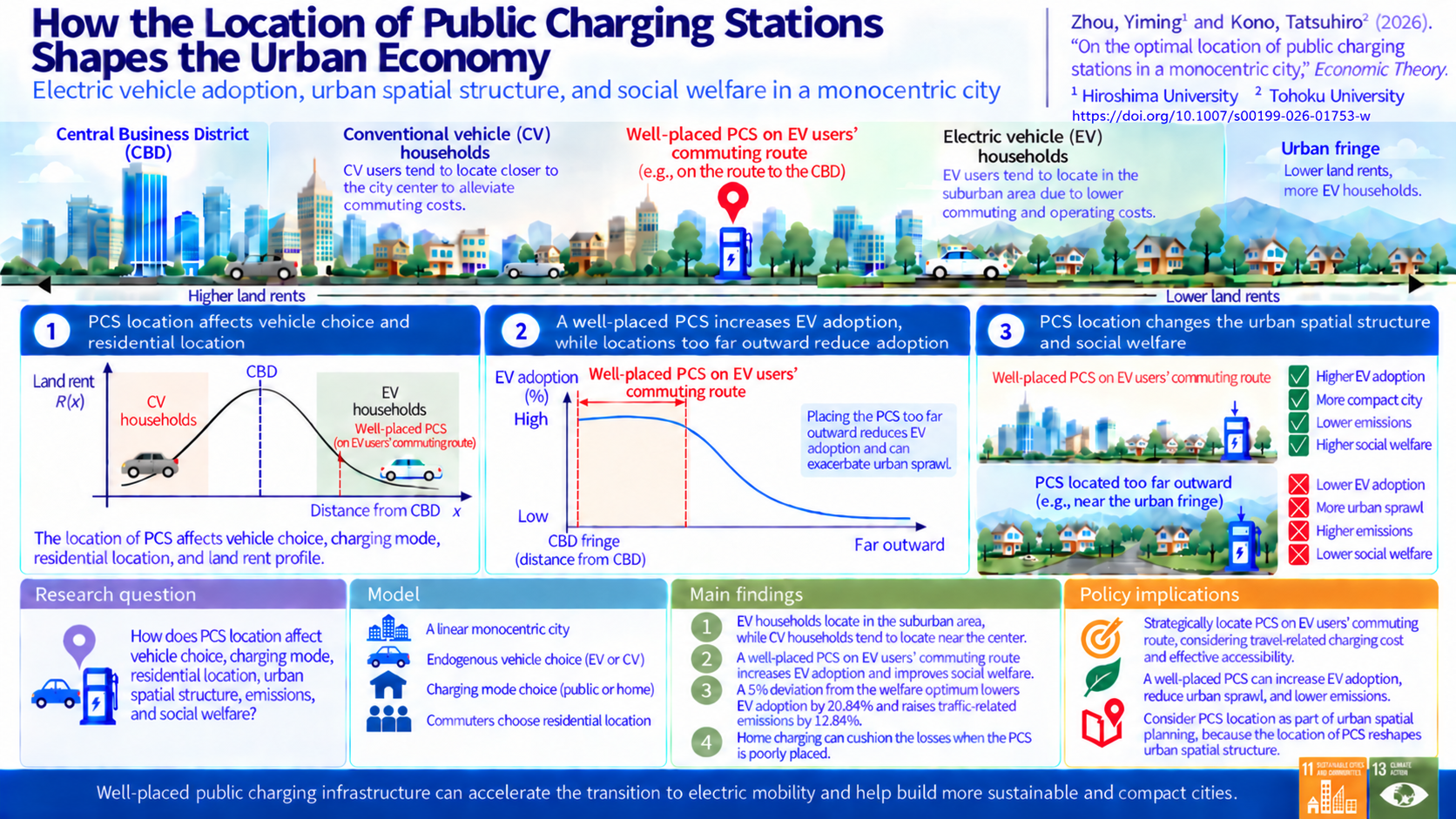
Our laboratory studies how infrastructure, policy, and market frictions shape the allocation of economic activity within cities and across countries, and its consequences for social welfare, the environment, and inequality. We build economic models, derive analytical solutions, and quantify them with numerical simulations and data. In urban economics, we study how the location of public charging stations shapes households' choices of vehicle type, charging mode, and residential location, and through these choices affects EV adoption, traffic-related emissions, urban spatial structure, and social welfare. In international trade, we study how financial development and trade jointly affect income inequality and efficiency in the global economy. Students may choose a graduation thesis topic from one of two areas:
(A) Urban Economics and Electric Vehicle Adoption (see Zhou & Kono, 2026, Economic Theory, https://doi.org/10.1007/s00199-026-01753-w)
- Charging infrastructure and urban spatial structure: how the placement of public charging stations affects EV adoption, land use patterns, urban sprawl, and social welfare.
- Charging behavior and EV adoption: how home vs. public charging, charging time, and charging prices influence vehicle choice and EV adoption.
- Policy evaluation: welfare effects of charging subsidies, EV purchase incentives, and environmental policies.
(B) International Trade
- Trade policy: how tariffs and other trade policies affect trade patterns and the gains from trade.
- Trade, finance, and inequality: how financial development interacts with international trade to shape income inequality within and across countries (see Zhou, 2026, Southern Economic Journal, https://doi.org/10.1002/soej.70070).
Research can be theoretical, numerical (model simulation), or empirical (data analysis), depending on the student's interests and skills.
(1) Background: Students majoring in economics, mathematics, physics, civil engineering, or related fields are welcome.
(2) Required knowledge: Applicants must be proficient in calculus (including multivariable calculus and optimization). Completion of at least one course in microeconomics is preferred.
(3) Preferred skills: Experience with programming (e.g., Mathematica, MATLAB, or Stata) or data analysis is an advantage but not required.
(4) Language: The working language of the laboratory is English. Students will read academic papers and write their graduation thesis in English.
(5) Thesis topic: The specific topic will be decided in consultation with the supervisor, taking into account the requirements of the student's home university. Applicants are encouraged to indicate their preferred area (A or B) in their application.
Please submit the required documents through IAAS. The application deadline is 5:00 pm (JST) on Thursday, March 19th, 2026. [TBD]
For more details of the required application documents in the program, please refer to the application guideline. You need to clearly indicate in your application materials, such as your resume, how you meet the additional requirements from the lab.
To register for IAAS, please visit the following website:
IAAS (International Admissions Assistant System)
Please note that applications are exclusively open to students from our partner universities. Partner universities will announce the application details to their students when the application period begins.
The selection process begins with a review of applicants' submitted documents. Candidates who pass this initial document screening will be invited for an interview.
Final acceptance will be based on the interview results, with successful applicants demonstrating the ability to effectively carry out the research activities required from each laboratory. Document screening will take place in March-April, and interviews for shortlisted candidates will be conducted in May-June. [TBD]


 Home
Home