Home
HomeInquiries on the study
Professor Katsuya Inoue
Graduate School of Advanced Science and Engineering
International Institute for Sustainability with Knotted Chiral Meta Matter (WPI-SKCM²)
E-mail: kxi * hiroshima-u.ac.jp
(Note: Please replace * with @)
Inquiries on the story
Hiroshima University Public Relations Office
E-mail: koho * office.hiroshima-u.ac.jp
(Note: Please replace * with @)
Scientists have found a way to spot early signs of skin aging, discovering that collagen's hidden internal structure begins to unravel before the fibers themselves break apart.
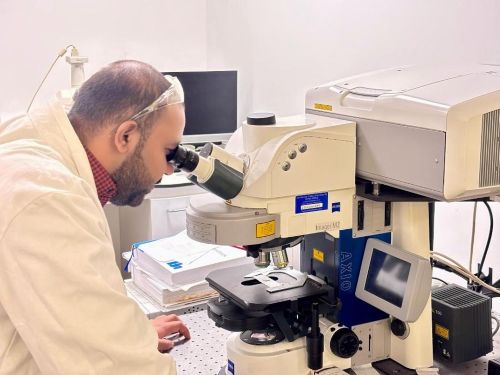
Ali Haider, a graduate student at HU and WPI-SKCM2 and first author of the study, observes the skin structure using confocal microscopy to investigate collagen organization and extracellular matrix remodeling. (Ali Haider / Hiroshima University)
An international team led by researchers at Hiroshima University has developed a new way to detect subtle, early-stage changes in human skin collagen before any visible signs of damage appear. The study, published in ACS Nano on July 16, 2026, reveals that the molecular organization and supramolecular chirality—or structural handedness—of dermal collagen collapses prior to the actual thinning or fragmentation of the visible fiber network.
Collagen is a hierarchical material that forms a highly organized network, which supports skin’s structure and mechanical strength. Traditional imaging methods can easily identify visible deterioration, such as fiber thinning or loss of connectivity. However, these structural failures represent late stages of tissue remodeling.
“One way to think about our findings is that conventional imaging methods can show the ‘bricks’ of a collagen structure, but they may miss subtle changes in how those bricks are arranged,” said Ali Haider, first author of the study and a graduate research fellow at Hiroshima University’s International Institute for Sustainability with Knotted Chiral Meta Matter (WPI-SKCM²). “It’s similar to detecting changes in the arrangement of words and sentences in a book before any pages appear damaged or missing.”
To uncover these hidden patterns, the team integrated advanced optical imaging with chiroptical spectroscopy, including synchrotron radiation vacuum-ultraviolet circular dichroism (SR-VUVCD) and multi-dimensional quantum cascade laser vibrational circular dichroism (MultiD-QCL-VCD). This framework allowed them to map both the presence of collagen and its chiral structural coherence in the exact same physical tissue section.
The results demonstrated a distinct decoupling between collagen mass and structural order: tissue samples retained their bulk collagen content and coverage even after their underlying supramolecular chirality coherence had severely degraded.
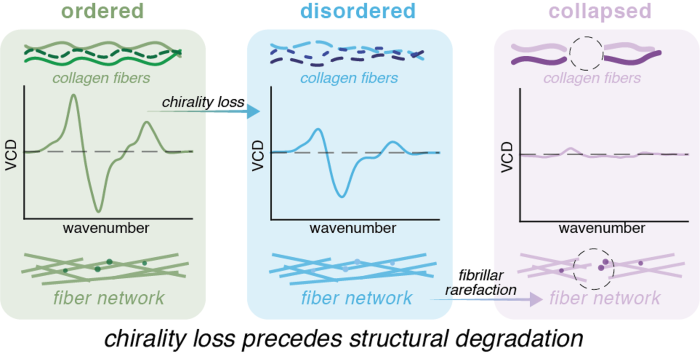
Healthy collagen has a highly ordered microscopic "twist" (chirality) that gives rise to a strong optical signal. As collagen begins to age or deteriorate, this twist is gradually lost long before the fibers themselves start to break apart. Eventually, the collagen network becomes sparse and collapses. This work demonstrates that changes in collagen's molecular organization can reveal tissue deterioration earlier than conventional structural observations. (Ali Haider / Hiroshima University)
“The key message of this paper is that collagen should not be viewed only as a visible fiber network but as a hierarchical material whose function depends on organization across multiple length scales,” said Katsuya Inoue, a professor at WPI-SKCM² who is one of the study’s corresponding authors. “Our study shows that advanced correlative methods can reveal changes in this hidden organization that are not apparent from morphology alone.”
The researchers’ goal is to establish a comprehensive framework that integrates molecular chirality, supramolecular organization, and macroscopic tissue architecture. This could provide insights for medical interventions, wound healing, and biomaterial design, allowing researchers to evaluate tissue integrity before irreversible macroscopic breakdown occurs.
The study was conducted by Ali Haider, Yusuke Kochi, Andrew K. Schulz, Kuya Aoyama, Aiko Sada, Hisako Sato, Elisabetta Matsumoto, Malcolm Kadodwala, Koichi Matsuo, and Katsuya Inoue. The authors represent a multidisciplinary collaboration across Hiroshima University (including WPI-SKCM², the Graduate School of Advanced Science and Engineering, the Chirality Research Center, and the Research Institute for Synchrotron Radiation Science), the Max Planck Institute for Intelligent Systems, Kyushu University, Kumamoto University, Ehime University, the Georgia Institute of Technology, and the University of Glasgow. Together, this collaboration spans Japan, Germany, the United States, and the United Kingdom, bringing together expertise from around the world.
This work was supported by WPI-SKCM², Institut Henri Poincaré, LabEx CARMIN, and the Alexander von Humboldt Foundation.
About the study
- Journal: ACS Nano
- Title: Correlative multimodal framework reveals supramolecular chirality loss preceding fibrillar rarefaction in dermal collagen
- Authors: Ali Haider, Yusuke Kochi, Andrew K. Schulz, Kuya Aoyama, Aiko Sada, Hisako Sato, Elisabetta Matsumoto, Malcolm Kadodwala, Koichi Matsuo & Katsuya Inoue
- DOI: 10.1021/acsnano.6c06602
Media Contact