Home
HomeInquiries on the correspondence article
Fumito Maruyama
Professor
The IDEC Institute, Hiroshima University
E-mail: fumito * hiroshima-u.ac.jp
(Note: Please replace * with @)
Inquiries on the story
Hiroshima University Public Relations Office
E-mail: koho * office.hiroshima-u.ac.jp
(Note: Please replace * with @)
Airborne genetic material could transform biodiversity and biosecurity monitoring, but researchers say major gaps in sampling, interpretation, and governance must be closed first before suitable technologies can be deployed.
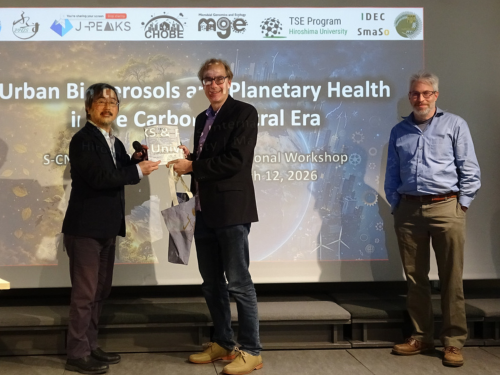
Professor Fumito Maruyama of Hiroshima University presents a certificate of appreciation to Professor Stephan C. Schuster (center) of Nanyang Technological University during the "Urban Bioaerosols and Planetary Health in the Carbon-Neutral Era” international workshop held at Hiroshima University’s Phoenix International Center MIRAI CREA on March 12, 2026. Professor Stefan J. Green of Rush University Medical Center stands on the right. (Yue Yin/Hiroshima University)
The air around us is filled with genetic traces from plants, animals, microbes, and people. Scientists increasingly hope to use this airborne DNA to monitor ecosystems, detect biological threats, and track pathogens without having to capture the organisms themselves.
But finding DNA in the air does not necessarily reveal what is alive, active, or dangerous.
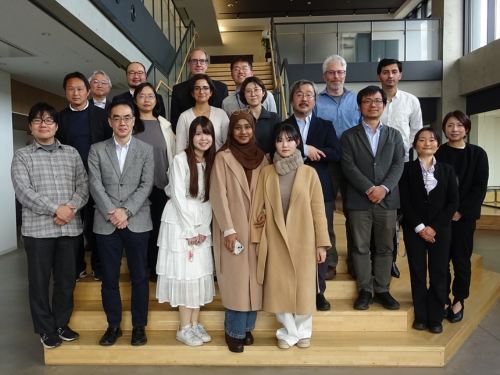
Speakers and participants of the "Urban Bioaerosols and Planetary Health in the Carbon-Neutral Era" international workshop. The event brought together researchers from Asia, Europe, and the USA, including the authors of the Nature correspondence. (Yue Yin/Hiroshima University)
In a correspondence article published in Nature, Fumito Maruyama, professor at Hiroshima University’s The IDEC Institute, and an international group of researchers identify three unresolved gaps in sampling, interpretation, and governance.
They argue that these must be addressed before suitable airborne DNA monitoring technologies can be reliably deployed in real-world surveillance.
The correspondence was authored by Maruyama; Naomichi Yamamoto of Seoul National University, South Korea; Stefan J. Green of Rush University Medical Center, USA; and Stephan C. Schuster of Nanyang Technological University, Singapore.
About the correspondence article
Journal: Nature
Title: Airborne DNA can yield insights with the right techniques
Authors: Fumito Maruyama, Naomichi Yamamoto, Stefan J. Green & Stephan C. Schuster
DOI: 10.1038/d41586-026-01604-7
Media Contact