Home
E-mail: koho * office.hiroshima-u.ac.jp
(Please replace * with @)
HU graduate student supports medical teams in Gaza as part of JICA’s Information Management Team deployed to WHO Regional Office for the Eastern Mediterranean
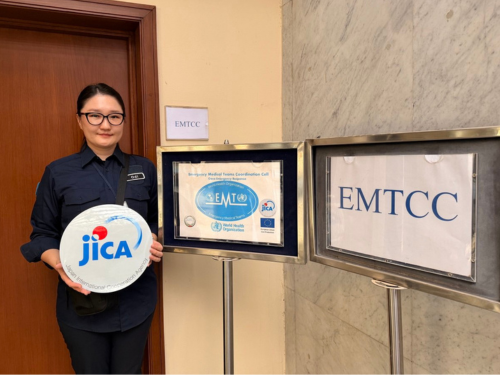
(Oyundari Batsaikhan)
As the humanitarian crisis in Gaza continues, severe disruption to healthcare systems and shortages of medical resources have created an urgent need to support Emergency Medical Teams (EMTs) working on the ground. For more than two years, the Japan International Cooperation Agency (JICA) has contributed to the response by providing remote medical data management support in collaboration with the World Health Organization (WHO). Professor Tatsuhiko Kubo and other members of Hiroshima University’s Graduate School of Biomedical and Health Sciences are contributing to this initiative.
In January 2026, Oyundari Batsaikhan, then a fourth-year PhD student from Mongolia at Hiroshima University’s Graduate School of Biomedical and Health Sciences, was dispatched to Cairo, Egypt, as part of JICA’s Information Management Team supporting the response to the Gaza crisis. Looking back, she reflects on how she found herself working at the heart of an international humanitarian effort. In this interview, she shares her experience at the WHO Regional Office for the Eastern Mediterranean (EMRO), reflects on her doctoral studies and research at Hiroshima University, and discusses her future goals.
*Oyundari earned her PhD from Hiroshima University in September 2026 and now works as a researcher in the university’s Department of Public Health and Health Policy while continuing to support the humanitarian response in Gaza.
Why did you decide to study at Hiroshima University?
I was born into a family of doctors, including both my parents and grandparents, so medicine was a very familiar part of my life from an early age. Even before kindergarten, I remember role-playing as a doctor and imagining that I would become one myself someday. As I grew older and considered my own professional path, I decided to pursue dentistry at the Mongolian National University of Medical Sciences, then I began my career in clinical practice.
While working in a clinical setting, I saw many patients seeking treatment for conditions that might have been prevented, as awareness and practice of disease prevention were limited. As a clinician, I could help one patient at a time, but I realized that public health can improve the health of entire populations through prevention, health promotion, effective programs, and evidence-based policies.
This realization inspired me to pursue a Master of Public Health at the University of Missouri in the United States, where I could experience a different academic and public health environment.
After earning my master’s degree, I returned to Mongolia and gained experience at several institutions, including the WHO Country Office, the Ministry of Health, and the National Center for Public Health.
Building on my clinical and public health experience, I wanted to further strengthen my research skills and contribute meaningfully to improving population health. I was fortunate to receive a scholarship from the Ministry of Education, Culture, Sports, Science and Technology (MEXT) to study for my PhD at Hiroshima University. I was particularly drawn to the university’s international academic environment and the opportunity to study under distinguished faculty. I was also moved by Hiroshima’s unique history of peace and resilience.
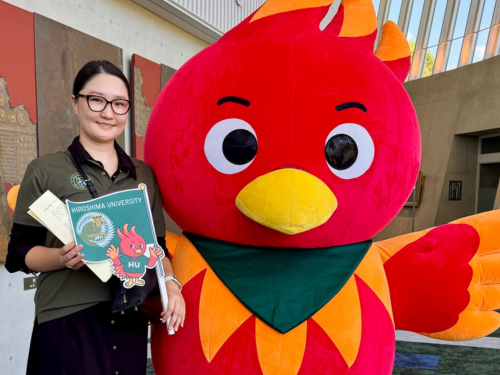
At the Entrance Ceremony with Heroty!
Could you tell us about your research at Hiroshima University?
I enrolled in 2022 and have been involved in several public health research projects under the supervision of Professor Tatsuhiko Kubo and Associate Professor Odgerel Chimed-Ochir.
I have published a paper on the burden of liver cancer and its attributable causes in Mongolia using data from the Global Burden of Disease (GBD) study, a large-scale international research program that measures health loss caused by diseases, injuries, and risk factors worldwide. My research has since expanded to occupational mental health, and with support from a grant-in-aid for Scientific Research (KAKENHI). I recently completed an international collaborative study on occupational stress and presenteeism among healthcare workers in Mongolia.
Within my department, I have also been involved in other studies on disease burden, occupational health, mental health, COVID-19, and emergency medicine.
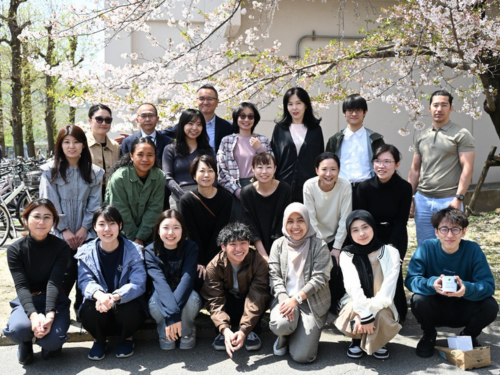
Cherry blossom season at Kasumi Campus with fellow lab members!
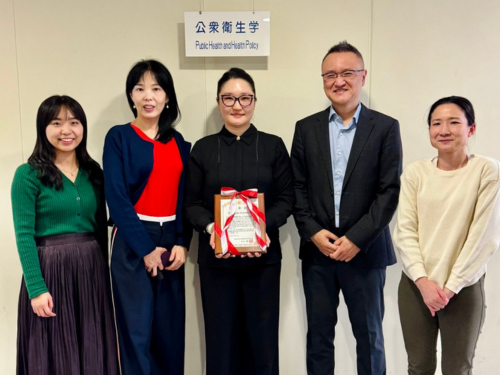
Oyundari received the 2025 Dean’s Award from the Graduate School of Biomedical and Health Sciences
Hiroshima University’s support for medical data management in Gaza
The prolonged humanitarian crisis in Gaza has severely disrupted the healthcare system, creating an urgent need to support EMTs working on the ground. In response, JICA, in collaboration with WHO, has provided remote support for medical data management and coordination.
In humanitarian crises, limited medical resources need to be allocated appropriately. This requires accurate information on patient numbers and conditions, the availability of medical services, and local healthcare needs, as well as effective information-sharing among the organizations involved.
EMTs on the ground report this information to the WHO EMT Coordination Cell (EMTCC) through the Minimum Data Set (MDS), a standardized reporting system. However, because they work under extremely demanding conditions, their reports may be incomplete or submitted as photographs of handwritten forms. The data then needs to be entered, organized, cleaned, verified, and consolidated into a central database.
Since 2023, public health and health policy students at Hiroshima University have supported this work as part of JICA’s expert team under the guidance of Professor Kubo, helping to organize and verify the data.
Also read: HU professor heads team dispatched to Egypt for emergency medical support in Palestine
As conditions on the ground and the operational structure of the EMTCC continued to evolve, some aspects of the situation became difficult to fully understand through remote support alone. The in-person dispatch to Cairo provided an opportunity to discuss these operational challenges directly with WHO and other team members and identify areas for improvement.
The Assignment in Cairo
In January 2026, I was dispatched for five days to WHO EMRO in Cairo as a member of JICA’s Information Management Team. For safety reasons, we did not travel to Gaza. Instead, we worked from Cairo, collaborating with other team members there and coordinating remotely with colleagues in Gaza.
Our team consisted of five members: two medical doctors, a logistics specialist, a JICA specialist, and me. Together, the team brought extensive experience in disaster and emergency response, with several members registered with the Japan Disaster Relief (JDR) team.
The main goal of the mission was to support the implementation of the MDS. During our time in Cairo, we discussed data flows, information management processes, and operational challenges that had come up. Together, we identified ways to address these issues, including revising the data items in the MDS tool.
In addition, a health and safety survey was being conducted among EMTs working in Gaza, with Hiroshima University playing a central role in the project. The survey gathered information about the health of medical team members and their safety concerns. During the mission, one of my main roles was to share the preliminary findings from the first phase of the survey with colleagues at WHO EMRO and members of our team.
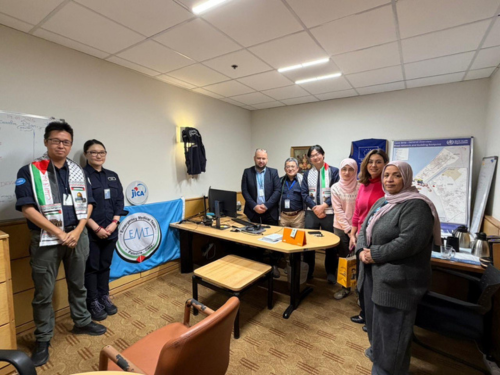
EMTCC members based at WHO EMRO
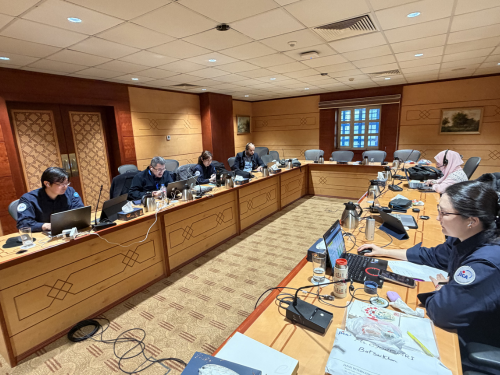
EMTCC meeting
Working together in a humanitarian crisis
I was the first non-Japanese member to participate in the dispatch of the Information Management Team. At first, I was unsure whether I would be able to contribute while working alongside such experienced professionals. However, the other team members welcomed me warmly and supported me, which allowed me to remain calm and carry out my role.
This experience reinforced for me the importance of international cooperation in humanitarian crises. I was already familiar with its value through my previous professional experience, classes, and research, but seeing experts from different countries and organizations work together in response to an urgent humanitarian situation gave me a deeper appreciation of how such collaboration works in practice.
This mission also highlighted the critical role of reliable data in supporting response efforts and informing decisions about how best to deliver assistance to those in need. Seeing this firsthand further strengthened my commitment to contributing to global health and humanitarian assistance.
Applying my experience at Hiroshima University to global health challenges
What I particularly value about studying at Hiroshima University is the close connection between research and real-world health challenges. The PhD program has given me opportunities to build on my previous experience while developing more advanced research and academic skills and applying them to a range of public health and global health issues.
Going forward, I hope to draw on the knowledge and experience I have gained in clinical practice, public health, policy, and research to help strengthen public health systems and improve global health.
To those who are interested in studying at Hiroshima University, I encourage you to stay curious and approach a variety of opportunities with a positive attitude. Sometimes, opportunities outside your immediate area of research can broaden your perspective and contribute to your professional development.
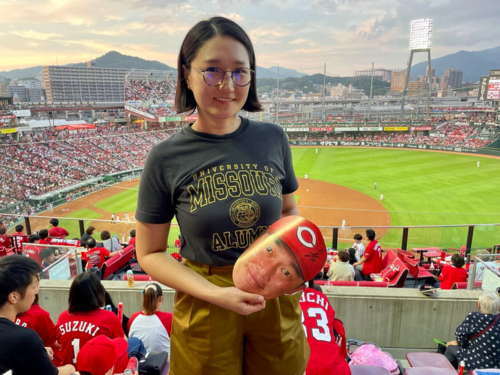
Cheering on the Hiroshima Toyo Carp, Hiroshima’s beloved local baseball team!
Interview: Public Relations Office A (March 2026)
[Inquiries]
Hiroshima University Public Relations Office