To the point:
- Machine learning reveals distinct predatory behavioral states in a microscopic worm.
- Two opposing brain chemicals, octopamine and tyramine, determine whether the worm attacks or stays passive.
- Evolution repurposed specific sensory neurons to enable this aggressive hunting strategy.
- Changes in neuromodulatory circuits, rather than new neurons, gave rise to predatory aggression in this lineage.
- The study, published in Nature, shows how changes in neuromodulatory circuits enabled the evolution of predatory aggression in nematodes.
A new window into the evolution of complex behavior
Aggression is widespread across the animal kingdom, yet how complex behaviors evolve at the molecular and neural level remains poorly understood. A research team led by the Max Planck Institute for Neurobiology of Behavior, and included Hiroshima University Associate Professor Misako Okumura as a collaborating researcher, has now identified the neural adaptations that enabled predatory aggression to emerge in a group of nematodes. Their study reveals that changes in noradrenergic signaling, specifically in how sensory neurons respond to the neuromodulators octopamine and tyramine, gave rise to a new behavioral repertoire associated with predation.
From grazers to predators: two worm cousins compared
Predatory behavior in nematodes is strikingly diverse. While Caenorhabditis elegans is a harmless bacterial feeder, its relative Pristionchus pacificus possesses teeth-like structures that allow it to bite and attack prey. Yet not every encounter leads to an attack, suggesting that predation is regulated by factors that could include both environmental conditions as well as internal states.
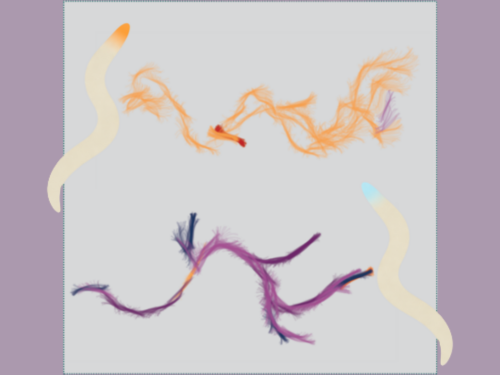
To uncover these states, the team recorded hundreds of hours of worm behavior and used a machine learning model to identify consistent behavioral patterns. The analysis revealed six distinct behavioral states, including three predation-specific ones: predatory search, predatory biting and predatory feeding.
Leonard Böger, co-first author, explains: “It was really exciting to see these three behavioral states emerge from the data. This not only showed us that aggression in P. pacificus is real, but also how it manifests through these three intuitive behavioral components: searching, biting and feeding. An impressive set of novel behaviors, given how similar its brain is to that of C. elegans.”
Two neuromodulators create a behavioral switch
With this behavioral framework established, the researchers turned to the underlying neural mechanisms. They found that octopamine strongly promotes transitions into aggressive predatory states, while tyramine counteracts this drive and pulls the animal back into a passive mode.
Mutants unable to produce octopamine showed drastically reduced predatory biting. This phenotype could be rescued when tyramine was simultaneously removed. Conversely, adding octopamine externally restored aggressive behavior. These findings show that the balance between these two neuromodulators regulates whether the animal enters an aggressive or a passive state.
Güniz Göze Eren, co-first author, says: “What struck me most was how strongly octopamine pushed the worms into predatory behavior and how effectively tyramine could suppress it. That push-and-pull mechanism suddenly made the entire system clear to me.”
Evolution repurposed sensory circuits
The team discovered that this neuromodulatory system acts on sensory neurons whose identity and function have diverged across nematode evolution. In P. pacificus, octopamine and tyramine receptors are localized to specific head sensory neurons, most notably the IL2 and OL neurons, which do not express these receptors in C. elegans.
Silencing IL2 neurons disrupted the animals' ability to perform predatory attacks. This indicates that sensory circuits were repurposed to detect prey and trigger aggression.
A conserved mechanism across predatory species
The researchers then examined a second predatory species, Allodiplogaster sudhausi, and found that octopamine promotes predatory aggression there as well. This suggests that the noradrenergic innovation regulating aggression arose early in the evolution of the nematode lineage.
Small changes, big behavioral consequences
Together, the study shows how relatively small molecular and cellular changes can produce major shifts in behavior. Instead of adding new neurons, the location where neuromodulatory signals are received was modified across evolution. These changes enabled the emergence of a complex aggressive hunting strategy.
This article is adapted from a press release originally published by the Max Planck Institute for Neurobiology of Behavior — caesar.

 Home
Home