Home
HomeInquiries on the study
Fumito Maruyama
Professor
The IDEC Institute, Hiroshima University
E-mail: fumito * hiroshima-u.ac.jp
(Note: Please replace * with @)
Inquiries on the story
Hiroshima University Public Relations Office
E-mail: koho * office.hiroshima-u.ac.jp
(Note: Please replace * with @)
A review finds that antibiotic resistance genes—capable of undermining modern medicine—can travel through the air across both cities and farmland, and argues that airborne spread represents an overlooked public health risk.
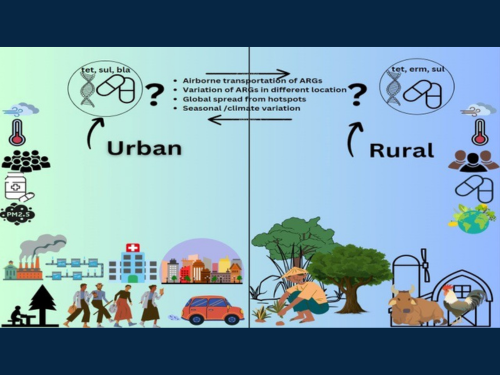
Researchers describe the air as an invisible library of antibiotic resistance genes that circulate silently between humans, animals, and the environment. (Fumito Maruyama/Hiroshima University)
The air we breathe serves as a silent vector of antimicrobial resistance, calling for the need to integrate air monitoring into global public health strategies, according to a review by an international team of researchers.
While the fight against antimicrobial resistance (AMR) has traditionally focused on soil, water, and clinical settings, new research highlights that the air resistome—the collection of antibiotic resistance genes (ARGs) found in the atmosphere—is a critical but overlooked pathway for transmission.
ARGs can spread both on their own and through microorganisms that carry them. Urban environments often carry a high diversity of these genes due to dense human activity and wastewater infrastructure. However, even rural air, thought to be “cleaner”, harbors ARGs linked to agricultural practices, such as livestock farming, manure and sludge application, wastewater treatment plants, composting facilities, and aquaculture, the researchers explained. “This means every breath we take can potentially connect us to the global challenge of antimicrobial resistance,” said Professor Fumito Maruyama at Hiroshima University’s The IDEC Institute, who led the team.
In a review published in Critical Reviews in Environmental Science and Technology, the research team has examined how ARGs are distributed across different environments.
The team found that urban pollution and infrastructure shape the air microbiome, releasing clinically relevant ARGs—the kind most likely to reduce the effectiveness of medical treatments—into the air. In rural areas, the air resistome changes with the seasons because it is tied to the timing of specific agricultural tasks. For example, when farmers apply manure as fertilizer or manage large groups of livestock, they inadvertently release different sets of resistance genes into the air.
The researchers describe the air as an invisible library of ARGs that circulate silently between humans, animals, and the environment. By recognizing air as a key reservoir, scientists can begin to design more effective preventive strategies. Currently, the lack of standardized monitoring systems across different regions and seasons makes it difficult to assess the full scale of the risk. The researchers emphasize that understanding these airborne patterns is essential for strengthening global AMR control frameworks.
Moving forward, the team aims to establish standardized surveillance systems to track the air resistome across various cities and rural landscapes. The ultimate goal is to ensure that international health policies consider this atmospheric transmission route alongside waterborne and soil-borne routes. By integrating air monitoring into global strategies, policymakers can better protect public health from hidden environmental risks.
The research team also includes Salametu Saibu of Lagos State University, Nigeria; Kyoko Yarimizu, Ishara Uhanie Perera, Yin Yue, and So Fujiyoshi of Hiroshima University, Japan; Sofya Pozdniakova of the Barcelona Institute for Global Health, Spain; Pierre Amato of CNRS–Université Clermont Auvergne, France; and Naomichi Yamamoto and Florent Rossi of Seoul National University, South Korea. Perera is also affiliated with Yamaguchi University, Japan, while Rossi and Fujiyoshi are additionally affiliated with Université du Québec à Chicoutimi, Canada. Fujiyoshi is also affiliated with Toyama Prefectural University, Japan.
About the study
Journal: Critical Reviews in Environmental Science and Technology
Title: Air Resistome in Urban and Rural Environments – Review
Authors: Salametu Saibu, Kyoko Yarimizu, Ishara Uhanie Perera, Sofya Pozdniakova, Pierre Amato, Naomichi Yamamoto, Florent Rossi, Yin Yue, So Fujiyoshi & Fumito Maruyama
DOI: 10.1080/10643389.2026.2646509
Media Contact