Home
HomeInquiries on the study
Masahiro Nakamori
Lecturer
Graduate School of Biomedical and Health Sciences, Hiroshima University
E-mail: mnakamo * hiroshima-u.ac.jp
(Note: Please replace * with @)
Inquiries on the story
Hiroshima University Public Relations Office
E-mail: koho * office.hiroshima-u.ac.jp
(Note: Please replace * with @)
A large-scale study of more than 31,000 patients found pneumonia occurred more often after breathing tubes were removed than during ventilation. Researchers say the condition, tied to swallowing dysfunction, should be recognized as a distinct clinical entity—one that may be preventable with early intervention.
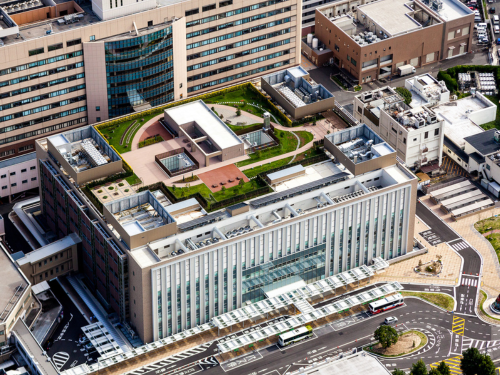
Hiroshima University Hospital. Analyzing records of over 31,000 patients, Hiroshima University researchers identified post-extubation pneumonia as a distinct clinical entity rather than a routine postoperative complication. (Hiroshima University Public Relations Office)
A Hiroshima University study of more than 31,000 patients found that pneumonia occurred more often after breathing tubes were removed than during ventilation, with most cases developing within a 1–2 week window after surgery. The findings suggest this underrecognized condition may be a distinct clinical entity linked to swallowing dysfunction—and that early assessment and intervention, including identification of high-risk patients, may be key to prevention and improved outcomes.
Pneumonia that develops after removal of an endotracheal tube can significantly affect recovery and quality of life. While mechanical ventilation to support breathing is a common and life-saving procedure in both emergency and elective surgeries under general anesthesia, some patients experience difficulty swallowing after extubation. This can lead to aspiration—when food or liquids enter the airway—resulting in pneumonia that may require antibiotic treatment.
In the study, conducted at Hiroshima University Hospital in Hiroshima, Japan, assistant head nurse Junko Hirayama, lecturer Masahiro Nakamori of the Graduate School of Biomedical and Health Sciences, and colleagues examined the incidence of post-extubation pneumonia (PEP) in non-emergency surgeries, identified high-risk patient characteristics, and compared PEP with ventilator-associated pneumonia (VAP), which develops during mechanical ventilation.
Analyzing records between 2016 and 2023, the team found that 212 patients (0.67%) developed pneumonia after breathing tube removal, compared with 27 cases of VAP. The researchers identified PEP as a distinct clinical entity rather than a routine postoperative complication. The paper was published on March 16 in Scientific Reports.
Age, sex, and BMI are risk factors
Patients who developed PEP tended to be older than those who did not. Men had a 65% higher risk than women, while patients with a low body mass index (BMI <18.5) or impaired consciousness were also at significantly higher risk.
The likelihood of pneumonia was elevated across a wide range of procedures—not only head and neck surgery, but also gastrointestinal, respiratory, cardiovascular, and orthopedic operations—suggesting PEP risk should be recognized across all types of surgery.
Potential for prevention
The study highlights the impact of PEP on postoperative recovery and quality of life.
“Of particular concern was that these patients were originally admitted with the expectation of improvement through surgery, yet their health status worsened due to complications,” said Hirayama.
Nakamori emphasized that PEP may be preventable.
“We believe that early assessment and intervention focusing on swallowing function by a multidisciplinary team—including physicians, dentists, nurses, pharmacists, dietitians, dental hygienists, and rehabilitation professionals—are essential for improving clinical outcomes,” he stated.
About the study
- Journal: Scientific Reports
- Title: Risk factors for postextubation pneumonia using diagnosis procedure combination and claims data in Japan
- Authors: Junko Hirayama, Masahiro Nakamori, Akihiro Matsumoto, Sanmei Chen, Kohei Yoshikawa, Yasushi Horimasu, Kohei Ota, Hirotsugu Miyoshi, Yoko Shimpuku & Yoko Sato
- DOI: 10.1038/s41598-026-44666-3
Media Contact