Home
HomeInquiries on the study
Hanae Inami
Associate Professor
Hiroshima Astrophysical Science Center
E-mail: hanae * hiroshima-u.ac.jp
(Note: Please replace * with @)
Inquiries on the story
Hiroshima University Public Relations Office
E-mail: koho * office.hiroshima-u.ac.jp
(Note: Please replace * with @)
NSF VLA and ALMA observations detect enormous cold molecular gas reserves in a distant galaxy seen 13 billion years ago, a study involving Hiroshima University reports.
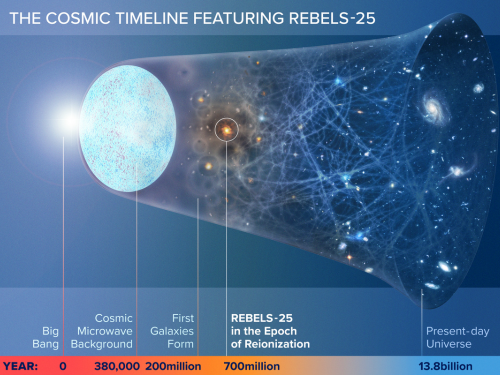
This illustration traces the universe’s evolution from the Big Bang to the present day, highlighting REBELS-25, a very distant galaxy seen during the Epoch of Reionization 13 billion years ago. New deep observations with the NSF VLA and ALMA reveal that REBELS-25 already had an enormous reservoir of cool molecular gas—the direct fuel for star formation—when the universe was just 700 million years old. (NSF/AUI/NSF NRAO/M.Weiss)
Astronomers have discovered a huge reservoir of cold molecular gas, the direct fuel for star formation, in REBELS-25, a massive, star-forming galaxy.
The team, led from Leiden University, focused on REBELS-25, seen when the universe was only about 700 million years old, around 5% of its current age. Astronomers use "redshift" to describe this distance, which measures how much the universe's expansion has stretched a galaxy's light to redder wavelengths. The higher the redshift, the farther back in time we look. REBELS-25 sits at redshift z=7.3, deep in the Epoch of Reionization, a key era in which the first stars and galaxies transformed the dark, neutral universe into the universe we see around us today.
Galaxies grow by turning gas into stars and cold molecular gas is the primary fuel. Until now, astronomers suspected early bright, massive galaxies had huge gas supplies, but no one had directly detected them at these distances.
The scientists used the U.S. National Science Foundation Very Large Array (NSF VLA), a radio telescope in Socorro County, New Mexico, as well as data from the Atacama Large Millimeter/submillimeter Array (ALMA) in the Chilean Andes. The NSF VLA searched for faint radio emission from carbon monoxide (CO) molecules, which emit at specific frequencies tracing cosmic molecular gas.
The NSF VLA observations revealed emission from a specific CO line tracing cool gas, constituting the most distant low-energy CO detection in the universe to date. The brightness of the signal suggests that REBELS-25 had a very large supply of star-forming material already when the universe was very young. ALMA's higher-energy CO data, combined with NSF VLA results, then constrained the gas's density and temperature under early universe conditions.
Detecting faint low-energy CO lines so far back in cosmic history is challenging. The cosmic microwave background (CMB), which constitutes the relic radiation from shortly after the Big Bang, acts as a background against which this emission must be detected. While this effect is present at all cosmic epochs, the CMB becomes significantly brighter at high redshift, reducing the contrast of cold gas emission and making such observations increasingly difficult. Because the impact of the CMB depends on the physical conditions within a galaxy, astronomers were uncertain about how detectable cold molecular gas would be in the earliest systems.
"Our results show galaxies just 700 million years after the Big Bang already contained large reservoirs of cold gas available for star formation," said Karin Cescon, PhD student at Leiden University and lead author. "With these deep NSF VLA observations, we were able to overcome the observational challenges posed by the CMB." This shows that, with the right telescopes, astronomers can see cool molecular gas deep into the Epoch of Reionization.
"Recent observations suggest that galaxies in the early universe grew much faster than we once thought," said co-author Hanae Inami, associate professor at the Hiroshima Astrophysical Science Center at Hiroshima University, Japan. "Our discovery adds new evidence for this picture and opens the door to understanding how these early galaxies formed stars so efficiently. Was it simply because they contained large reservoirs of fuel, or were other physical mechanisms at work that enabled rapid star formation?"
Their paper was published on June 11 in the Monthly Notices of the Royal Astronomical Society.
These results provide key insight into how the first galaxies became so massive so quickly after the Big Bang. By detecting the star-forming fuel itself, astronomers can now measure the gas driving this rapid growth rather than infer it indirectly. REBELS-25's large gas mass shows some early galaxies were already primed for intense star formation, which is a key step in understanding mass assembly in the universe's first billion years.
This success foreshadows the Next-Generation Very Large Array (ngVLA), a planned National Radio Astronomy Observatory telescope that includes antennas throughout New Mexico, west Texas, eastern Arizona, northern Mexico, and across North America. The ngVLA will make these measurements ~10 times faster, enabling detections for much larger samples of early galaxies, moving beyond individual bright case studies.
Where REBELS-25 may be the "tip of the iceberg," ngVLA will study fainter and more distant systems. Paired with ALMA, it will be able to map how galaxies gathered fuel and grew during cosmic dawn.
"This NSF VLA detection is an exciting sneak peek of what’s to come with the ngVLA," noted Cescon’s PhD advisor, Professor Jacqueline Hodge, who is also part of the research team. "The ngVLA will allow us to find and study cool gas in many more young galaxies, including those at even earlier times. This will be crucial for understanding how the first galaxies formed and grew."
Other members of the research team include Leindert Boogaard, Lucie Rowland, Rychard Bouwens, Paul van der Werf, Pavel Mancera Piña, Matus Rybak, and Sander Schouws of Leiden University, the Netherlands; Hiddo Algera of the Institute of Astronomy and Astrophysics, Academia Sinica, Taiwan; Dominik Riechers of the University of Cologne, Germany; Renske Smit of Liverpool John Moores University, the United Kingdom; Ilse De Looze of Ghent University, Belgium; Manuel Aravena of Universidad Diego Portales and the Millennium Nucleus for Galaxies, Chile; Elisabete da Cunha of the University of Western Australia and the ARC Centre of Excellence for All Sky Astrophysics in 3 Dimensions (ASTRO 3D), Australia; Pratika Dayal of the University of Toronto, Canada; Andrea Ferrara of Scuola Normale Superiore, Italy; Rebecca Fisher of the University of Manchester, the United Kingdom; Hanae Inami of Hiroshima University, Japan; Pascal Oesch of the University of Geneva, Switzerland, and the University of Copenhagen, Denmark; Andrea Pallottini of the University of Pisa, Italy; Laura Sommovigo of Columbia University and the Flatiron Institute, United States; Mauro Stefanon of the University of Valencia, Spain; and Livia Vallini of the Osservatorio di Astrofisica e Scienza dello Spazio, Italy.
This article is adapted from a press release originally published by the National Radio Astronomy Observatory.
###
About NRAO
The National Radio Astronomy Observatory is a major facility of the U.S. National Science Foundation, operated under cooperative agreement by Associated Universities, Inc.
About ALMA
The Atacama Large Millimeter/submillimeter Array (ALMA), an international astronomy facility, is a partnership of the European Southern Observatory (ESO), the U.S. National Science Foundation (NSF) and the National Institutes of Natural Sciences (NINS) of Japan in cooperation with the Republic of Chile. ALMA is funded by ESO on behalf of its Member States, by NSF in cooperation with the National Research Council of Canada (NRC) and the National Science and Technology Council (NSTC) in Taiwan and by NINS in cooperation with the Academia Sinica (AS) in Taiwan and the Korea Astronomy and Space Science Institute (KASI).
ALMA construction and operations are led by ESO on behalf of its Member States; by the National Radio Astronomy Observatory (NRAO), managed by Associated Universities, Inc. (AUI), on behalf of North America; and by the National Astronomical Observatory of Japan (NAOJ) on behalf of East Asia. The Joint ALMA Observatory (JAO) provides the unified leadership and management of the construction, commissioning and operation of ALMA.
About the study
- Journal: Monthly Notices of the Royal Astronomical Society
- Title: Direct detection of cool molecular gas in a star-forming galaxy at z = 7.31
- Authors: Karin Cescon, Jacqueline A. Hodge, Leindert A. Boogaard, Hiddo S. B. Algera,
Lucie E. Rowland, Dominik A. Riechers, Renske Smit, Ilse De Looze, Rychard Bouwens, Paul van der Werf, Manuel Aravena, Elisabete da Cunha, Pratika Dayal, Andrea Ferrara, Rebecca Fisher, Hanae Inami, Pavel E. Mancera Piña, Pascal A. Oesch, Andrea Pallottini, Matus Rybak, Sander Schouws, Laura Sommovigo, Mauro Stefanon & Livia Vallini - DOI: 10.1093/mnras/stag924
Media Contact