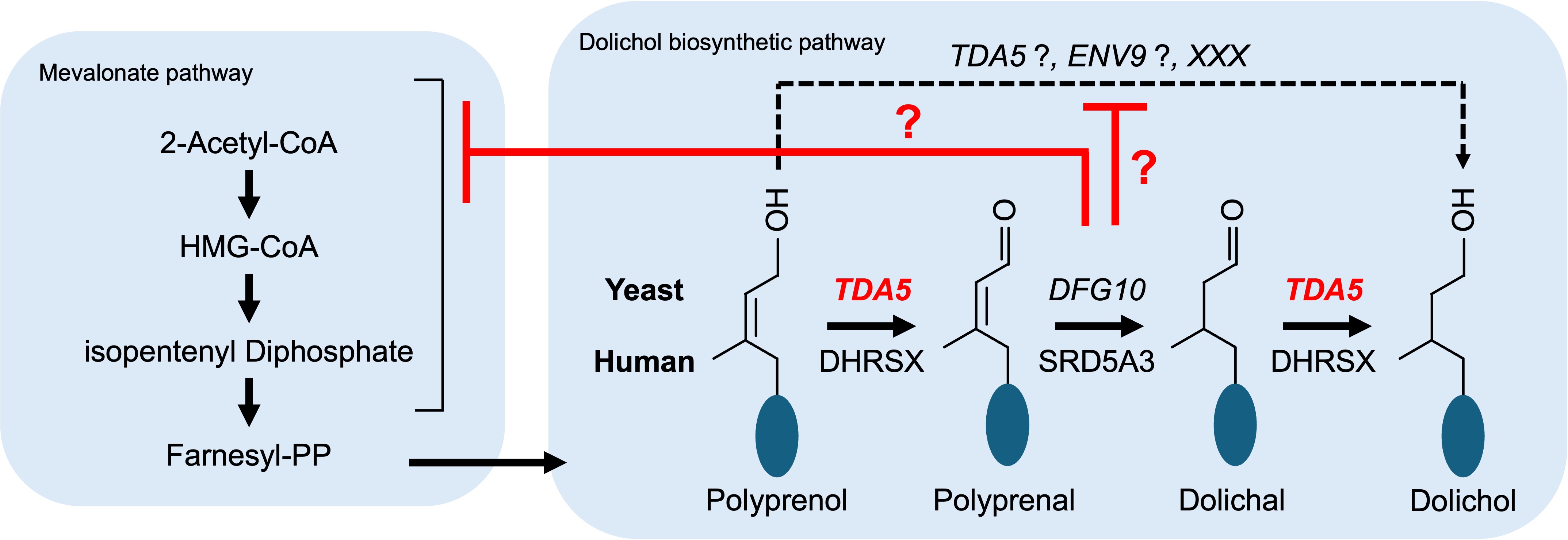
Proposed model for dolichol biosynthesis in budding yeast Saccharomyces cerevisiae. (Kazuki Hanaoka, Kuya Matsunaga, et al. PNAS. May 27, 2026)
Dolichol is an essential lipid in eukaryotic cells. It is required for protein glycosylation, the addition of carbohydrates to proteins. This process is vital for a variety of protein functions. Defects in the synthesis of dolichol lead to congenital disorders of glycosylation (CDGs), a large group of rare genetic disorders which are treatable but incurable.
A research team at Hiroshima University has provided evidence for the evolutionary conservation of a three-step synthesis pathway for dolichol in yeast. This discovery supports the view that multiple dolichol biosynthesis pathways are evolutionarily conserved across eukaryotes.
Their findings were published in the journal PNAS on May 27, 2026.
Dolichol was held to be synthesized by a single-step reduction of polyprenol. The gene encoding the enzyme that catalyzes this reaction is SRD5A3 in humans and DFG10 in budding yeast (Saccharomyces cerevisiae). Research from 2024 revealed that this understanding was incomplete, and a three-step detour pathway for dolichol biosynthesis in humans involving the gene DHRSX was proposed.
As genes corresponding to DHRSX were not identified in yeast, it was unknown if the detour pathway was conserved in yeast and in other eukaryotes, or if it was unique to humans.
The researchers set out to settle the question by focusing on mutation studies of enzymes in yeast belonging to the short-chain dehydrogenase/reductase (SDR) superfamily, to which DHRSX belongs. Of the 13 genes they examined, two genes – TDA5 and ENV9 – were identified as being involved with dolichol biosynthesis, with TDA5 being more directly associated than ENV9.
Further experiments showed that TDA5 serves the same function as DHRSX in yeast; moreover, the role it plays is separate from that of DFG10. Their observations also revealed that TDA5 and DFG10 may be acting in parallel rather than just sequentially.
“What we most want to convey is that the recently proposed 'three-step dolichol biosynthesis bypass pathway’ is not a mechanism unique to humans, but is also conserved in budding yeast, making it a fundamental biological system common to all eukaryotes,” says Kouichi Funato, professor at Hiroshima University’s Graduate School of Integrated Sciences for Life and corresponding author of the paper.
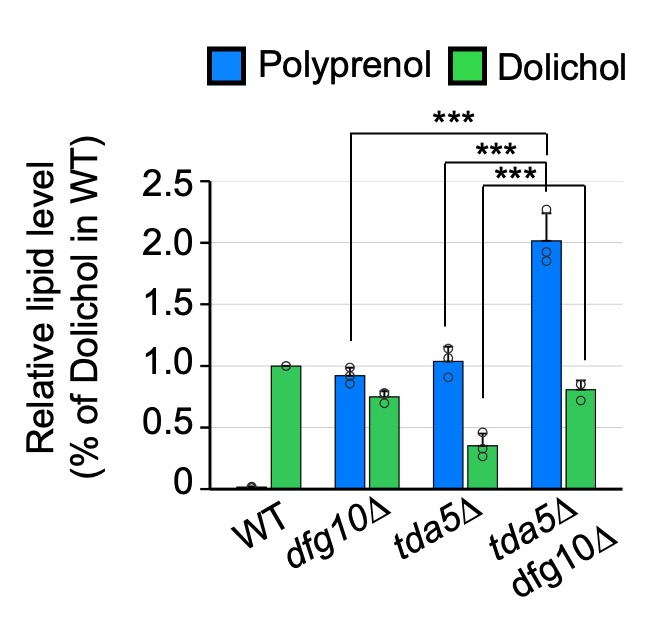
A detailed analysis of dolichol and polyprenol levels in wild-type and mutant yeast was conducted by chromatography. In wild-type yeast, dolichol was predominant, and polyprenol was undetectable. DFG10 deletion mutants showed increased polyprenol levels. TDA5 deletion mutants showed significantly increased polyprenol and severely reduced dolichol levels. Surprisingly, in DFG10-TDA5 double deletion mutants, while polyprenol levels were double that of TDA5 deletion mutants, dolichol levels were also doubled.
Relative dolichol and polyprenol in wild-type, DFG10 deletion mutants, TDA5 deletion mutants and DFG10-TDA5 double deletion mutants. (Kazuki Hanaoka, Kuya Matsunaga, et al. PNAS. May 27, 2026)
“Even when TDA5 and DFG10 were both knocked out simultaneously, dolichol did not completely disappear. This suggests the possibility that cells retain a ‘backup pathway’ separate from the three-step detour pathway that requires TDA5 and DFG10 to support dolichol biosynthesis,” Funato explains.
The next step is to elucidate the nature of this 'alternative pathway’ which is believed to exist independently of the three-step detour pathway. We suspect that this pathway may involve as-yet-unidentified factors”, Funato concludes. “Ultimately, our goal is to elucidate the complete picture of dolichol biosynthesis and lay the groundwork for explaining how abnormalities in glycan modification lead to cellular dysfunction and disease.”
Kazuki Hanaoka, Kuya Matsunaga, Souichirou Shimizu & Soshi Sakai at Hiroshima University; and Harald Pichler at Graz University of Technology and at Austrian Centre of Industrial Biotechnology GmbH contributed to this study. Kazuki Hanaoka and Kuya Matsunaga were joint first authors of the study.
This work was supported by the Japan Society for the Promotion of Science (JSPS) Grants-in-Aid for Scientific Research (KAKENHI; 21K19088).

 Home
Home