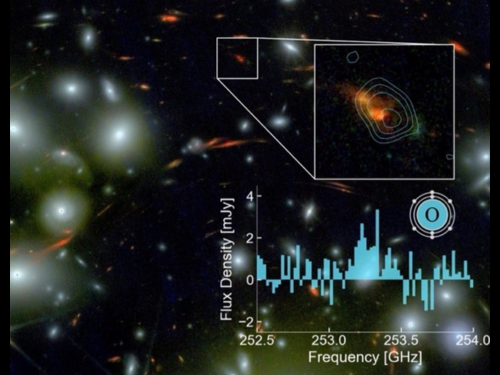
Understanding how galaxies formed requires studying the neutral gas that fueled early star formation, but detecting this component is difficult. In a recent study, an international research team leveraged measurements from the Atacama Large Millimeter/submillimeter Array to detect a direct tracer of neutral gas in star-forming galaxies seen as they were 700 to 800 million years after the Big Bang, enabling detailed analysis of their star-forming conditions.
A look into the deep past of our Universe
A1689-zD1, a galaxy seen 700 million years after the Big Bang (background), with the ALMA-detected [O I] line shown as contours and a spectrum. This is one of four galaxies studied in this paper. (Credit: Assistant Professor Yoshinobu Fudamoto from Chiba University, Japan)
In the early Universe, the first galaxies began to take shape roughly million years after the Big Bang. Within these young systems, stars formed from vast reservoirs of cold gas, gradually building the structures we see in the cosmos today. Understanding this star-forming gas is key to explaining how galaxies grew, but directly tracing its neutral component has remained challenging, especially at great distances. In this study, the researchers overcome this challenge by detecting the [O I] 145 µm emission line, a direct tracer of neutral gas, enabling detailed investigation of star-forming conditions in early galaxies.
Despite its importance, neutral gas has remained difficult to study. Modern telescopes, such as the James Webb Space Telescope (JWST) and the Hubble Space Telescope (HST), can observe stars and hot gas in distant galaxies with remarkable clarity. However, they cannot directly detect the neutral gas that feeds star formation. To overcome this challenge, the researchers targeted the [O I] 145 µm emission line, a direct tracer of neutral gas that provides a clearer view of star-forming material within galaxies. In contrast, commonly used signals, such as the [C II] emission line, can originate from both neutral and ionized regions, making them harder to interpret. By also analyzing the [N II] emission line, which traces only ionized gas, the team was able to disentangle these contributions and isolate the neutral gas component.
Now, an international research team led by Assistant Professor Yoshinobu Fudamoto and Professor Masamune Oguri from the Center for Frontier Science, Chiba University, Japan, has addressed this challenge. Their study, which will be published in the Astrophysical Journal on June 15, 2026, reports new observations of distant galaxies using the Atacama Large Millimeter/submillimeter Array (ALMA). Members of the team included Dr. Akio K. Inoue from the Waseda Research Institute for Science and Engineering, Waseda University, Japan, Dr. Hanae Inami from Hiroshima Astrophysical Science Center, Hiroshima University, Japan, and Dr. Takuya Hashimoto from Tomonaga Center for the History of the Universe (TCHoU), University of Tsukuba, Japan.
The team targeted four typical star-forming galaxies seen as they were about 700 to 800 million years after the Big Bang. Using ALMA, the researchers detected the [O I] 145 µm emission line in all four galaxies. This signal, emitted by neutral oxygen atoms, serves as a clear tracer of the neutral gas. By combining these observations with data from JWST, the team was able to analyze the physical and chemical conditions of this star-forming material in unprecedented detail for such distant galaxies.
To support this analysis, the team also examined the [N II] 205 µm emission line, which traces only ionized gas. Its weak or absent signal indicates that most of the emission in these galaxies arises from neutral gas. This comparison further strengthens the interpretation of the [O I] detection and helps clarify the origin of previously observed signals such as [C II], placing them in the context of the galaxies’ star-forming reservoirs. "Our results represent the most distant direct detection of neutral gas in typical star-forming galaxies to date," remarks Dr. Fudamoto. "This analysis unlocks the wealth of existing [C II] observations as a probe of neutral gas in the early Universe."
The team also used the [O I] and [C II] detections together to model the physical conditions in the neutral gas. They found that gas densities were very high, even comparable to those in starburst galaxies, which are among the most vigorously star-forming systems known. However, the intensity of the radiation field was moderately lower than in starburst galaxies. This paints a picture of early galaxies as compact and dense sites of star formation.
"The story of galaxy evolution is ultimately a story about gas: how it cools, collapses, and forms stars. These observations reveal a key part of that process in the distant Universe. It is very exciting that we can now investigate these internal conditions of galaxies that existed when the Universe was still in its infancy,” said co-author Hanae Inami, associate professor at the Hiroshima Astrophysical Science Center at Hiroshima University, Japan.
Overall, the researchers showcased how observations made using instruments like ALMA can shed light on key details about the history of the Universe. "Our work establishes the [O I] emission line as an effective tool for studying an elusive gas component in the early Universe, opening a new window onto the 'fuel' behind star formation," remarks co-author Akio Inoue from the Waseda Research Institute for Science and Engineering at Waseda University, Japan.
Looking ahead, Dr. Fudamoto adds: "We plan to extend these observations to a larger sample of galaxies and, by combining ALMA with JWST and other facilities, build a comprehensive picture of how galaxies formed and evolved from the cosmic dawn to the present day. Basic research of this kind addresses one of humanity's most fundamental questions, namely how the Universe and our own Milky Way came to be what it is today."
This article is adapted from a joint press release with Chiba University.
Yoshinobu Fudamoto, Yuma Sugahara, and Akio K. Inoue acknowledge support from NAOJ ALMA Scientific Research Grant number 2020-16B. This work was supported by JSPS KAKENHI Grant Numbers JP22K21349 and JP23K13149. Pratika Dayal acknowledges support from the NWO grant 016.VIDI.189.162 ("ODIN") and from the European Commission's and University of Groningen's CO-FUND Rosalind Franklin program. Hanae Inami and HSBA acknowledge support from the NAOJ ALMA Scientific Research Grant Code 2021-19A. Hanae Inami acknowledges support from JSPS KAKENHI Grant Number JP19K23462. Rebecca A. A. Bowler acknowledges support from an STFC Ernest Rutherford Fellowship [grant number ST/T003596/1]. Seiji Fujimoto acknowledges the funding from NASA through the NASA Hubble Fellowship grant #HST-HF2-51505.001-A awarded by the Space Telescope Science Institute, which is operated by the Association of Universities for Research in Astronomy, Incorporated, under NASA contract NAS5-26555. Manuel Aravena is supported by FONDECYT grant number 1252054 and gratefully acknowledges support from ANID Basal Project FB210003 and ANID MILENIO NCN2024 112.

 Home
Home