The pandemic may have faded from daily headlines, but its effects on everyday well-being appear far from over. By analyzing surveys conducted across Japan in 2017, 2020, and 2024, researchers found a continuing nationwide decline in health-related quality of life, particularly among the working-age population. (Pexels)
The COVID-19 pandemic upended many aspects of everyday life, including socialization, office work, and medical care, but little data was available to quantify how those changes affected quality of life both during the pandemic and over the long term, particularly on a national scale.
Researchers from Hiroshima University in Japan implemented a nationwide survey of adults between the ages of 20 and 85 to assess health-related quality of life (HRQoL) in all of Japan and within individual prefectures, or regions, over three fiscal years (FY): FY2017, FY2020, and FY2024. In Japan, the fiscal year begins on April 1 and ends on March 31 of the following calendar year. The middle point, labeled FY2020 in the paper, was, in fact, fielded in March 2021, around the time Japan was lifting its second state of emergency following the third wave of COVID-19 infections.
The team used the EQ-5D-3L standardized questionnaire, developed by the EuroQol (EQ) Group, to measure 5 dimensions (5D) of HRQoL—mobility, self-care, usual activities, pain/discomfort, and anxiety/depression—by asking respondents to rate each using three levels (3L) of severity. The surveys were tailored for specific age groups, formats, languages, and country-specific value sets for culturally appropriate scoring. HRQoL scores in this study were calculated using an EQ-5D-3L value set developed specifically for the Japanese population.
HRQoL is affected by many factors, including acute events such as earthquakes, tsunamis, and pandemics like COVID-19, and broader, more long-term changes like socio-economic conditions, health behaviors, and disease patterns. While the researchers originally initiated the surveys to identify emerging population health issues, design targeted interventions, and optimize resource allocation within the Japanese healthcare system, a stratified two-stage random sampling design and three-point timing of the study provided the first national-level information to scientists regarding HRQoL in Japan before, during, and after the COVID-19 pandemic.
The paper's version of record was published on June 2 in the journal Scientific Reports.
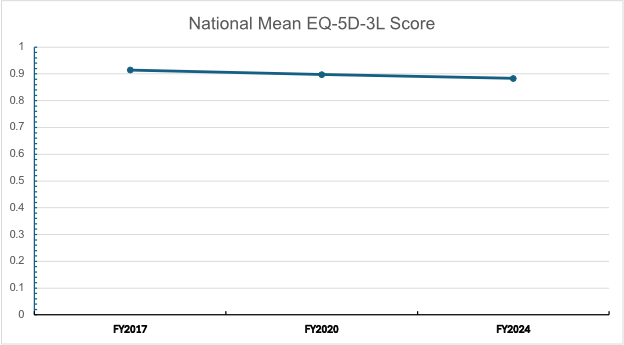
Mean EQ-5D-3L utility score in Japan across three nationwide surveys (FY2017, 2020, 2024). The post-pandemic value (0.8834) lies further below the pre-pandemic baseline than the pandemic-era value (0.8977), indicating that recovery has not occurred. (Creative Commons Attribution-NonCommercial-NoDerivatives 4.0 International License)
“The results of this study show that, over the seven-year period—including before, during and after the COVID-19 pandemic—HRQoL among Japan’s working-age population has declined gradually but steadily. These findings are expected to serve as important baseline data for considering health support measures for the working-age population in future health and medical policies as well as regional initiatives,” said Tomoyuki Akita, lecturer in the Graduate School of Biomedical and Health Sciences at Hiroshima University and corresponding author of the research paper.
The participation rate of the survey and distributions of sex, age, and occupation were comparable between years, with 34.0%, 44.1%, and 29.5% of surveys sent in FY2017, FY2020, and FY2024, respectively, received as valid responses. Across the seven-year span, the nationwide mean EQ-5D-3L utility score declined from 0.9133 in FY2017 to 0.8977 in FY2020 and 0.8834 in FY2024. The study found statistically significant declines in HRQoL among men in their 40s to 60s and women in their 30s to 50s nationwide in Japan across the three survey years (FY2017, FY2020, and FY2024).
Importantly, the researchers also analyzed regional differences in HRQoL among Japan’s prefectures, some of which have relatively low populations. Rather than using conventional statistical approaches, which may provide inaccurate estimates with smaller sample sizes, the team used Bayesian methods, which incorporate prior knowledge of nationwide HRQoL distributions, to more reliably compare across regions with varying sample sizes. This prefecture-level information is particularly useful for formulating local health and medical policies.
“During the COVID-19 pandemic, many indirect effects on HRQoL have been reported, including reduced use of healthcare services, decreased physical activity, and worsening mental health. While this study does not directly examine causal relationships, the marked decline in HRQoL among the working-age population may reflect the cumulative impact of these behavioral and social changes. In particular, attention should be paid to the fact that this gradual decline has continued over time,” said Akita.
The fortunate timing of the team’s HRQoL surveys provided a unique insight into quality-of-life issues that are extending well beyond the COVID-19 pandemic, and raises questions regarding the pertinence of these results to other nations. Did other nations presumably experience a similar decline in HRQoL during the pandemic? Has the decline improved in some nations and not others?
While retroactive, large-scale surveying of HRQoL in other countries is not possible, it doesn’t negate the importance of the information when developing health policy and distributing resources. The researchers plan to continue their work to guide Japanese healthcare policy in the future. “It is necessary to continue monitoring health-related quality of life (HRQoL) nationwide, while also conducting deeper analyses of the causes of its decline and comparisons with other countries,” said Akita.
This study was partly supported by the Japan Ministry of Health, Labour and Welfare Policy Research for Hepatitis Measures Program Grant Numbers H25-kanenippan-010, H28-kansei-ippan-001, H29-kansei-shitei-001, JPMH19HC1001, JPMH20HC2002, JPMH22HC1001, JPMH23HC2003, and JPMH25HC1001.

 Home
Home