Home
HomeInquiries on the study
Kouichi Funato
Professor, Hiroshima University Graduate School of Integrated Sciences for Life
Email: kfunato * hiroshima-u.ac.jp
(Note: Please replace * with @)
Inquiries on the story
Hiroshima University Public Relations Office
E-mail: koho * office.hiroshima-u.ac.jp
(Note: Please replace * with @)
A study in budding yeast suggests that changes in membrane lipids trigger a braking system that slows internal protein transport when the endoplasmic reticulum comes under stress, comparable to modern logistics networks where shipments are slowed when distribution hubs are under stress.
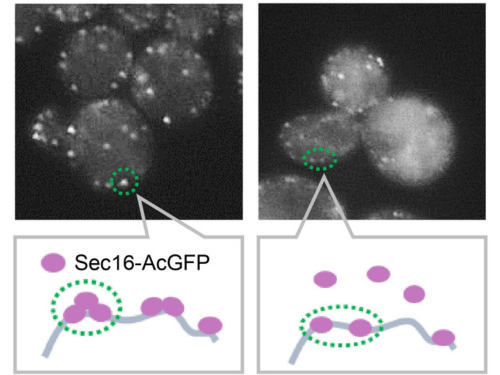
Yip3 inhibits Sec16 assembly into the ERES. When Yip3 is overexpressed, formation of the ERES by Sec16-AcGFP (fluorescent-tagged Sec16) is inhibited (right, when compared to wild type strains (left). (Kazuki Hanaoka, Mitsuki Nakazato, Philipp Schlarmann et al, Nature Communications, July 3, 2026).
Cells synthesize proteins in the endoplasmic reticulum (ER), and these proteins are transported to the Golgi apparatus for distribution to their ultimate destinations inside and outside the cell. The structures that transport proteins from ER to Golgi apparatus are called COPII vesicles; the processes which regulate the formation of COPII vesicles are only partially understood.
An international research team led by Hiroshima University has revealed how COPII vesicular transport between endoplasmic reticulum and Golgi apparatus is regulated during ER stress. This functions as a counterbalance to the negative effects of stress on protein synthesis.
Their findings were published in Nature Communications on July 3, 2026.
“We investigated how protein transport from the endoplasmic reticulum to the Golgi apparatus is regulated during endoplasmic reticulum stress,” says Kouichi Funato, professor at Hiroshima University’s Graduate School of Integrated Sciences for Life and corresponding author of the paper. “When cells are under stress, protein folding is disrupted, leading to the production of misfolded proteins. Consequently, cells possess a quality control mechanism that prevents these misfolded proteins from being released to locations other than the endoplasmic reticulum until they are properly repaired.”
Using the model organism Saccharomyces cerevisiae, budding yeast, the researchers created a series of mutants for genes associated with COPII vesicle-mediated transport and analyzed their phenotypes.
The researchers found that endoplasmic reticulum stress leads to an increase in the levels of phosphatidic acid (PA) in the endoplasmic reticulum membrane. Furthermore, they demonstrated that this change in PA levels increases YIP3 gene expression via the Opi1–Ino2/Ino4 transcriptional regulatory system, and that the Yip3 protein limits COPII vesicle formation by suppressing the accumulation of Sec16 at the ER exit site (ERES), the site of COPII vesicle formation.
“The key point we wish to convey is that when cells experience endoplasmic reticulum (ER) stress, they possess a mechanism that detects changes in their own membrane lipid state and suppresses intracellular transport via transcription,” says Funato. “In this study, we demonstrated a mechanism by which the endoplasmic reticulum (ER) uses changes in the membrane lipid PA as a cue to increase Yip3 levels via transcription, thereby suppressing the accumulation of Sec16—a scaffold protein for COPII vesicle formation—at ERES, and consequently inhibiting COPII vesicle-mediated transport. This discovery indicates that the ER possesses a sophisticated mechanism for regulating intracellular trafficking in response to stress.” Scaffold proteins are proteins that tether multiple proteins to a specific cellular location, thereby enhancing the efficiency of reactions mediated by protein complexes.
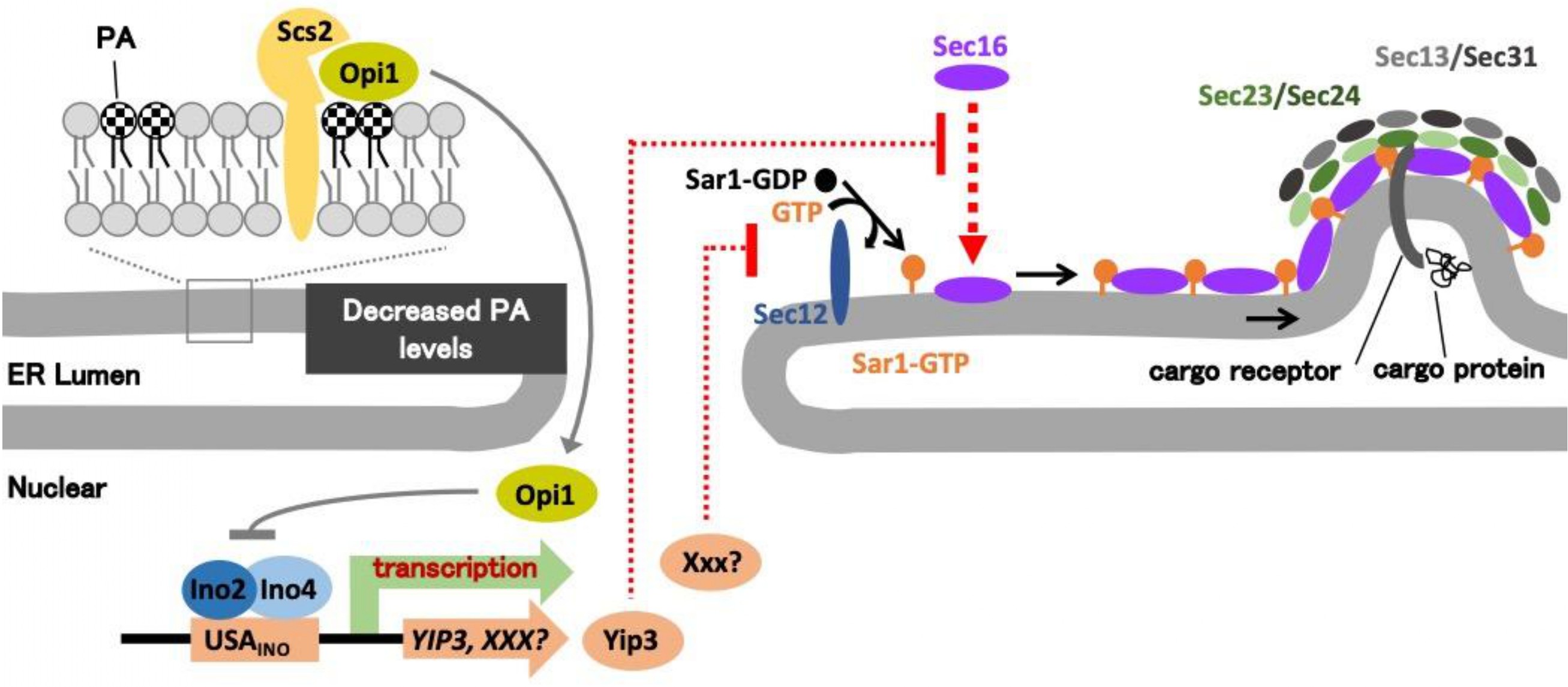
A model of ER sensing of phosphatidic acid (PA) metabolism in regulating COPII vesicle formation. (Kazuki Hanaoka, Mitsuki Nakazato, Philipp Schlarmann et al, Nature Communications, July 3, 2026).
Under normal conditions, Sec16 accumulates on the ER membrane, where it functions as a platform for the “shipping gate” for intracellular transport; under endoplasmic reticulum (ER) stress, Sec16 no longer accumulates at ER exit sites (ERES). Funato uses the analogy of a factory temporarily dismantling the structure of its shipping dock when defective products increase, thereby eliminating the shipping point to suppress the volume of goods being shipped. The finding that changes in membrane lipids regulate the assembly of transport machinery via transcription represents a novel concept that had not been previously reported.
“The next step is to identify which molecules Yip3 uses to suppress the accumulation of Sec16 at ERES,” Funato concludes. “Ultimately, we aim to elucidate how the ER senses stress and membrane lipid states and how it transmits this information to each stage of COPII vesicle formation, with the goal of fully understanding the regulatory mechanisms of intracellular transport during ER stress.”
Kazuki Hanaoka, Mitsuki Nakazato, Philipp Schlarmann, Hiroki Nakamura, Mei Kato, Ryoko Ikema, Mizuki Iguchi, Katsuki Eto, Takefumi Karashima, Atsuko Ikeda, and Yukari Yabuki at Hiroshima University; Javier Manzano-Lopez, Auxiliadora Aguilera-Romero, Susana Sabido-Bozo, Ana Maria Perez-Linero, and Manuel Muñiz at the University of Seville, Spain; Muneyoshi Kanai and Haruyuki Iefuji at the National Research Institute of Brewing, Japan; and, Isabelle Riezman and Howard Riezman at the University of Geneva co-authored the study. Kazuki Hanaoka, Mitsuki Nakazato and Philipp Schlarmann are joint first authors.
This work was funded by the Grants-in-Aid for Scientific Research from Japan Society for the Promotion of Science (JSPS; JP19H02922, JP21K19088); the Agencia Estatal de Investigación, (AEI), Spain (MICIU/AEI/10.13039/501100011033); the European Regional Development Fund (ERDF) “A way of making Europe" (PID2023-151267NB-I00); the Swiss National Science Foundation (SNSF; 51NF-40-185898, 310030_184949); and the Leducq Foundation.
About the study
- Journal: Nature Communications
- Title: ER sensing of lipid metabolism drives PRA family-dependent regulation of COPII vesicle transport
- Authors: Kazuki Hanaoka, Mitsuki Nakazato, Philipp Schlarmann, Hiroki Nakamura, Mei Kato, Ryoko Ikema, Mizuki Iguchi, Katsuki Eto, Takefumi Karashima, Atsuko Ikeda, Yukari Yabuki, Javier Manzano-Lopez, Auxiliadora Aguilera-Romero, Susana Sabido-Bozo, Ana Maria Perez-Linero, Muneyoshi Kanai, Haruyuki Iefuji, Isabelle Riezman, Howard Riezman, Manuel Muñiz, and Kouichi Funato
- DOI: 10.1038/s41467-026-75057-x
- Date: July 3, 2026
Media Contact