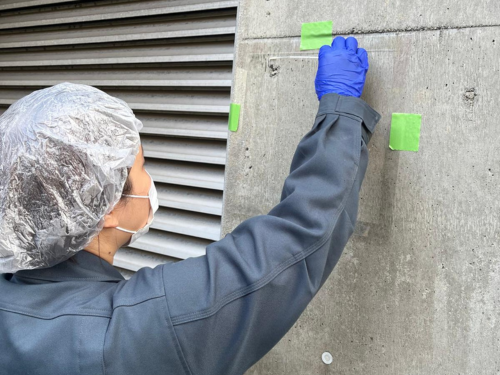
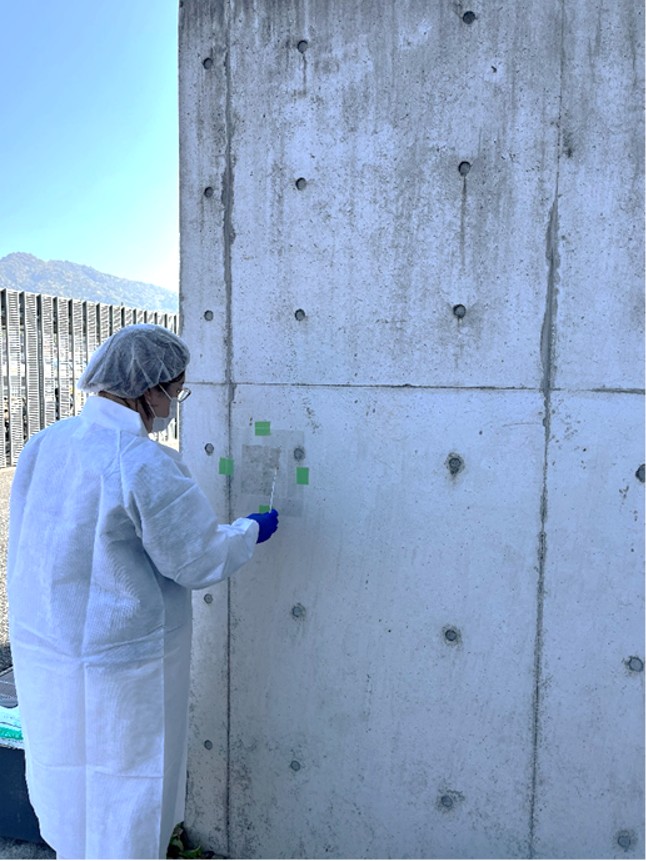
A member of the research team extracting samples from concrete specimens. A new study found that in sound concrete, surface and interior microbial communities remain distinct. Researchers suggest that tracking shifts in these microbial profiles could one day help signal early structural deterioration. (China Kuratomi/Hiroshima University)
Concrete may be one of the world’s most familiar materials, yet much is still unknown about its inner microbial world. Researchers from Hiroshima University and Kyoto University found that once concrete hardens, microbes introduced through raw materials are sealed inside, forming interior communities largely isolated from those on the surface—and whose DNA signatures can survive the 70°C heat of drilling for routine core sampling.
Researchers say these findings, published in Case Studies in Construction Materials, suggest that microbes could serve as early-warning indicators of hidden structural deterioration. In Japan, where overseeing the safety of aging buildings increasingly falls to building managers, general maintenance staff, and even residents, such signals might one day inform simpler tools that put diagnostics within reach of non-specialists—much like how thermometers and blood pressure monitors allow anyone to check their health.
“I was motivated by the idea of making the maintenance of concrete structures more accessible to a wider range of people,” said China Kuratomi, study first author and doctoral student at Hiroshima University’s Graduate School of Advanced Science and Engineering. “Just as we notice changes in our health through everyday indicators such as body temperature and visit a doctor when necessary, I hope that building conditions can also be understood through various indicators, with specialists providing detailed diagnosis when needed.”
Can microbes reveal when concrete is deteriorating?
“Without understanding how methodological choices affect microbial data, it is impossible to interpret results correctly or apply microbial information to concrete diagnostics.”
The heat from drilling, it turned out, was not a problem. Even temperatures of up to 70°C did not meaningfully alter bacterial profiles, suggesting the microbial evidence survives standard sampling conditions.
Microbial migration may signal damage
Their analysis revealed that microbial communities inside concrete look nothing like those on the surface. Surface communities reflect microbes introduced from the surrounding environment, while interior ones trace back primarily to the raw materials used during mixing. Each ingredient—cement, sand, gravel, and water—brings its own cast of microorganisms to the mix. Once the concrete sets, however, most of them don't make it. The material's caustic and nutrient-scarce environment is too hostile for most microbes to survive in, and its tiny, poorly connected pores restrict their movement. What predominantly remains of the original communities are Proteobacteria and Actinobacteria.
“A particularly surprising finding,” Teramoto said, “is that, although concrete is a porous material, microorganisms in well-compacted, sound concrete rarely migrate from the surface into the interior, or even within the interior itself.” “Therefore, the detection of microbial migration may indicate the presence of defects such as cracking or increased connectivity, highlighting the potential of microbial information as a novel indicator for deterioration diagnosis.”
The next step for the team is determining how damaged concrete has to be before microbes can squeeze through, and what their movement reveals about the trouble quietly unfolding inside.
The research team also includes Fumito Maruyama and So Fujiyoshi of Hiroshima University. Fujiyoshi is also affiliated with Toyama Prefectural University.

 Home
Home