Home
HomeInquiries on the study
Kentaro Kawai
Assistant Professor, Hiroshima University Graduate School of Integrated Sciences for Life
Email: kawai-ken * hiroshima-u.ac.jp
(Note: Please replace * with @)
Inquiries on the story
Hiroshima University Public Relations Office
E-mail: koho * office.hiroshima-u.ac.jp
(Note: Please replace * with @)
Ultrasonic tracking in Hiroshima Bay shows that male and female black sea bream move differently during the spawning season, offering a novel discovery into the reproductive behavior of a broadcast-spawning sparid fish in the wild.

A black sea bream swimming off after being released into Hiroshima Bay following tagging with an ultrasonic transmitter for the study. (Kentaro Kawai / Hiroshima University)
In most animal species, reproductive behavior differs between males and females. This variation is attributed to the differences in energy required for the formation of male and female gametes (germ cells or sex cells): development of oocytes, the female gamete, requires far more energy than that of spermatozoa, the male gamete. Understanding these differences is vital to understanding reproduction; however, studying sexual behavior in aquatic animals in the wild is especially difficult.
A research team led by Hiroshima University has revealed that male and female black sea bream Acanthopagrus schlegelii show distinct movement patterns during the spawning season in oyster farming areas of Hiroshima Bay, Japan. Using ultrasonic biotelemetry, the team found that males moved over broader areas and made frequent upward and downward movements around the evening spawning period, while females tended to remain near particular oyster rafts and showed more restricted movements.
Their findings were published in the journal Hydrobiologia on May 9, 2026.
The black sea bream, also known as the blackhead sea bream or black porgy, is a commercially important fish across East Asia belonging to the sparids, the fish family containing sea breams and porgies. In Hiroshima Bay, the species spawns mainly in oyster farming areas, where dense arrays of suspended oyster-culturing wires create complex three-dimensional habitats. These areas also provide food and shelter, meaning that feeding and spawning grounds overlap.
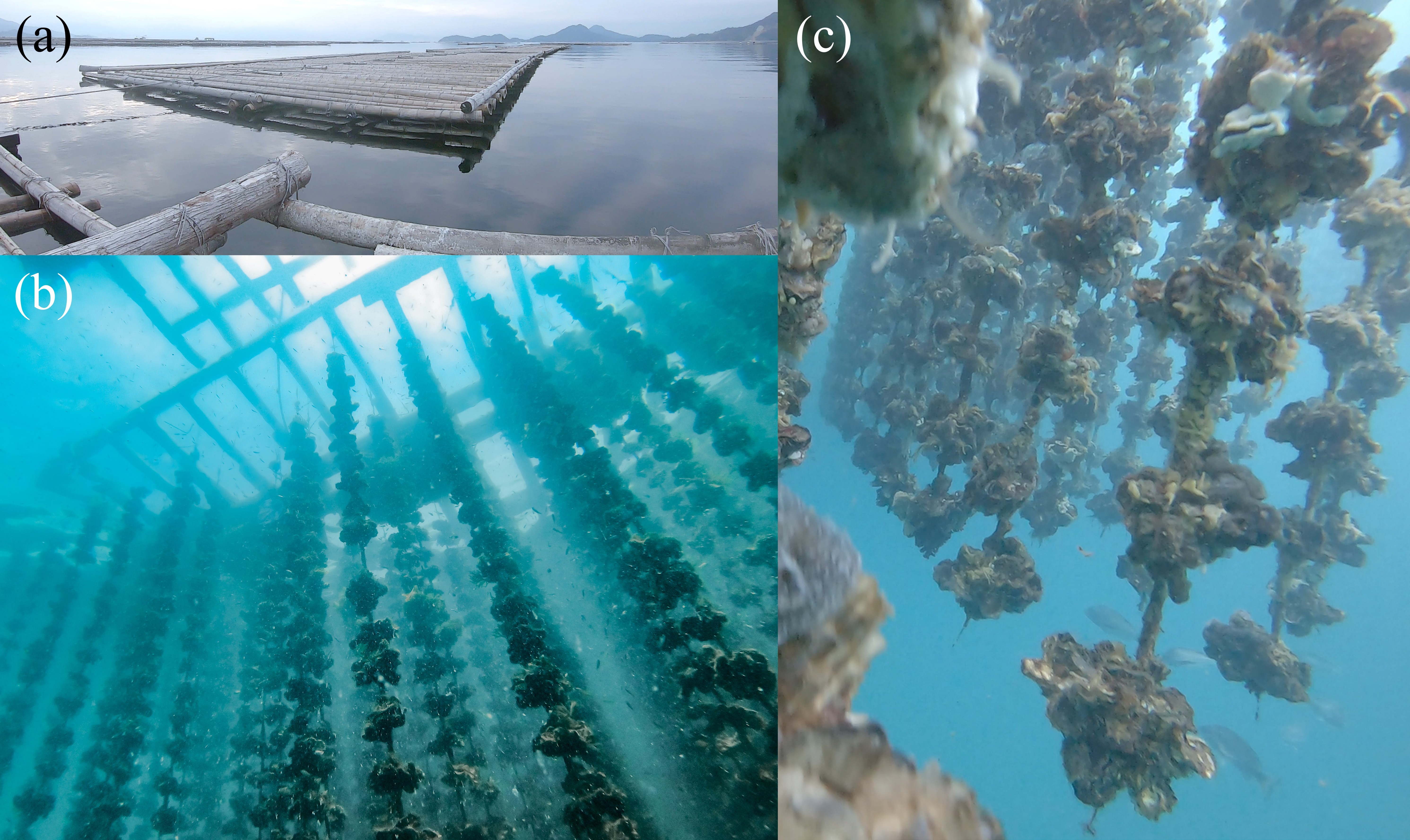
An oyster farming raft in Hiroshima Bay. (a) Surface view of the raft; (b) upper part of the hanging oyster-culturing wires; (c) bottom part of the wires, with a small group of black sea bream (lower right) passing through. (Kentaro Kawai, et al. Hydrobiologia. May 9, 2026)
The black sea bream is a broadcast spawner, a species that releases eggs and milt (sperm) into the surrounding water where fertilization occurs. While its reproductive behavior has been observed under laboratory conditions, that in the wild is unknown.
“The reproductive behavior of the black sea bream is difficult to study because sparid fish usually show little external sexual dimorphism, spawn around sunset or at night, and are hard to observe directly in turbid coastal waters,” says Kentaro Kawai, assistant professor at Hiroshima University’s Graduate School of Integrated Sciences for Life and first and corresponding author of the study. “Ultrasonic biotelemetry allowed us to follow the movements of reproductively active individuals without relying on direct visual observation.”
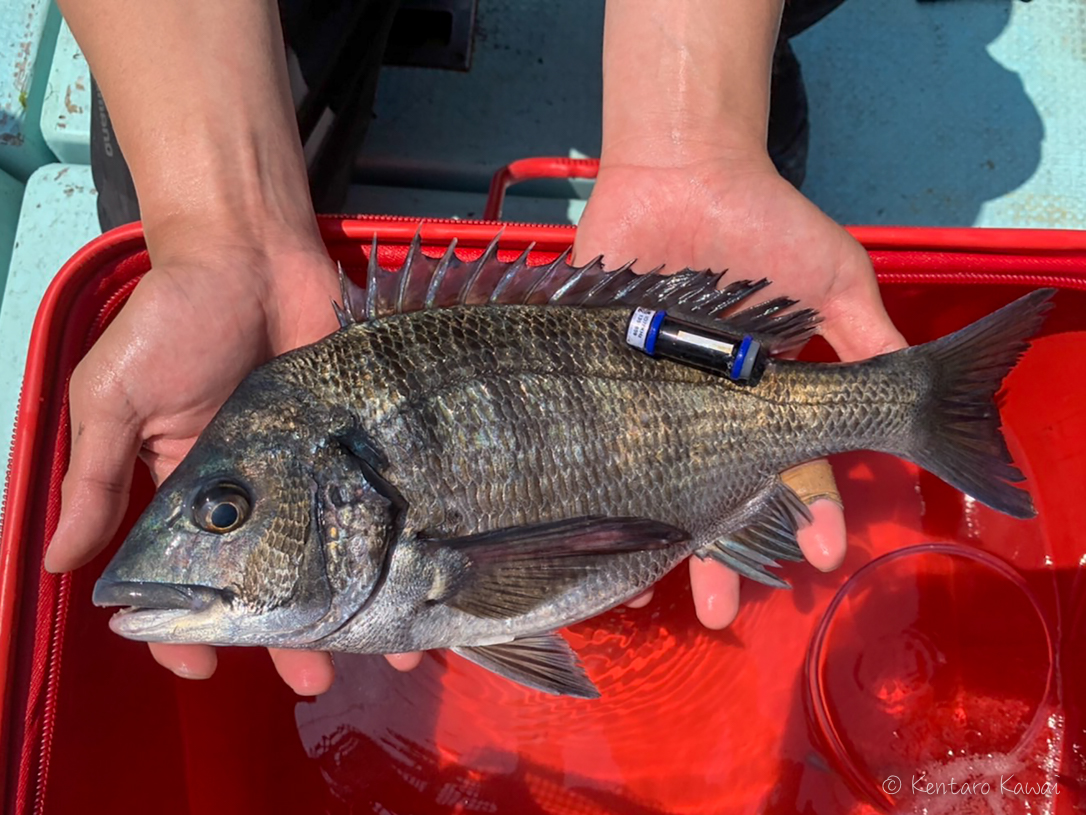
A black sea bream tagged with an ultrasonic transmitter. (Kentaro Kawai / Hiroshima University)
During spawning seasons across three years, the researchers captured black sea bream in oyster farming areas of Hiroshima Bay. They selected reproductively active individuals that released eggs or milt, confirming their sex and reproductive condition before attaching ultrasonic transmitters. In total, eight males and five females were tagged and tracked in and around oyster-culturing rafts.
The results revealed a clear contrast between the sexes. Males used broader areas within the oyster farming grounds and showed more frequent vertical movements, especially in the evening, when this species usually spawns. During this period, males made more than three times as many upward and downward movements as females. Females, by contrast, tended to stay near particular oyster rafts and showed more localized movement.
“The most important message is that males and females can show distinct reproductive movement patterns even in broadcast-spawning fish,” says Kawai. “In black sea bream, males appeared to patrol more broadly and actively around the evening spawning period, whereas females tended to stay near particular oyster rafts. This contrast is captured by the phrase ‘patrolling males and waiting females.’”
The team suggests that the male pattern may reflect active mate-searching or spawning-related behavior, while the more restricted movement of females may be linked to conserving energy for egg production. Because black sea bream are thought to continue feeding during the spawning season, oyster farming areas may offer a unique setting where reproduction, foraging, and shelter are closely connected.
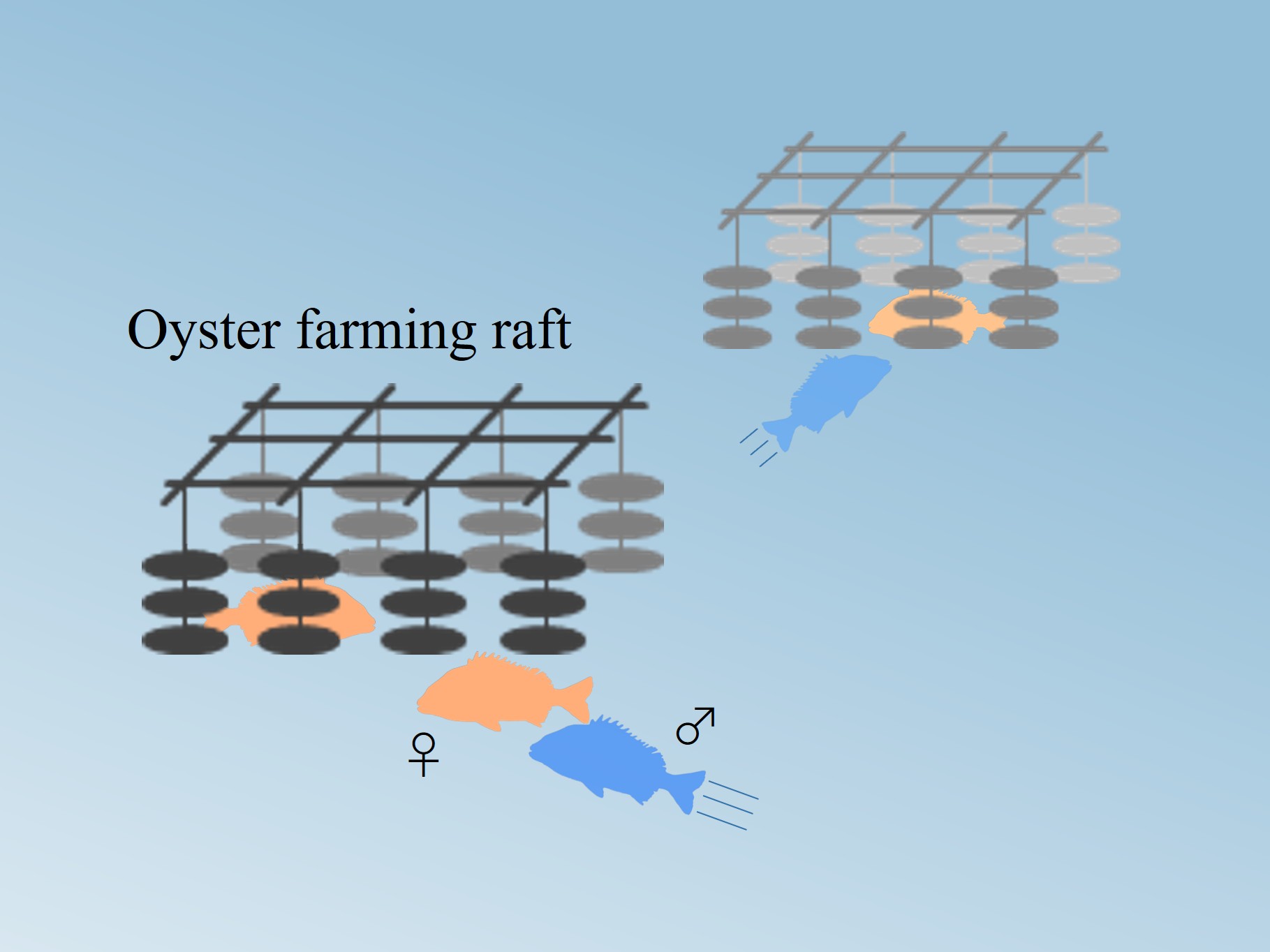
Black sea bream males (blue) moved over broader areas and made frequent upward and downward movements around the evening spawning period, while females (orange) tended to remain near particular oyster farming rafts and showed more restricted movements. (Kentaro Kawai / Hiroshima University)
“One striking result is that space beneath oyster rafts may function as a hidden spawning stage at twilight,” Kawai said. “These artificial structures are not just places where fish gather. They may also shape how males and females encounter each other during reproduction.”
This study provides the first field-based evidence of sex-related reproductive movement patterns in a typical broadcast-spawning sparid fish.
Future studies that track more individuals over longer periods, and combine telemetry with direct observation or biologging where conditions allow, could help identify actual spawning events more precisely. The researchers hope that a better understanding of sex-specific spawning behavior will contribute to broader knowledge of sparid fish ecology and support the sustainable management of coastal fishery resources.
Yosei Nakagoshi, Tatsuki Saika, Shota Ito, Ryoya Izuta and Tetsuya Umino at Hiroshima University; Hiroki Fujita at Central University of Kerala, India; and, Kotaro Ichikawa and Hiromichi Mitamura at Kyoto University co-authored the study.
This research was supported by a Grant-in-Aid for JSPS Fellows (18J22335) and Grant-in-Aid for Early-Career Scientists (22K14938) from the Japan Society for the Promotion of Science (JSPS); and, the Hiroshima University Education and Research Support Foundation.
About the study
- Journal: Hydrobiologia
- Title: Patrolling males and waiting females: sex-specific reproductive movement patterns of black sea bream in oyster farming areas
- Authors: Kentaro Kawai, Yosei Nakagoshi, Tatsuki Saika, Shota Ito, Ryoya Izuta, Hiroki Fujita, Kotaro Ichikawa, Hiromichi Mitamura, Tetsuya Umino
- DOI: 10.1007/s10750-026-06235-7
- Date: May 9, 2026
Media Contact