Home
HomeInquiries on the study
Satoshi Okada
Professor, Graduate School of Biomedical and Health Sciences
E-mail: sokada * hiroshima-u.ac.jp
(Note: Please replace * with @)
Inquiries on the story
Hiroshima University Public Relations Office
E-mail: koho * office.hiroshima-u.ac.jp
(Note: Please replace * with @)
Position of a RELA mutation can shape symptoms, severity and treatment response
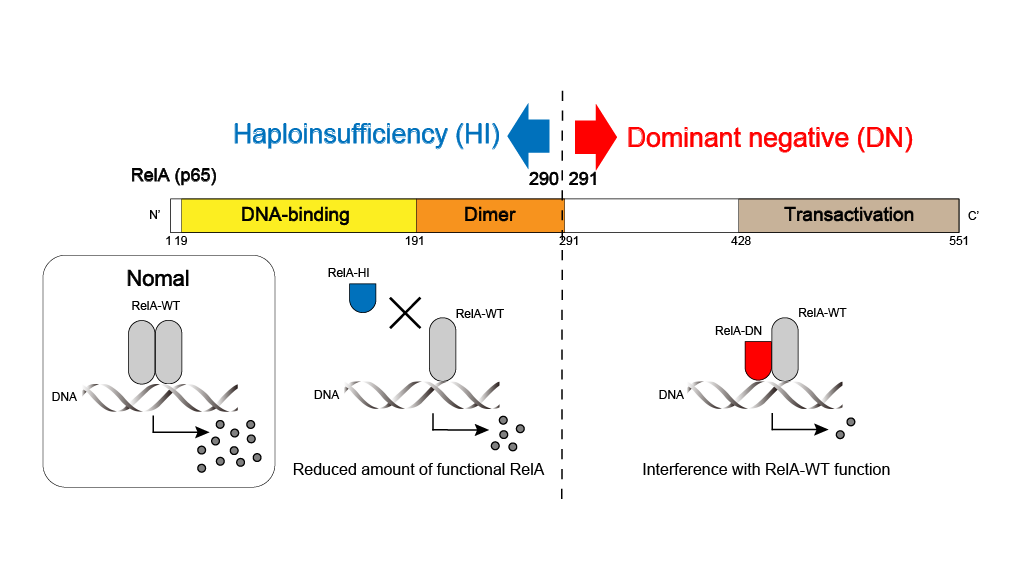
Scientists identified a key breakpoint in the RELA gene that helps predict how harmful mutations cause a rare inherited inflammatory disease. Mutations in a location before amino acid P290 reduce protein levels, whilst those located after P290 produce disruptive proteins. The finding could improve diagnosis and treatment selection for patients with RELA deficiency. (Hiroko Hayakawa/Hiroshima University)
Not all broken genes fail in the same way: some simply stop working, while others interfere with what still works.
Researchers from Hiroshima University have identified a critical boundary within the immune-regulating gene called RELA that helps predict how harmful mutations cause disease. Their findings could improve diagnosis and treatment for patients with a rare inherited inflammatory disease.
The study was published in the Journal of Allergy and Clinical Immunology on March 13.
RELA produces a protein that plays an important role in immune responses, cell survival and inflammation. Mutations in one copy of the RELA gene can cause a condition known as autosomal dominant RELA deficiency. Patients may develop recurring mouth and genital ulcers, intestinal inflammation, and, in some cases, broader autoinflammatory symptoms. Thus far, only 45 people from 17 families have been confirmed to have this deficiency worldwide.
“In autosomal dominant RELA deficiency, clinical manifestations differ depending on the nature of the variant,” said Satoshi Okada, professor at Hiroshima University’s Graduate School of Biomedical and Health Sciences and corresponding author of the study.
Some mutations lead to haploinsufficiency, in which the body does not produce enough functional protein. Others cause a dominant-negative effect, in which the abnormal protein interferes with the normal one.
Seeking a way to accurately predict which type of mutation is responsible for which effect, the team studied eight patients from five families with autosomal dominant RELA deficiency. Their results identified amino acid proline at position 290 (P290) as a key dividing line in the RELA protein.
“RELA variants with a stop codon located N-terminal to amino acid P290 exhibit haploinsufficiency, whereas RELA variants with a stop codon located C-terminal to P290 exhibit a dominant-negative effect,” Okada said.
A stop codon is a nucleotide sequence in mRNA that, just like a period at the end of a sentence, signals the cell to terminate protein synthesis. If the stop codon occurs early, before P290 (or near the protein’s N-terminal end), the faulty gene copy often cannot produce a usable protein, leaving only one functional copy and causing a shortage of RELA protein. If the stop codon occurs later, after P290 (or near the C-terminal end), the cell may produce a shortened protein that interferes with the normal one and can trigger more severe inflammation.
Understanding the distinction could have direct clinical value. Patients carrying dominant-negative variants responded less well to corticosteroids and more often required biologic therapies, particularly anti-tumor necrosis factor (anti-TNF) drugs.
“Our findings offer an indicator that could help clinicians interpret newly discovered RELA mutations more quickly and therefore choose more appropriate treatments earlier in the disease course,” Okada said.
However, not all variants are easy to classify. Missense mutations, which alter a single amino acid rather than creating an early stop signal, still require laboratory testing since their effects cannot be predicted from location alone.
“Reliably determining the functional impact of RELA missense variants remains an unmet challenge and an important priority for future research,” Okada said.
This study was supported by the Japan Society for the Promotion of Science (JSPS) KAKENHI, the Japan Agency for Medical Research and Development (AMED), the Program for Accelerating Medical Research HK2-MIRAI, and the Program for Forming Japan’s Peak Research Universities (J-PEAKS).
Other members of the research team include Hiroko Hayakawa, Miyuki Tsumura, Takanori Utsumi, Seiichi Hayakawa, Yoko Mizoguchi, Shuhei Karakawa, and Takaki Asano of Hiroshima University, Japan; Hiroshi Nihira of Kurume University, Japan; Wei-Te Lei of Chang Gung University, Hsinchu Municipal MacKay Children’s Hospital, and MacKay Medical University, Taiwan; Ryo Ogino, Kazushi Izawa, and Takahiro Yasumi of Kyoto University, Japan; Giorgia Bucciol, Sunita Janssenswillen, Sien Van Loo, and Isabelle Meyts of University Hospitals Leuven, Belgium; Tomohiro Nakano of Tohoku University, Japan; Kiyoko Amo of Osaka City General Hospital, Japan; Kunihiko Moriya of National Defense Medical College, Japan; You-Ning Lin, Han-Po Shih, and Chia-Chi Lo of Chang Gung University, Taiwan; Djalila Mekahli of KU Leuven and University Hospitals Leuven, Belgium; Dusan Bogunovic of Hiroshima University, Japan, and Columbia University Medical Center, United States; Stephanie Boisson-Dupuis of The Rockefeller University, United States, the Laboratory of Human Genetics of Infectious Diseases, and Paris Cité University, France; and Cheng-Lung Ku of Chang Gung University and Chang Gung Memorial Hospital, Taiwan.
About the study
- Journal: The Journal of Allergy and Clinical Immunology
- Title: Discovering patterns in the pathologic significance of non-missense deleterious variants in RELA
- Authors: Hiroko Hayakawa, Miyuki Tsumura, Takanori Utsumi, Hiroshi Nihira, Wei-Te Lei, Ryo Ogino, Giorgia Bucciol, Tomohiro Nakano, Kiyoko Amo, Kunihiko Moriya, Seiichi Hayakawa, Yoko Mizoguchi, Shuhei Karakawa, You-Ning Lin, Han-Po Shih, Chia-Chi Lo, Sunita Janssenswillen, Sien Van Loo, Djalila Mekahli, Dusan Bogunovic, Stephanie Boisson-Dupuis, Kazushi Izawa, Cheng-Lung Ku, Takahiro Yasumi, Takaki Asano, Isabelle Meyts & Satoshi Okada
- DOI: 10.1016/j.jaci.2026.01.020
Media Contact