Home
HomeInquiries on the study
Tatsuo Ichinohe
Senior Specially Appointed Research Fellow, Hiroshima University Hospital Clinical Research Center in Hiroshima
Email: nohe * hiroshima-u.ac.jp
(Note: Please replace * with @)
Inquiries on the story
Hiroshima University Public Relations Office
E-mail: koho * office.hiroshima-u.ac.jp
(Note: Please replace * with @)
Hiroshima University researchers have demonstrated a proof of concept for the mass-production of genome-edited T cells that can be used to treat malignant tumors, using a genetic engineering technique called Platinum TALEN.
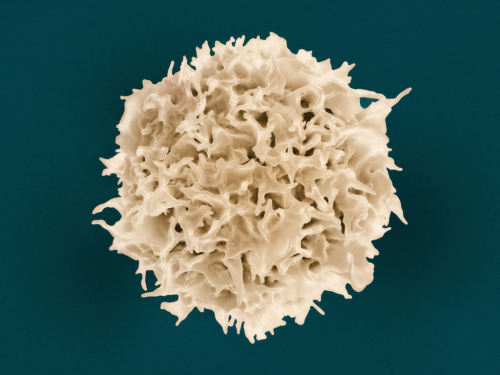
(National Institute of Allergy and Infectious Diseases / Unsplash)
Genome editing is a powerful tool for the development of designed cells for medical purposes. Specifically, it has found great use in the creation of genetically modified T-cells that target and destroy cancer cells.
Hiroshima University researchers have shown that Platinum TALEN, a type of transcription activator-like effector nuclease (TALEN) genetic editing technique, can be used for industrial-scale production of genetically modified cancer-targeting T-cells, which were effective in vitro.
Their findings were published in the journal Cytotherapy on May 21, 2026.
TALENs are conceptually more error-free in terms of off-target activity in comparison to the RNA-guided CRISPR-Cas9 system, because TALEN-mediated gene disruption requires the binding of a pair of TALEN, i.e., a left and right TALEN, in close proximity in an orientation to dimerize the Fok I domains for inducing DNA double-strand break of the target sequences. In fact, a previous study showed that no off-target sites were detected using TALENs, whereas some of the CRISPR-Cas9 targets showed detectable off-target integration of integrase-defective lentiviral vectors.
As with CRISPRs, TALENs were discovered in bacteria, but the versions used in genetic engineering are artificial nucleases. The research group developed Platinum TALEN in a previous work: it possesses higher activity than conventional TALENs, reduces off-target effects, and modifies genes in mammalian somatic cells effectively. All these features make it well suited to the manufacturing of cellular products intended for clinical use.
“Our primary objective was to mass-produce genome-edited T cells that can be used to treat malignant tumors using Platinum TALEN,” says Tatsuo Ichinohe, Senior Specially Appointed Research Fellow at Hiroshima University Hospital’s Clinical Research Center in Hiroshima (Professor at Hiroshima University’s Research Institute for Radiation Biology and Medicine, at the time of research).
The researchers chose to use NY-ESO-1 as the model cancer-associated antigen and 1G4-TCR as the prototype cancer-reactive T-cell receptor (TCR). NY-ESO-1 is expressed in a wide variety of cancers such as myxoid and round cell liposarcoma, neuroblastoma, synovial sarcoma, melanoma, epithelial ovarian cancer, and many others. 1G4 is a TCR derived from NY-ESO-1 that has been subjected to clinical trials and has shown efficacy against solid tumors and multiple myeloma.
The researchers developed and synthesized Platinum TALEN mRNA that targeted the DNA sequences encoding constant regions of TCRα (TRAC-TALEN) and TCRβ (TRBC-TALEN) subunits, which connect the recognition of specific antigens and the activation of both the cytotoxic T cells and T helper cells. These two mRNA and an ssDNA coding for 1G4 were inserted into plasmids and amplified in bacteria. Human primary T-cells were collected from volunteers, cultured, and activated for 72 hours, upon which the plasmids were introduced into the cells (transformation) via electroporation (using high voltage to make temporary pores in the cell membrane for plasmids to enter). Platinum TALEN inserts the 1G4 DNA into the target region by exploiting homology-directed repair (HDR), a natural DNA repair process. The transformed cells were cultured for 7 to 18 days to obtain clinical-scale yields. The engineered cells were subsequently analyzed and characterized.
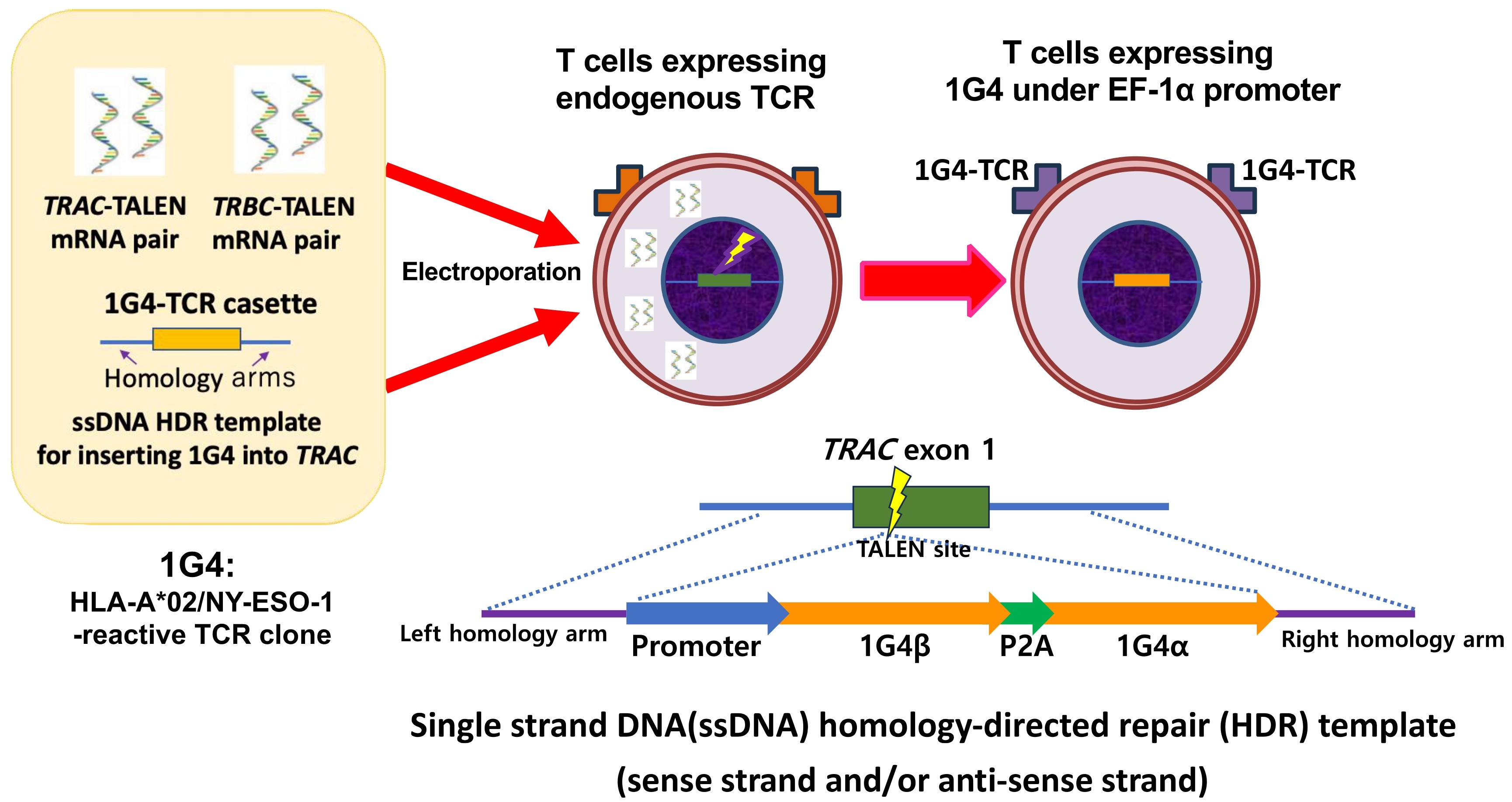
Summarizing scheme of nonviral TRAC genome editing by Platinum TALEN using long single-stranded DNA HDR template encoding EF-1α promoter and 1G4-TCR. (Kayo Toishigawa, Kenta Magoori, Hiroyuki Sato, et al. Cytotherapy. May 21, 2026)
The efficiency of Platinum TALEN on T cells was determined in terms of viability of the TCR/CD3 complex-negative cells and 1G4-TCR-introduced T cells with the desired genomic engineering. The researchers found that the viability of such T cells was more than 80% when 5 μg of TRAC-TALEN mRNA and 10 μg of TRBC-TALEN mRNA were used per 3 million T cells. Following genomic engineering and culturing, the researchers obtained an average of 72 million 1G4-TCR cells for every 3 million T-cells.
“Analysis of the functional subsets of genome-edited T cells generated using Platinum TALEN revealed that, like normal T cells, they contain naive T cells and memory T cells, which are critical for maintaining antitumor activity following infusion into the body,” Ichinohe explains. “To put it another way, genome-edited T cells generated using Platinum TALEN can be described as high-performance T cells that have acquired the ability to recognize cancer cells while retaining the functions of normal T cells.”
Finally, under in vitro conditions, the 1G4-TCR T cells produced interferon-γ and killed NY-ESO-1-expressing cells from the cell lines SaOS-2 (osteosarcoma) and U266B1 (multiple myeloma).
1G4-TCR T cells but not control T cells kill human cancer cell lines expressing the NY-ESO-1 antigen in an effector cell-dose-dependent manner. (Kayo Toishigawa, Kenta Magoori, Hiroyuki Sato, et al. Cytotherapy. May 21, 2026)
“Through this research, we have established a technology that allows the T cell receptor—which enables T cells to recognize antigens—to be freely swapped out according to specific therapeutic needs, utilizing Platinum TALEN,” Ichinohe says. “While the development of genetically modified T-cell therapeutics is currently advancing rapidly, particularly in Europe, the United States, and China, development in Japan lags significantly behind. Given the high demand for the development of new domestic technologies ..., we consider [our findings] to be a highly significant research achievement.”
This study established proof-of-concept for utilizing Platinum TALEN for industrial production of genetically engineered T cells. Further research must be done before the technique is ready to be considered for commercial use: increasing efficiency of HDR-mediated insertion of the 1G4 ssDNA; developing a method to screen final cell products for off-target editing, and determining the long-term viability and survival of the modified cells in vivo.
"Our ultimate goal is to develop a gene-modified T cell therapy for malignant tumors originating in Japan,” Ichinohe concludes.
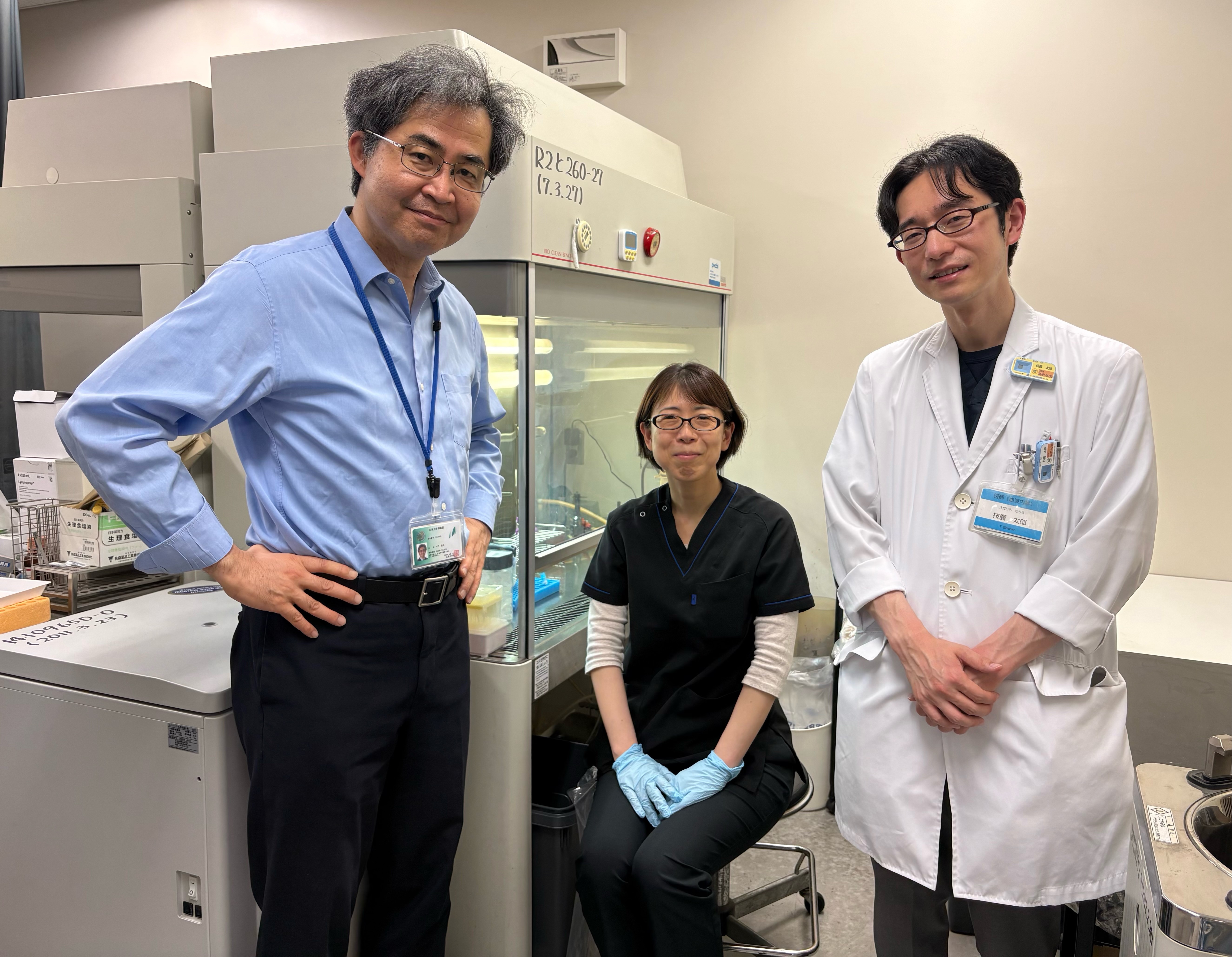
Study authors Tatsuo Ichinohe (left), Kayo Toishigawa (center) and Taro Edahiro (right). (Tatsuo Ichinohe / Hiroshima University)
Kayo Toishigawa, Taro Edahiro, Hiroshi Ureshino, Takero Shindo, Takashi Yamamoto, and Morihito Okada at Hiroshima University; Kenta Magoori, Hiroyuki Sato and the late Ryuji Suzuki at Repertoire Genesis Inc.; and, Tetsushi Sakuma at Kyoto University co-authored the study. Kenta Magoori and Hiroyuki Sato are also affiliated with Hiroshima University; Ryuji Suzuki was also affiliated with Sagamihara Hospital. Kayo Toishigawa, Kenta Magoori and Hiroyuki Sato are joint first authors of the study.
This study was supported in part by Grants-in-Aid from the Japan Agency for Medical Research and Development (AMED) (19pc0101041h0001); Grants-in-Aid from the Ministry of Education, Culture, Sports, Science, and Technology of Japan (23K07815); and the Program of the network-type Joint Usage/Research Center for Radiation Disaster Medical Science of Hiroshima University, Nagasaki University, and Fukushima Medical University.
About the study
- Journal: Cytotherapy
- Title: Platinum TALEN-mediated nonviral gene editing facilitates clinical-scale production of cancer antigen-reactive T cells
- Authors: Kayo Toishigawa, Kenta Magoori, Hiroyuki Sato, Taro Edahiro, Hiroshi Ureshino, Takero Shindo, Ryuji Suzuki, Tetsushi Sakuma, Takashi Yamamoto, Morihito Okada, Tatsuo Ichinohe
- DOI: 10.1016/j.jcyt.2026.102911
- Date: May 21, 2026
Media Contact